challenge
pp. 16-53 · Read in the full issue
Ratu Mara’s challenge
With the Fiji general election finally fixed for April 4-11, the battleground is clearly defined. But there has been plenty of action behind the lines, reports our Suva correspondent, that will have an important bearing on the eventual outcome.
When Fiji’s prime minis ter, Ratu Sir Kamisese Mara, announced that the general election would be held in April, he squashed widespread speculation that he would opt for a lightning campaign this month.
Nevertheless, the voters will go to the polls six months before the election was due.
When Ratu Mara announced his decision in late December, the campaign was already in full swing for Fiji’s fifth post-inde pendence general election.
And the prime minister who has governed since independ ence 16 years ago now faces possibly his stiffest electoral test.
The early election decision is partly a result of the momen tum generated by a powerful looking coalition of the “traditional” opposition Na tional Federation Party (NFP) and the two-year-old Labour Party.
It would not have escaped the politically astute Ratu Mara that the same momentum, given enough time, could be come an electoral steamroller.
But the coalition is still a very real threat. Alliance analysts thought when it was first sug gested that the coalition would never get its act together on agreed policies and candidates and would be aborted in its formative stages.
It didn’t happen.
The Alliance team, on the other hand, have enough in their favour to risk an early vote.
The current line-up in the 52-member House of Repre
sentatives is: Alliance, 29; NFP, 19; Labour 4 (former NFP members). But before the de fection to the Alliance of former NFP deputy leader, Mrs Narayan (see box), and the four to Labour, it was a straight 28 Alliance to 24 NFP, reflecting the two-horse race at the 1982 poll.
The Labour Party was bom in July, 1985 with the support of Fiji’s trade union movement.
Originally seen as a protest against the government-im posed wage freeze and the inability of the NFP to prevent it, Labour has quickly found a political constituency.
Led by able and experienced ex-civil servants, the party already controls the capital’s municipal council. It also only narrowly lost a by-election to the Alliance.
Previously a safe 5,000majority NFP seat, it fell to the Alliance as a result of Labour’s splitting of the Indian vote. The lesson was not lost on the NFP and Labour leaderships. The seeds of coalition had been sown The NFP-Labour coalition was officially endorsed at a working committee NFP meet ing following intense closed door negotiations.
Both sides had fielded their first XVs. Former opposition leader Mr Jai Ram Reddy play ed a pivotal role in hammering out the agreement. Labour leader Dr Timoci Bavadra was chosen as coalition leader, with NFP chief Mr Harish Sharma as his deputy.
Hard on the heels of the formal launch of the coalition,
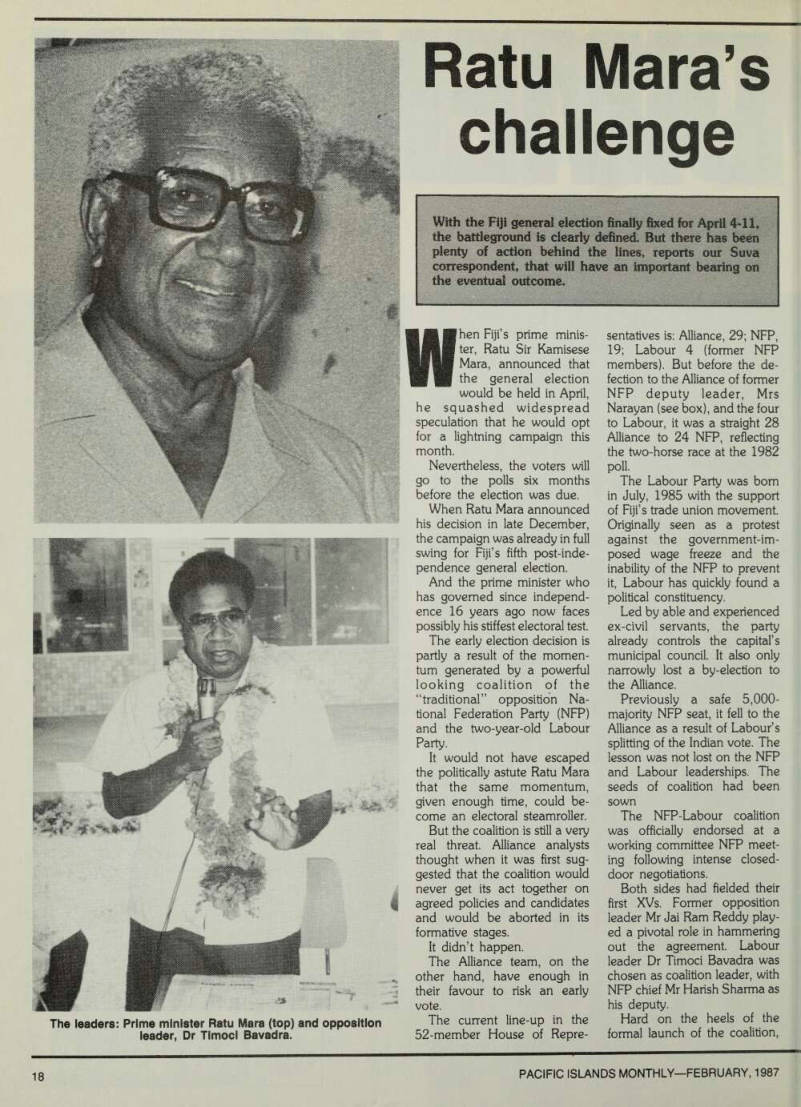
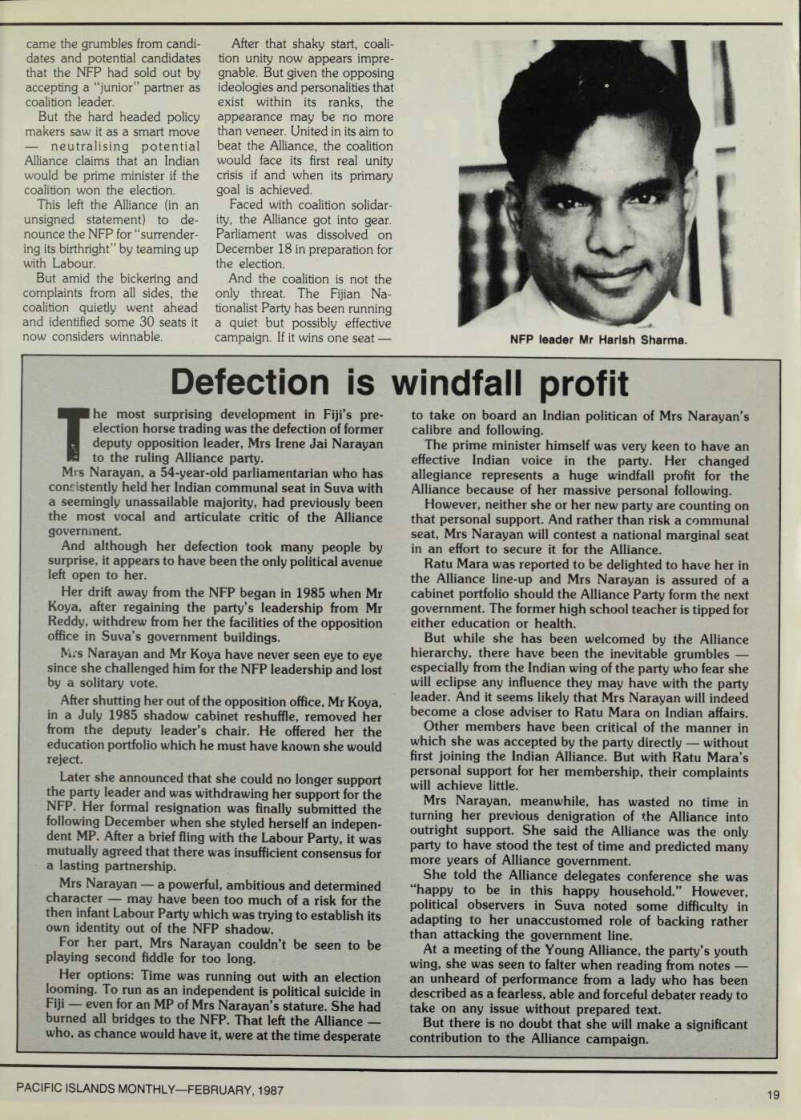
The leaders: Prime minister Ratu Mara (top) and opposition leader, Dr Timoci Bavadra.
came the grumbles from candi dates and potential candidates that the NFP had sold out by accepting a “junior” partner as coalition leader.
But the hard headed policy makers saw it as a smart move neutralising potential Alliance claims that an Indian would be prime minister if the coalition won the election.
This left the Alliance (in an unsigned statement) to de nounce the NFP for “surrender ing its birthright” by teaming up with Labour.
But amid the bickering and complaints from all sides, the coalition quietly went ahead and identified some 30 seats it now considers winnable.
After that shaky start, coali tion unity now appears impre gnable. But given the opposing ideologies and personalities that exist within its ranks, the appearance may be no more than veneer. United in its aim to beat the Alliance, the coalition would face its first real unity crisis if and when its primary goal is achieved.
Faced with coalition solidar ity, the Alliance got into gear.
Parliament was dissolved on December 18 in preparation for the election.
And the coalition is not the only threat. The Fijian Na tionalist Party has been running a quiet but possibly effective campaign. If it wins one seat
NFP leader Mr Harish Sharma.
or, worse, splits the Fijian vote across the board it would spell disaster for the Alliance.
In his address to the Alliance Party delegates conference late last year, Ratu Mara, in an apparent reference to the poli cies of the coalition, pledged continued peace and progress under an Alliance government.
Against a background of achievement and stability, who, he asked, would want to change “experience for an un known quantity.”
“Progress or stagnation; peace or instability; proven leadership or disunity,” were the choices he offered.
In the same address, he also warned that he expected effi ciency and proper accounting from those he placed in high office. Leaders, he declared, should lead by example.
“There must be honesty and integrity of the highest order.”
The Labour leader replied by referring to the Alliance Party as a “a wolf in sheep’s clothing, stalking among the trusting vo ters.”
According to the provisional electoral rolls released in late December, a total of 331,326 voters were registered com pared to 292,341 in 1982.
The prime minister has brought in new blood with an intake of younger, more sophisticated candidates to re place some of the “old guard.”
Similarly, the NFP has dropped a number of sitting MPs, prefer ring younger, more experi enced and energetic former civil servants and administrators.
The Alliance retired 11 sitting members, including four cabi net ministers, from its line-up of 52 candidates while the coali tion has chopped 18 members from its initial list of 39.
The cabinet ministers to go are veterans Mr Mohammad Ramzan, minister for employ ment and industrial relations, Mr Edward Beddoes, the hous ing and urban affairs minister, lands and energy minister Mr done Naisara and home affairs minister, Mr Akariva Nabati.
Recognising, perhaps, that the days of the old colonial style politicians are over, prime minister Mara has opted for educated professionals with proven track records. He has included the articulate and effi-
cient secretary of the Public Service Commission, Mr Narsi Raniga; the general manager of the Fiji Electricity Authority, Mr David Pickering; the authority’s chairman, Mr Viliame Gonelevu; insurance broker, Mr Archie Seeto and, of course, Mrs Irene Jai Narayan.
Other young faces in the
Alliance line-up are district offic er, Mr Veer Singh and Ratu Tu’akitau Cakanauto.
While Ratu Mara has ruth lessly cut away much old wood, he has been obliged to retain some sitting MPs who enjoy strong traditional support in their areas such as Ratu William Toganivalu and Mr
Militoni Leweniaila, both for mer cabinet members.
The Alliance team also con tains some defectors. Apart from Mrs Narayan, there is Mr Shiromani Madhavan, a former NFP man and the son of one of that party’s founding fathers; Mr Vinod Singh, also ex-NFP; and Mr Mahendra Sukhdeo, a former vice-president of the Labour Party.
However, their party en dorsement has brought loud objections from traditional Alliance supporters who had hoped to run on the Alliance ticket. According to them, the defectors are given a greater say and more recognition than the old party faithful.
For this reason, the Alliance Party has had to deal with near-rebellion from a section of its supporters.
It’s not alone. The NFP’s passed-over veterans have threatened to field parallel candidates. The main com plaint has been that Labour has had the upper hand in the selection process.
Two big names in Fiji politics former opposition leaders Mr Siddiq Koya and Mr Jai Ram Reddy were missing from the initial list of coalition candi dates. Mr Reddy declined an invitation to join the platform, while Mr Koya was sacrificed in an effort to present a fresh image.
In the past the many lawyers in the NFP had been accused of failing to give sufficient priority to their parliamentary duties and the new coalition emphasis
is on academics and experi enced or retired civil servants well-versed in the workings of government.
But Ratu Mara may have upstaged his opponents by fiel ding his own new-look team.
The unknown factor for both sides is the spoiling potential of rebel candidates, especially in the marginal seats. Both the main parties have gone to great lengths to present the voters with a list candidates free of colonial “hang-ups”.
But the Alliance appeared to grab the early initiative with a list of achievement-backed candidates and a set of issues that could catch the coalition off balance.
continued on page 55
Dropped: Former cabinet ministers Mr Akariva Nabati (left) and Mr Jone Naisara.
Dropped: Former ministers Mr Edward Beddoes (left) and Mr Mohammed Ramzan.
and asked why nothing had been done earlier.
Also on the minus side for the Alliance has been the auditor general’s latest annual report. It contained embarrassing revela tions of mismanagement of government money. And the standard of health care is per ceived to be declining.
Labour seeks to capitalise on just these issues but it could have some difficulty in persuad ing enough voters that its alternatives are better.
Labour policies on land, na tionalisation of the gold mining industry and transport have not been well received in the busi ness community.
But in the final analysis, the result still depends on racial voting patterns. The question is: Will the coalition be able to attract enough Fijian support from the Alliance to turn the tables in half a dozen seats, or will the rebel candidates split the Indian vote, giving “safe” coalition seats to the Alliance?
The economy is on the up, inflation is well under control, tax cuts were a feature of the last budget. The government’s ace card the lifting of the wage freeze has already been played to great effect. It also stands on a solid record of peace and stability.
The two chinks the Alliance armour, however, are the stark realities of crime and un employment.
The prime minister, in an effort to head off accusations hat he was doing nothing ibout the rising crime rate, appointed former police com nissioner, Mr Roy Henry, to :arry out an enquiry.
Based on his findings, Ratu 4ara in December appointed a ligh-powered task force to deal vith the problem.
On the very next day, how ever, Mr Reddy denounced the nove as an election gimmick
Changed sides: Mrs Irene Jai Narayan.