pacific report
pp. 6-7 · Read in the full issue
Cyclone Devastates
Cook Islands.
Cyclone Sally, which passed directly over the Cook Islands centre of Raroton ga caused As3s million in damage. The island of Aitutaki lost all of its only cash crop bananas while main harbour installations in Rarotonga were nearly totally destroyed and the main commer cial and administrative area flooded.
However, stand by generators soon had the tourism industry back in action.
Prime Minister Sir Tom Davis and resort representatives appealed to tourists not to cancel bookings. Offers of aid came from New Zealand, Australia, France, UK and the United States. French secretary of state, Mr Gaston Flosse was the first overseas representative to arrive and promised French aid for reconstruction.
France and Britain also offered aid to Fiji where Cyclone Raja caused extensive damage to crops and buildings.
Court Rules In Favour
Of Tv.
Papua New Guinea’s Supreme Court has ruled that the law passed last year banning broadcast television until next January was unconstitutional. The five judges were unanimous that the Televi sion (Prohibition and Control) Act breached the freedom of speech provi sions in the constitution. However by a three to two majority, the judges ruled that it was reasonably necessary to restrict television up to the end of this year, leaving the way clear for the government to re-introduce the Act in a constitutional manner.
Islands Get
Aids Warning
An expert on the fatal disease, AIDS, warned that the virus could decimate the populations of some island countries within 10 years. Ms Elizabeth Reid, an adviser to the Australian National Advis ory Council on AIDS, said in Suva after a tour of the Pacific region that the small size of the island states coupled with a predicted increase in tourism was a major factor in the AIDS danger. She said other potential means of spreading the virus were through the return of migrants from countries where AIDS was already established. The traditional roles played by homosexuals in some island societies was also a possible means of spreading the virus. These factors, she said, were a greater threat to the region than the 1918 influenza epidemic that killed 20 per cent of Western Samoa’s population.
Expats Told: Keep
Out Of Politics
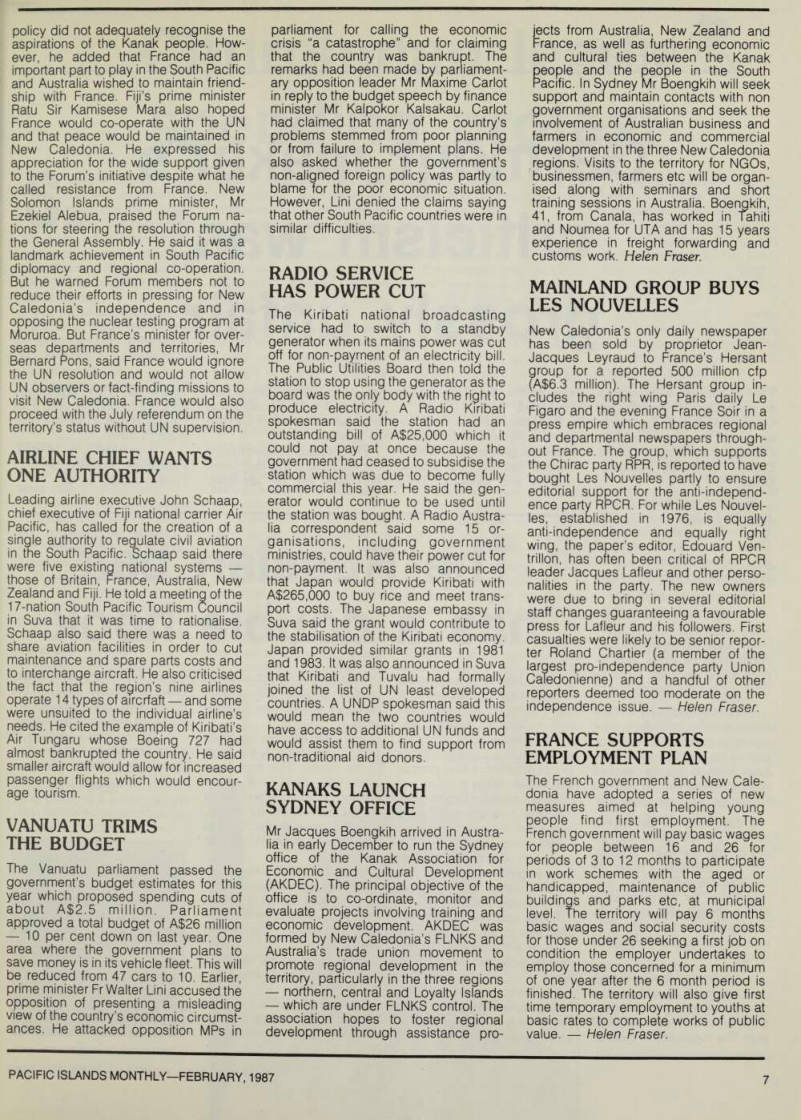
Fiji’s education minister, Mr Felipe Bole, warned expatriates that they have no right to criticise the government or its policies. He issued the warning after criticism by USP professor, New Zealan der Ron Crocombe, who had claimed that the government was delaying pro cessing his application for a work permit renewal. Professor Crocome, of the Pacific Island Studies department, has been a faculty member for 18 years. He had previously claimed that the Fiji government discriminated against other Pacific island nations in the employment of USP staff. Bole said Fiji citizens were entitled to criticise the government, but that the same right did not extend to foreigners.
Forestry Plans
Worth Millions
The government of Vanuatu has approved in principle the establishment of a large industrial forestry plantation on the northern island of Espiritu Santo. The approval follows studies by several gov ernments and organisations including the Commonwealth Development Corporation, the Japanese Association for International Co-operation, the New Zealand government, the Asian Deve lopment Bank and Vanuatu’s Forest Services Department. The government expects the project, if it proceeds, will have a significant impact on the island’s
economy. The plantation is expected to cover about 6,000 hectares. Studies put the development cost of the project at about Asl2 million. The government said negotiations with potential aid donors would begin at once with the hope that work could begin this year. The planta tion would then be in production by the year 2007. In Fiji, meanwhile, Forestry Development Services Ltd announced multi-million dollar plans for timber ex ports to Australia and Japan over the next five years. The company said it had reached agreement with Australian dis tributors for an annual sale of 24,000 cubic metres of planed and sawn pine worth about As2o million in the first three years. The company announced that it had also reached agreement for the marketing of woodchips through the Japanese trading house, C. Itoh and Co, with annual sales worth As 7 million.
Forestry Development Services 50 per cent owned by the Fiji Pine Commis sion is to be renamed Tropik Wood Industries Ltd.
A-G Report Slams
Control Standards
The annual report of the auditor-general of Vanuatu has strongly criticised the standard of controls over public spen ding. Mr Joe Dwyer said the standard was rapidly dropping and his report said the administration of the country’s budget was of particular concern. Books recording spending by government de partments were often badly maintained, said the report, despite considerable training of the people involved. Officers responsible for departmental spending could not easily see the department’s financial position because of the poorly kept books, the report said. It also said that if government departments had remained within their spending limits, a deficit of Asl million in 1985 could have been contained at A 5200,000.
France Urged To
Work With Un
South Pacific countries expressed their hope that France would adopt a con structive attitude and work with the United Nations to resolve the future of New Caledonia after the UN had adopted a resolution re-inscribing the territory on the list of non-self governing entities. The minister representing the foreign minister in the Australian Senate, Senator Gareth Evans, said all Forum countries hoped France would work with the UN for the benefit of the people of New Caledonia. He said present French
Mr. Bole: Warned foreigners to stay out of domestic politics
policy did not adequately recognise the aspirations of the Kanak people. How ever, he added that France had an important part to play in the South Pacific and Australia wished to maintain friend ship with France. Fiji's prime minister Ratu Sir Kamisese Mara also hoped France would co-operate with the UN and that peace would be maintained in New Caledonia. He expressed his appreciation for the wide support given to the Forum’s initiative despite what he called resistance from France. New Solomon Islands prime minister, Mr Ezekiel Alebua, praised the Forum na tions for steering the resolution through the General Assembly. He said it was a landmark achievement in South Pacific diplomacy and regional co-operation.
But he warned Forum members not to reduce their efforts in pressing for New Caledonia’s independence and in opposing the nuclear testing program at Moruroa. But France’s minister for over seas departments and territories, Mr Bernard Pons, said France would ignore the UN resolution and would not allow UN observers or fact-finding missions to visit New Caledonia. France would also proceed with the July referendum on the territory’s status without UN supervision.
Airline Chief Wants
One Authority
Leading airline executive John Schaap, chief executive of Fiji national carrier Air Pacific, has called for the creation of a single authority to regulate civil aviation in the South Pacific. Schaap said there were five existing national systems those of Britain, France, Australia, New Zealand and Fiji. He told a meeting of the 17-nation South Pacific Tourism Council in Suva that it was time to rationalise.
Schaap also said there was a need to share aviation facilities in order to cut maintenance and spare parts costs and to interchange aircraft. He also criticised the fact that the region’s nine airlines operate 14 types of aircrfaft and some were unsuited to the individual airline’s needs. He cited the example of Kiribati’s Air Tungaru whose Boeing 727 had almost bankrupted the country. He said smaller aircraft would allow for increased passenger flights which would encour age tourism.
Vanuatu Trims
The Budget
The Vanuatu parliament passed the government’s budget estimates for this year which proposed spending cuts of about A 52.5 million. Parliament approved a total budget of As 26 million 10 per cent down on last year. One area where the government plans to save money is in its vehicle fleet. This will be reduced from 47 cars to 10. Earlier, prime minister Fr Walter Uni accused the opposition of presenting a misleading view of the country’s economic circumst ances. He attacked opposition MPs in
parliament for calling the economic crisis “a catastrophe” and for claiming that the country was bankrupt. The remarks had been made by parliament ary opposition leader Mr Maxime Carlot in reply to the budget speech by finance minister Mr Kalpokor Kalsakau. Carlot had claimed that many of the country’s problems stemmed from poor planning or from failure to implement plans. He also asked whether the government’s non-aligned foreign policy was partly to blame for the poor economic situation.
However, Uni denied the claims saying that other South Pacific countries were in similar difficulties.
Radio Service
Has Power Cut
The Kiribati national broadcasting service had to switch to a standby generator when its mains power was cut off for non-payment of an electricity bill.
The Public Utilities Board then told the station to stop using the generator as the board was the only body with the right to produce electricity. A Radio Kiribati spokesman said the station had an outstanding bill of A 525,000 which it could not pay at once because the government had ceased to subsidise the station which was due to become fully commercial this year. He said the gen erator would continue to be used until the station was bought. A Radio Austra lia correspondent said some 15 or ganisations, including government ministries, could have their power cut for non-payment. It was also announced that Japan would provide Kiribati with A 5265,000 to buy rice and meet trans port costs. The Japanese embassy in Suva said the grant would contribute to the stabilisation of the Kiribati economy.
Japan provided similar grants in 1981 and 1983. It was also announced in Suva that Kiribati and Tuvalu had formally joined the list of UN least developed countries. A UNDP spokesman said this would mean the two countries would have access to additional UN funds and would assist them to find support from non-traditional aid donors.
Kanaks Launch
Sydney Office
Mr Jacques Boengkih arrived in Austra lia in early December to run the Sydney office of the Kanak Association for Economic and Cultural Development (AKDEC). The principal objective of the office is to co-ordinate, monitor and evaluate projects involving training and economic development. AKDEC was formed by New Caledonia’s FLNKS and Australia’s trade union movement to promote regional development in the territory, particularly in the three regions northern, central and Loyalty Islands which are under FLNKS control. The association hopes to foster regional development through assistance pro
jects from Australia, New Zealand and France, as well as furthering economic and cultural ties between the Kanak people and the people in the South Pacific. In Sydney Mr Boengkih will seek support and maintain contacts with non government organisations and seek the involvement of Australian business and farmers in economic and commercial development in the three New Caledonia regions. Visits to the territory for NGOs, businessmen, farmers etc will be organ ised along with seminars and short training sessions in Australia. Boengkih, 41, from Canala, has worked in Tahiti and Noumea for UTA and has 15 years experience in freight forwarding and
customs work.
Helen Fraser.
Mainland Group Buys
Les Nouvelles
New Caledonia’s only daily newspaper has been sold by proprietor Jean- Jacques Leyraud to France’s Hersant group for a reported 500 million cfp (A 56.3 million). The Hersant group in cludes the right wing Paris daily Le Figaro and the evening France Soir in a press empire which embraces regional and departmental newspapers through out France. The group, which supports the Chirac party RPR, is reported to have bought Les Nouvelles partly to ensure editorial support for the anti-independ ence party RPCR. For while Les Nouvel les, established in 1976, is equally anti-independence and equally right wing, the paper’s editor, Edouard Ven trillon, has often been critical of RPCR leader Jacques Lafleur and other perso nalities in the party. The new owners were due to bring in several editorial staff changes guaranteeing a favourable press for Lafleur and his followers. First casualties were likely to be senior repor ter Roland Chartier (a member of the largest pro-independence party Union CaTedonienne) and a handful of other reporters deemed too moderate on the
independence issue.
Helen Fraser.
France Supports
Employment Plan
The French government and New Cale donia have adopted a series of new measures aimed at helping young people find first employment. The French government will pay basic wages for people between 16 and 26 for periods of 3 to 12 months to participate in work schemes with the aged or handicapped, maintenance of public buildings and parks etc, at municipal level. The territory will pay 6 months basic wages and social security costs for those under 26 seeking a first job on condition the employer undertakes to employ those concerned for a minimum of one year after the 6 month period is finished. The territory will also give first time temporary employment to youths at basic rates to complete works of public
value.
Helen Fraser.