Heavyweight champ
p. 52 · Read in the full issue
is fighting fit
Last year’s Common wealth Games in Edin burgh brought little joy to South Pacific sportsmen and sportswomen. Papua New Guinea’s decision to withdraw over Britain’s reluctance to im pose sanctions on South Africa robbed the region of many of its best medal prospects.
Fiji’s lawn bowlers were alone in challenging for medals, only to falter on the last day of the competition.
However, some consolation can be gained from the triumph of Jimmy Peau, a member of New Zealand’s Samoan com munity, who won the heavy weight boxing title.
His story is typical of the many Samoans who have formed the backbone of New Zealand’s amateur boxing effort in recent years.
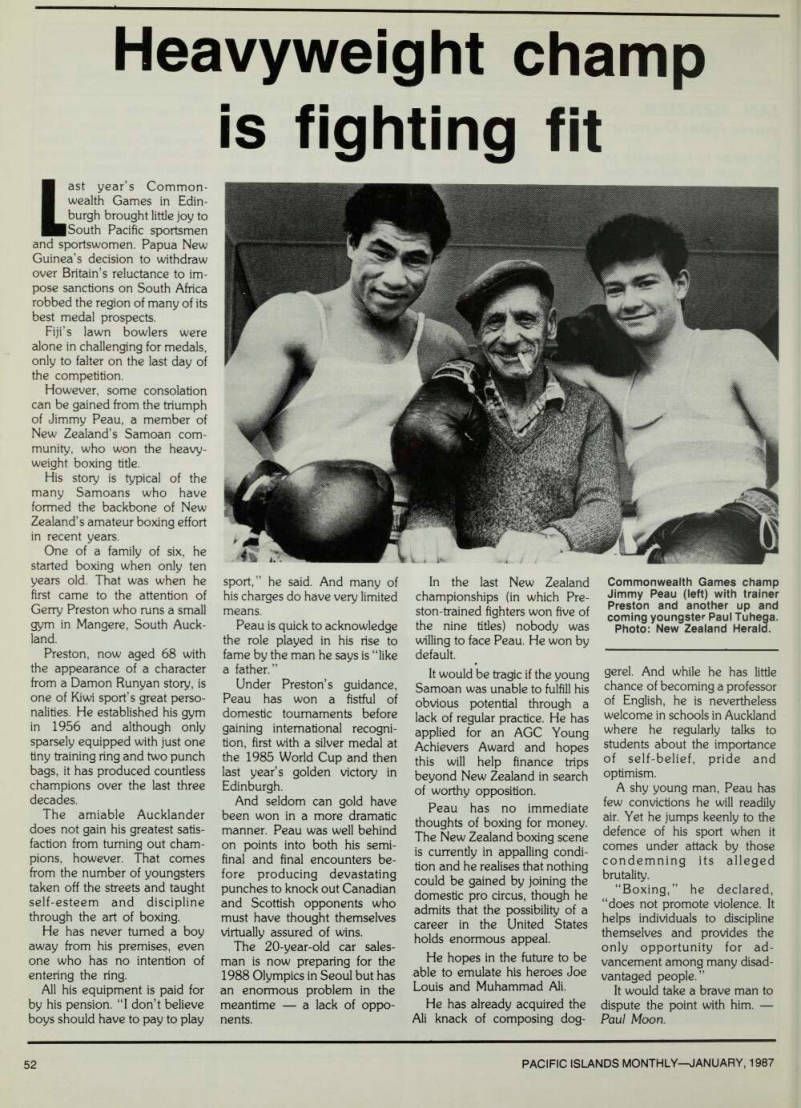
One of a family of six, he started boxing when only ten years old. That was when he first came to the attention of Gerry Preston who runs a small gym in Mangere, South Auck land.
Preston, now aged 68 with the appearance of a character from a Damon Runyan story, is one of Kiwi sport’s great perso nalities. He established his gym in 1956 and although only sparsely equipped with just one tiny training ring and two punch bags, it has produced countless champions over the last three decades.
The amiable Aucklander does not gain his greatest satis faction from turning out cham pions, however. That comes from the number of youngsters taken off the streets and taught self-esteem and discipline through the art of boxing.
He has never turned a boy away from his premises, even one who has no intention of entering the ring.
All his equipment is paid for by his pension. “I don’t believe boys should have to pay to play
sport,” he said. And many of his charges do have very limited means.
Peau is quick to acknowledge the role played in his rise to fame by the man he says is “like a father.”
Under Preston’s guidance, Peau has won a fistful of domestic tournaments before gaining international recogni tion, first with a silver medal at the 1985 World Cup and then last year’s golden victory in Edinburgh.
And seldom can gold have been won in a more dramatic manner. Peau was well behind on points into both his semi final and final encounters be fore producing devastating punches to knock out Canadian and Scottish opponents who must have thought themselves virtually assured of wins.
The 20-year-old car sales man is now preparing for the 1988 Olympics in Seoul but has an enormous problem in the meantime a lack of oppo nents.
In the last New Zealand championships (in which Pre ston-trained fighters won five of the nine titles) nobody was willing to face Peau. He won by default.
It would be tragic if the young Samoan was unable to fulfill his obvious potential through a lack of regular practice. He has applied for an AGC Young Achievers Award and hopes this will help finance trips beyond New Zealand in search of worthy opposition.
Peau has no immediate thoughts of boxing for money.
The New Zealand boxing scene is currently in appalling condi tion and he realises that nothing could be gained by joining the domestic pro circus, though he admits that the possibility of a career in the United States holds enormous appeal.
He hopes in the future to be able to emulate his heroes Joe Louis and Muhammad Ali.
He has already acquired the Ali knack of composing dog
gerel. And while he has little chance of becoming a professor of English, he is nevertheless welcome in schools in Auckland where he regularly talks to students about the importance of self-belief, pride and optimism.
A shy young man, Peau has few convictions he will readily air. Yet he jumps keenly to the defence of his sport when it comes under attack by those condemning its alleged brutality.
“Boxing,” he declared, “does not promote violence. It helps individuals to discipline themselves and provides the only opportunity for ad vancement among many disad vantaged people.”
It would take a brave man to dispute the point with him.
Paul Moon.
Commonwealth Games champ Jimmy Peau (left) with trainer Preston and another up and coming youngster Paul Tuhega.
Photo: New Zealand Herald.