Fortune hunters met
p. 38 · Read in the full issue
with ill luck
As new prospectors seek precious metals in the mountains of Guadalcanal, R.A. LEVER has found that their fortunes are certain to be better than those that awaited the early gold seekers.
Towards the end of the last century, the Austro- Hungarian Empire was compiling information on mineral deposits on a worldwide basis.
Visits had already been made to Greece, Turkey, the Urals, Canada and Australia and, by 1896, a small expedition had arrived in the Solomon Islands.
The Albatross had been commissioned by the naval sec tion of the emperor’s War Office and by August of that year was visiting the large island of Guadalcanal. Her comple ment was 25 with one H.R. von Foullon-Norbeeck as chief geologist in charge of a party bent on prospecting in the lofty mountainous region of the is land’s interior.
This well armed party, pro vided with knives and tobacco as “currency” set off with guides on a planned eight days’ journey and were to scale a peak known as the Lion’s Head whose summit reaches about 6,500 feet.
To the east is a dome shaped mountain known as Tatuve which was the next objective.
Here, however, the Austrians had a major problem. They were told most emphatically by the people living in the district that Tatuve was to them a sacred place which could not be visited.
Most unwisely, however, Norbeeck decided to press ahead with his plans and, leav ing a small party at the base, set off for the summit of the sacred mountain.
The Solomon Islanders were at this time a most warlike people and, their advice disre garded, decided to kill some of the expedition members.
In the subsequent attack, two sailors died instantly and Nor-
beeck and his ensign later died of their wounds. The attack was so sudden that the sailors were unable to use their Bmm re peating rifles and revolvers.
And, strangely, while the ad vance party was under attack, the people gave bananas and sugar cane to some of the base party whom they thought hun gry and so should be provided with food.
The survivors of the ambush, with their wounded comman der and comrades, meanwhile, had to fight their way back to the base camp leaving their dead in the bush. It happened
that the resident commissioner and the governement surveyor were on board The Albatross.
The former was Charles Wood ford who, most unusually for a man in such a position, was an enthusiastic naturalist and had written a book called A Natural ist Among the Headhunters.
In his book, Woodford men tioned that he had been collec ting specimens in the Lion’s Head some time ten years earlier when he found his guides reluctant to proceed, but there is no mention of the sacred Tatuve.
Four or .five years after the
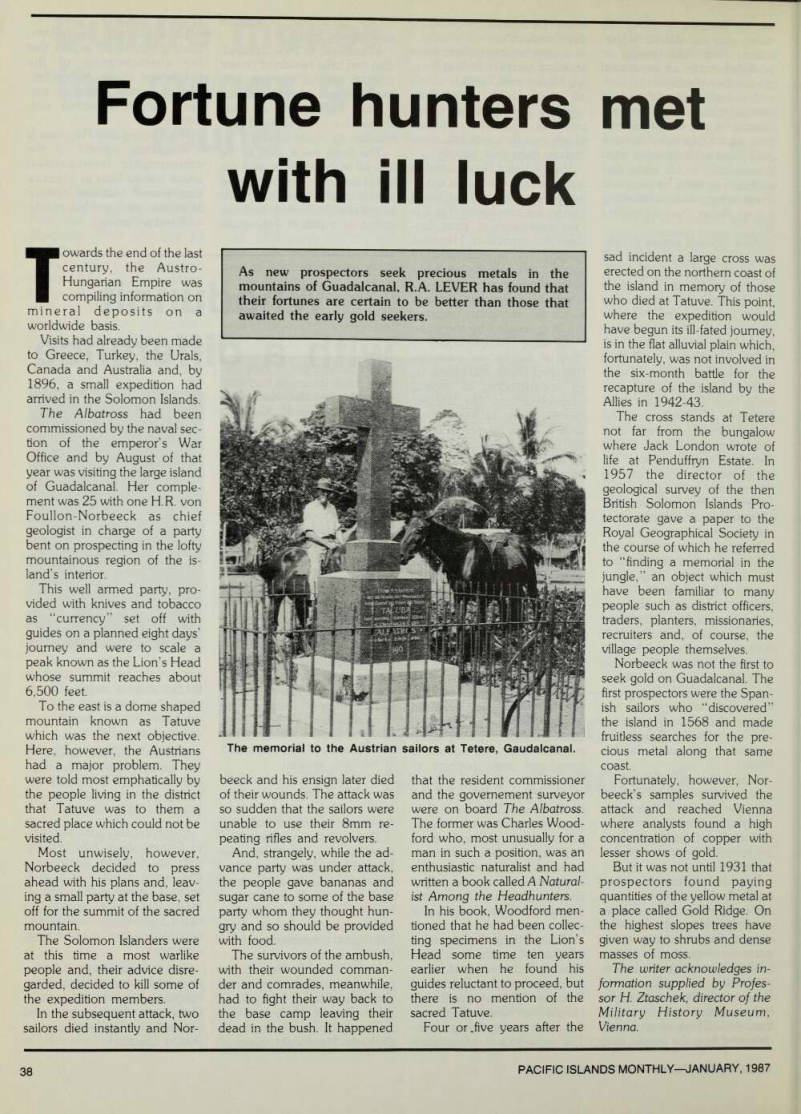
sad incident a large cross was erected on the northern coast of the island in memory of those who died at Tatuve. This point, where the expedition would have begun its ill-fated journey, is in the flat alluvial plain which, fortunately, was not involved in the six-month battle for the recapture of the island by the Allies in 1942-43.
The cross stands at Tetere not far from the bungalow where Jack London wrote of life at Penduffryn Estate. In 1957 the director of the geological survey of the then British Solomon Islands Pro tectorate gave a paper to the Royal Geographical Society in the course of which he referred to “finding a memorial in the jungle,” an object which must have been familiar to many people such as district officers, traders, planters, missionaries, recruiters and, of course, the village people themselves.
Norbeeck was not the first to seek gold on Guadalcanal. The first prospectors were the Span ish sailors who “discovered” the island in 1568 and made fruitless searches for the pre cious metal along that same coast.
Fortunately, however, Nor beeck’s samples survived the attack and reached Vienna where analysts found a high concentration of copper with lesser shows of gold.
But it was not until 1931 that prospectors found paying quantities of the yellow metal at a place called Gold Ridge. On the highest slopes trees have given way to shrubs and dense masses of moss.
The writer acknowledges in formation supplied by Profes sor H. Ztaschek, director of the Military History Museum, Vienna.
The memorial to the Austrian sailors at Tetere, Gaudalcanal.