family album
p. 35 · Read in the full issue
books
A national family album
Paradise Tales. Geoff McLaughlin.(Ed) Published by Robert Brown & Associ ates, 1986. ISBN 0 949267 23 6. Price $A24.95.
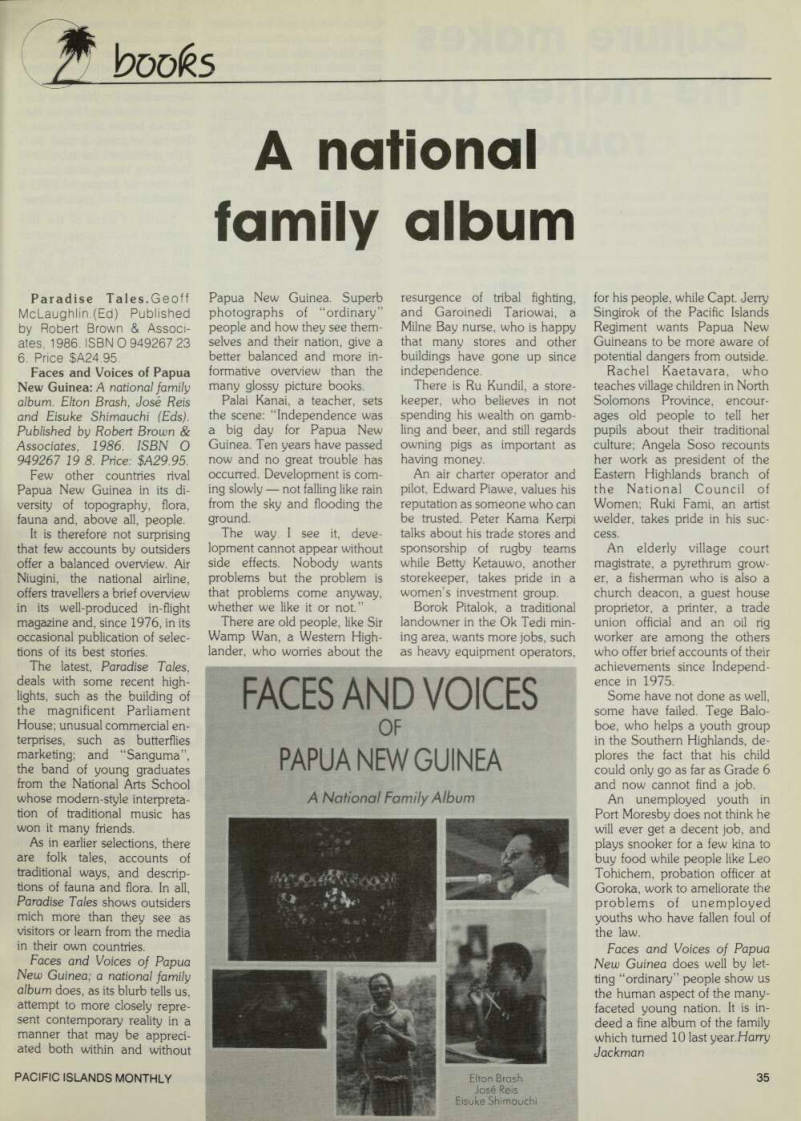
Faces and Voices of Papua New Guinea: A national family album. Elton Brash, Jose Reis and Eisuke Shimauchi (Eds).
Published by Robert Brown & Associates, 1986. ISBN O 949267 19 8. Price: $A29.95.
Few other countries rival Papua New Guinea in its di versity of topography, flora, fauna and, above all, people.
It is therefore not surprising that few accounts by outsiders offer a balanced overview. Air Niugini, the national airline, offers travellers a brief overview in its well-produced in-flight magazine and, since 1976, in its occasional publication of selec tions of its best stories.
The latest, Paradise Tales, deals with some recent high lights, such as the building of the magnificent Parliament House; unusual commercial en terprises, such as butterflies marketing; and “Sanguma”, the band of young graduates from the National Arts School whose modern-style interpreta tion of traditional music has won it many friends.
As in earlier selections, there are folk tales, accounts of traditional ways, and descrip tions of fauna and flora. In all, Paradise Tales shows outsiders mich more than they see as visitors or learn from the media in their own countries.
Faces and Voices of Papua New Guinea; a national family album does, as its blurb tells us, attempt to more closely repre sent contemporary reality in a manner that may be appreci ated both within and without
Papua New Guinea. Superb photographs of “ordinary” people and how they see them selves and their nation, give a better balanced and more in formative overview than the many glossy picture books.
Palai Kanai, a teacher, sets the scene: “Independence was a big day for Papua New Guinea. Ten years have passed now and no great trouble has occurred. Development is com ing slowly not falling like rain from the sky and flooding the ground.
The way I see it, deve lopment cannot appear without side effects. Nobody wants problems but the problem is that problems come anyway, whether we like it or not.”
There are old people, like Sir Wamp Wan, a Western High lander, who worries about the
resurgence of tribal fighting, and Garoinedi Tariowai, a Milne Bay nurse, who is happy that many stores and other buildings have gone up since independence.
There is Ru Kundil, a store keeper, who believes in not spending his wealth on gamb ling and beer, and still regards owning pigs as important as having money.
An air charter operator and pilot, Edward Piawe, values his reputation as someone who can be trusted. Peter Kama Kerpi talks about his trade stores and sponsorship of rugby teams while Betty Ketauwo, another storekeeper, takes pride in a women’s investment group.
Borok Pitalok, a traditional landowner in the Ok Tedi min ing area, wants more jobs, such as heavy equipment operators,
for his people, while Capt. Jerry Singirok of the Pacific Islands Regiment wants Papua New Guineans to be more aware of potential dangers from outside.
Rachel Kaetavara, who teaches village children in North Solomons Province, encour ages old people to tell her pupils about their traditional culture; Angela Soso recounts her work as president of the Eastern Highlands branch of the National Council of Women; Ruki Fami, an artist welder, takes pride in his suc cess.
An elderly village court magistrate, a pyrethrum grow er, a fisherman who is also a church deacon, a guest house proprietor, a printer, a trade union official and an oil rig worker are among the others who offer brief accounts of their achievements since Independ ence in 1975.
Some have not done as well, some have failed. Tege Balo boe, who helps a youth group in the Southern Highlands, de plores the fact that his child could only go as far as Grade 6 and now cannot find a job.
An unemployed youth in Port Moresby does not think he will ever get a decent job, and plays snooker for a few kina to buy food while people like Leo Tohichem, probation officer at Goroka, work to ameliorate the problems of unemployed youths who have fallen foul of the law.
Faces and Voices of Papua New Guinea does well by let ting “ordinary” people show us the human aspect of the many faceted young nation. It is in deed a fine album of the family which turned 10 last year .Harry Jackman