Why Levers
pp. 25-27 · Read in the full issue
trade winds
End Of An Era
Why Levers walked out of the forest
Almost a quarter of a century of logging came to an end in Solomon Islands when Levers Pacific Timbers sold off its en tire possessions on North New Georgia and Kolombangara.
LPT, the largest logging com pany in the Solomons, was also the country’s major export ear ner, accounting for an esti mated 20 to 25 per cent of export earnings and between 8 and 12 per cent of GNP.
Employing almost 400.
British-based timber mogul Levers has quit its logging operations in Solomon Islands after 25 years. But it was not of the company’s own accord. JOHN WRIGHT traces a troubled history of misunderstandings and endless land disputes
people at its Ringi Cove and Barora townships, the company had originally plannned to log for a further eight years on North New Georgia, But a protracted dispute over access to custom-held land forced LPT to pack its bags
eight years early.
The mid-November auction last year in which the com pany’s entire Western Pacific assets went under the hammer, was possibly the biggest ever seen in the region.
Buyers from Solomon Is
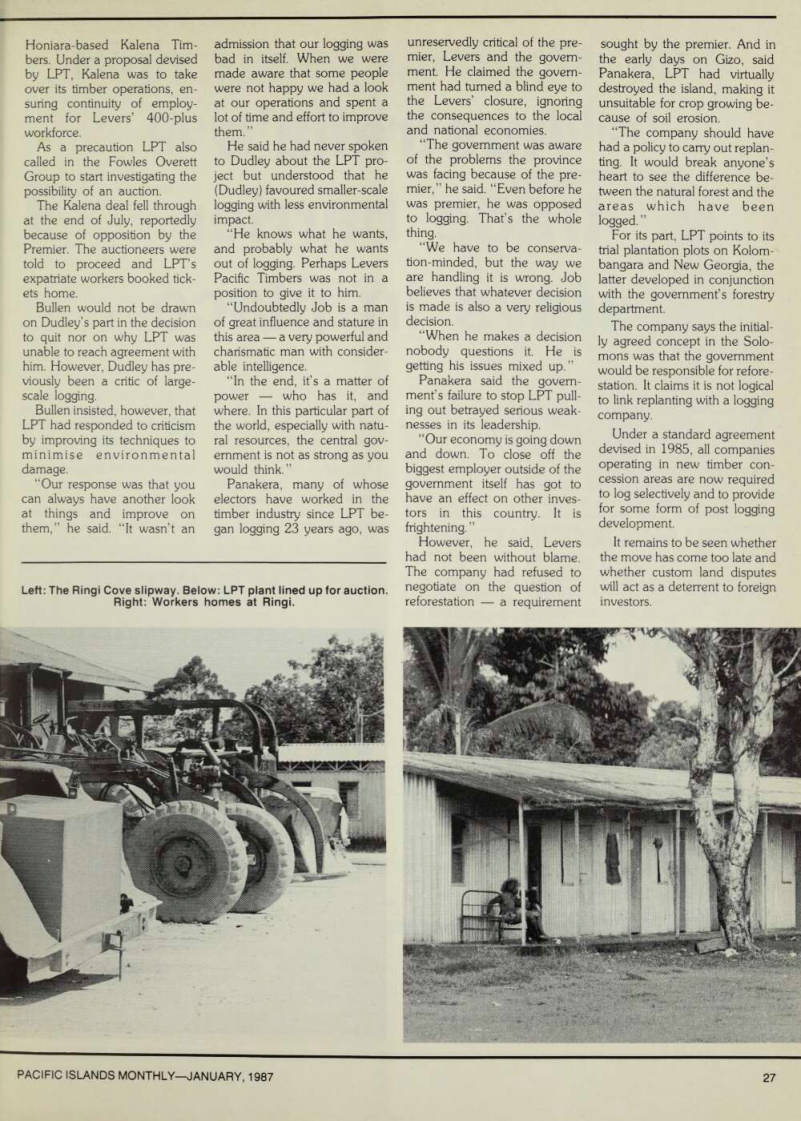
lands, New Zealand, Fiji, Vanuatu, Hong Kong and Papua New Guinea assembled at Ringi Cove. In three days it was gone three townships plus plant and equipment with an estimated replacement cost of As4o million.
The sale raised just under $5 million.
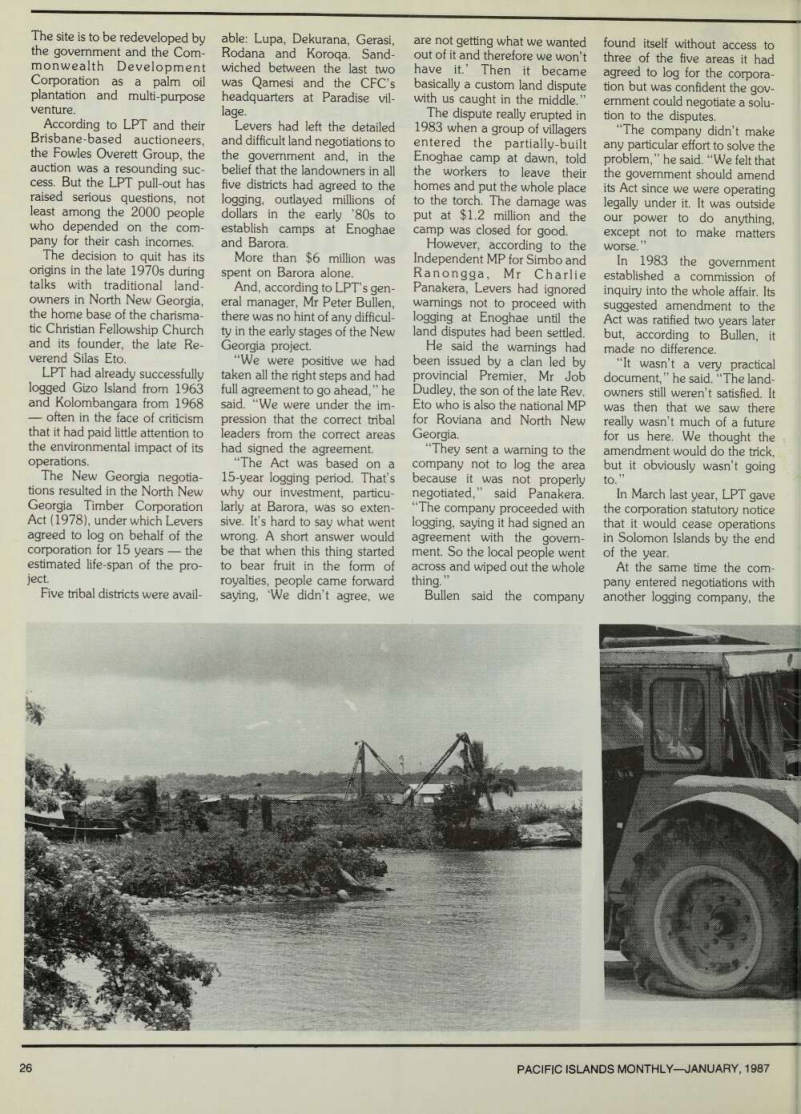
Biggest bargain of the day Ringi Cove and its infrastruc ture was quickly snapped up by the Solomon Islands govern ment for less than $1 million.
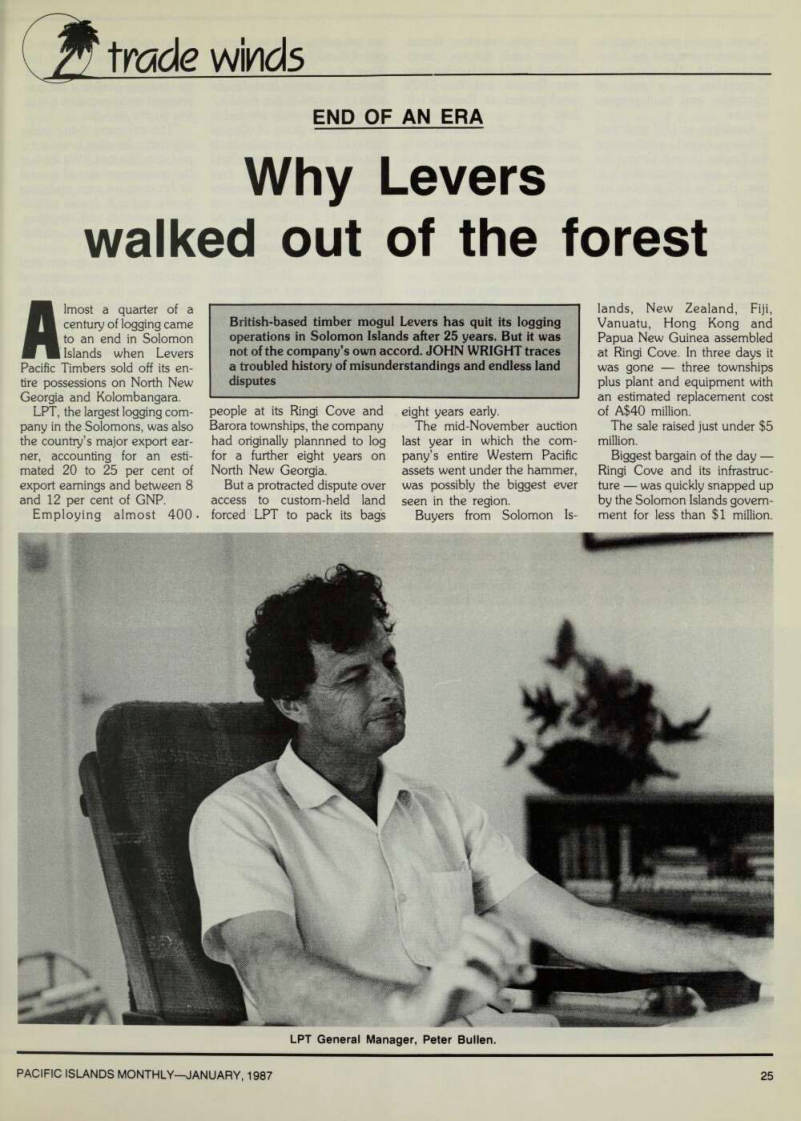
LPT General Manager, Peter Bullen.
The site is to be redeveloped by the government and the Com monwealth Development Corporation as a palm oil plantation and multi-purpose venture.
According to LPT and their Brisbane-based auctioneers, the Fowles Overett Group, the auction was a resounding suc cess. But the LPT pull-out has raised serious questions, not least among the 2000 people who depended on the com pany for their cash incomes.
The decision to quit has its origins in the late 1970 s during talks with traditional land owners in North New Georgia, the home base of the charisma tic Christian Fellowship Church and its founder, the late Re verend Silas Eto.
LPT had already successfully
logged Gizo Island from 1963 and Kolombangara from 1968 often in the face of criticism that it had paid little attention to the environmental impact of its operations.
The New Georgia negotia tions resulted in the North New Georgia Timber Corporation Act (1978), under which Levers agreed to log on behalf of the corporation for 15 years the estimated life-span of the pro ject.
Five tribal districts were avail
able: Lupa, Dekurana, Gerasi, Rodana and Koroqa. Sand wiched between the last two was Qamesi and the CPC’s headquarters at Paradise vil lage.
Levers had left the detailed and difficult land negotiations to the government and, in the belief that the landowners in all five districts had agreed to the logging, outlayed millions of dollars in the early ’Bos to establish camps at Enoghae and Barora.
More than $6 million was spent on Barora alone.
And, according to LPT’s gen eral manager, Mr Peter Bullen, there was no hint of any difficul ty in the early stages of the New Georgia project.
“We were positive we had taken all the right steps and had full agreement to go ahead,” he said. “We were under the im pression that the correct tribal leaders from the correct areas had signed the agreement.
“The Act was based on a 15-year logging period. That’s why our investment, particu larly at Barora, was so exten sive. It’s hard to say what went wrong. A short answer would be that when this thing started to bear fruit in the form of royalties, people came forward saying, ‘We didn’t agree, we
are not getting what we wanted out of it and therefore we won’t have it.’ Then it became basically a custom land dispute with us caught in the middle. ”
The dispute really erupted in 1983 when a group of villagers entered the partially-built Enoghae camp at dawn, told the workers to leave their homes and put the whole place to the torch. The damage was put at $1.2 million and the camp was closed for good.
However, according to the Independent MP for Simbo and Ranongga, Mr Charlie Panakera, Levers had ignored warnings not to proceed with logging at Enoghae until the land disputes had been settled.
He said the warnings had been issued by a clan led by provincial Premier, Mr Job Dudley, the son of the late Rev.
Eto who is also the national MP for Roviana and North New Georgia.
“They sent a warning to the company not to log the area because it was not properly negotiated,” said Panakera.
“The company proceeded with logging, saying it had signed an agreement with the govern ment. So the local people went across and wiped out the whole thing.”
Bullen said the company
found itself without access to three of the five areas it had agreed to log for the corpora tion but was confident the gov ernment could negotiate a solu tion to the disputes.
“The company didn’t make any particular effort to solve the problem,” he said. “We felt that the government should amend its Act since we were operating legally under it. It was outside our power to do anything, except not to make matters worse.”
In 1983 the government established a commission of inquiry into the whole affair. Its suggested amendment to the Act was ratified two years later but, according to Bullen, it made no difference.
“It wasn’t a very practical document,” he said. “The land owners still weren’t satisfied. It was then that we saw there really wasn’t much of a future for us here. We thought the amendment would do the trick, but it obviously wasn’t going to.”
In March last year, LPT gave the corporation statutory notice that it would cease operations in Solomon Islands by the end of the year.
At the same time the com pany entered negotiations with another logging company, the
Honiara-based Kalena Tim bers. Under a proposal devised by LPT, Kalena was to take over its timber operations, en suring continuity of employ ment for Levers’ 400-plus workforce.
As a precaution LPT also called in the Fowles Overett Group to start investigating the possibility of an auction.
The Kalena deal fell through at the end of July, reportedly because of opposition by the Premier. The auctioneers were told to proceed and LPT’s expatriate workers booked tick ets home.
Bullen would not be drawn on Dudley’s part in the decision to quit nor on why LPT was unable to reach agreement with him. However, Dudley has pre viously been a critic of large scale logging.
Bullen insisted, however, that LPT had responded to criticism by improving its techniques to minimise environmental damage.
“Our response was that you can always have another look at things and improve on them,” he said. “It wasn’t an
admission that our logging was bad in itself. When we were made aware that some people were not happy we had a look at our operations and spent a lot of time and effort to improve them.”
He said he had never spoken to Dudley about the LPT pro ject but understood that he (Dudley) favoured smaller-scale logging with less environmental impact.
“He knows what he wants, and probably what he wants out of logging. Perhaps Levers Pacific Timbers was not in a position to give it to him.
“Undoubtedly Job is a man of great influence and stature in this area a very powerful and charismatic man with consider able intelligence.
“In the end, it’s a matter of power who has it, and where. In this particular part of the world, especially with natu ral resources, the central gov ernment is not as strong as you would think.”
Panakera, many of whose electors have worked in the timber industry since LPT be gan logging 23 years ago, was
unreservedly critical of the pre mier, Levers and the govern ment. He claimed the govern ment had turned a blind eye to the Levers’ closure, ignoring the consequences to the local and national economies.
“The government was aware of the problems the province was facing because of the pre mier,” he said. “Even before he was premier, he was opposed to logging. That’s the whole thing.
“We have to be conserva tion-minded, but the way we are handling it is wrong. Job believes that whatever decision is made is also a very religious decision.
“When he makes a decision nobody questions it. He is getting his issues mixed up.”
Panakera said the govern ment’s failure to stop LPT pull ing out betrayed serious weak nesses in its leadership.
“Our economy is going down and down. To close off the biggest employer outside of the government itself has got to have an effect on other inves tors in this country. It is frightening. ”
However, he said, Levers had not been without blame.
The company had refused to negotiate on the question of reforestation a requirement
sought by the premier. And in the early days on Gizo, said Panakera, LPT had virtually destroyed the island, making it unsuitable for crop growing be cause of soil erosion, “The company should have had a policy to carry out replan ting. It would break anyone’s heart to see the difference be tween the natural forest and the areas which have been logged.”
For its part, LPT points to its trial plantation plots on Kolom bangara and New Georgia, the latter developed in conjunction with the government’s forestry department.
The company says the initial jy agreed concept in the Solo mons was that the government would be responsible for refore station. It claims it is not logical to ii n k replanting with a logging company Under a , s ‘ andard devised in 1985 ’ all companies °P erafin 9 in new timber con c®ssion areas are now required to lo 9 selectively and to provide for some form of P ost lo 99>ng development.
It remains to be seen whether the move has come too late and whether custom land disputes will act as a deterrent to foreign investors.
Left: The Ringi Cove slipway. Below: LPT plant lined up for auction.
Right: Workers homes at Ringi.