survivor wins again
pp. 21-23 · Read in the full issue
Sir Tom: The great survivor wins again
The coalition govern ment of the Cook Is lands was again on the verge of another split which threatened to dislodge Prime Minister, Sir Thomas Davis.
Once again, however, the great survivor triumphed.
Sir Thomas late last year had been facing increasing opposi tion from within his own Demo cratic Party following a series of development project failures and other public relations set backs.
However the crusty Sir Thomas has faced challenges before. Opposition leader Geoffrey Henry, when asked about rumors of Sir Tom’s impending demise, commented wryly, “I’ve been hearing that one since 1983”.
This time however the other side included long-time suppor ters like Foreign Affairs Minister Norman George and Outer Is land Affairs Minister Dr Pupuke Robati, a deputy Prime Minister prior to the coalition govern ments.
Dr Robati has been widely touted as the next Prime Minis ter if the pro-Pupuke faction within the coalition manage to oust Davis. Foreign Minister George, in an interview with PIM in September, confirmed this, saying, “. . . he has my total and absolute support as the successor to Sir Thomas.”
The Outer Islands Affairs Minister is seen as the only choice to replace Davis, the Foreign Minister being too young for the old-guard Demo cratic Party to support and present deputy Prime Minister Dr Terepai Maoate, despite
In the turbulent world of Cook Islands politics, things are often not as they seem. But amid continuing rumour and counter-rumour, prime minister Sir Thomas Davis, has shown himself to be the consummate politician. As a FIM special correspondent reports, even his opponents pay tribute to his skills.
some popular support, comes from the opposing party.
And although George has previously taken over as Acting Prime Minister, ahead of Roba ti, he also firmly rules out any suggestion that he’s aiming for the top position. “I consider myself to be a conscientious member of the coalition caucus rule me right out.”
Although leading politicians like George decline to assess Sir Thomas or even predict his future, many privately state that after years of service Sir Thomas is ready to be put out to pasture. Said one, “He’ll either have to step down gracefully or be removed.”
One scenario sees supporters of the present deputy Prime Minister, being asked some say lured to switch their support to Dr Robati, at the Caucus and, if need be, the House level.
The Maoate supporters, for mer members of the Opposition Cook Islands Party, together with the Democratic half of the coalition, would form a large by recent standards majority behind Dr Robati. Sir Thomas presumably would be asked to step down to be back benches and perhaps a top position in the Caucus.
Another, sweeter, scenario suggests that instead of step ping down he may be asked to step up and become Queen’s Representative, the country’s Head of State.
As for Sir Thomas himself the Prime Minister of the last eight years is said to be of two minds about retiring from the political arena. The other figure at the centre of the leadership rumors, Dr Robati, rarely if ever talks to reporters.
Obviously though, two can
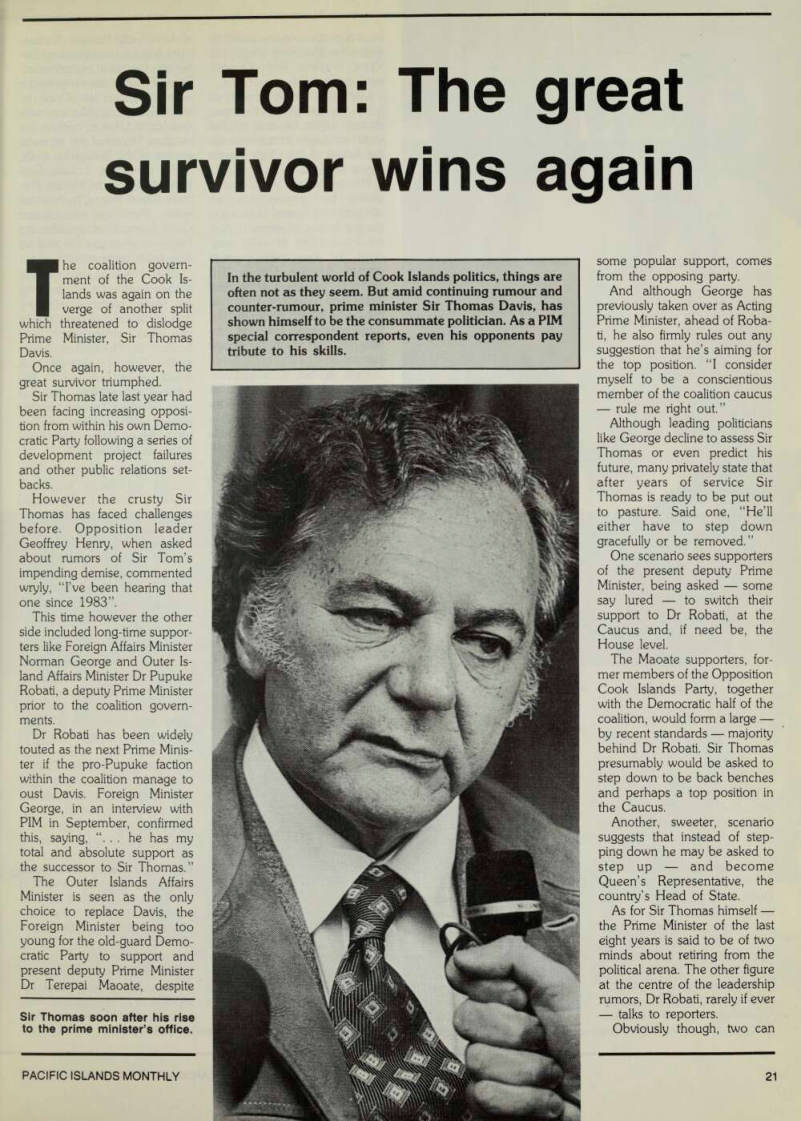
Sir Thomas soon after his rise to the prime minister’s office.
play the numbers game which is so popular in Cook Islands politics. The path was open to Sir Thomas to sway the unde cided as happened in the past and present coalitions. He took it.
Whether or not a fresh round of in-fighting breaks out the pro-Pupuke faction justify their actions with the allegation that continued leadership under Davis will seriously weaken the country overseas.
But more importantly for the future of the coalition, Davis as Prime Minister at the next year’s elections, may been seen by some as a serious liability if the two groups stand as a party.
Looking ahead, minister George says it is far too early to
tell whether the coalition will stand as a party. But, he con tinues, “We have a plan we know how we are going to approach these elections but we are not going to reveal these plans as yet.”
What is certain, he says, is that the “true party doctrines will be watered down.” Instead it will be a coalition type party and the “individual members will have a more important role to play.” Faced with factions within factions denouncing each other at the next elections, Minister George told PIM that he expected voters would have to look at the best combinations of candidates.
“But the one thing you can not expect is an amalgamation
by any section of the coalition with either the Geoff (Henry) or Vince (Ingram, both Opposi tion) factions.”
Given the last three years of party bed swapping, that pre diction might be one of the most optimistic comments on the future of the Cook Islands goverment yet.
No-confidence votes and grabs for power are an occupational hazard of being at the top in any goverment. And for the leaders of what were once the two main political parties in the Cooks, Sir Thomas of the Democratic Party and Geoffrey Henry of the Cook Islands Party, the last three years have been particu larly tortured even by Pacific standards.
Party politics which had pre viously split churches, families and whole island communities hit an all time low in 1983, a year which saw five successive “governments” and two gen eral elections.
It was April of that year in which Sir Thomas stepped down from the leadership of the Democratic Party after it lost the March elections to Henry’s CIPs by a two seat margin including Davis’ own Avatiu constituency.
Sir Thomas relinquished leadership to his former Econo mic Development Minister Vin cent Ingram, retiring to the Caucus level, presumably until the next elections, five years away. However things are nev er as they seem, particularly in Cook Islands politics.
A then goverment minister, Tupui Henry, made a grab for power by crossing the floor of Parliament to vote with the Opposition Democrats. How ever the members he had counted on crossing with him for a no-confidence vote against Geoffrey Henry failed to materialise and the 24 seat House was split.
Subsequently both of the Henry cousins failed to gain a majority. Opposition leader Vincent Ingram was also unable to gather the numbers. Parlia ment was dissolved and dis gusted Cook Islanders went back to the polls for the second time that year, in November 2.
In that time Sir Thomas rose
to take back the top position from Ingram, and relations be tween the two deteriorated.
Tupui Henry went on to field a separate party, the Cook Is lands Party for Alliance, with new candidates to contest the election. In one of the supreme ironies of the November polls, CIPA candidate Louise Gra ham, daughter of former Pre mier Albert Henry, took seven votes from the mainstream Cook Island Party allowing Davis to recapture his seat by that exact same margin.
After 1983, year of the five governments (Davis’ prior to the March elections, Henry’s, that of the head of state, then a caretaker government and finally, in November, Davis again), Vincent Ingram was made cabinet minister but without a portfolio. The next year, Norman George, freshly elected MP for Atiu and an ex-Auckland Police Chief, was sworn in over Ingram.
Although a subsequent Party caucus conference voted for Ingram’s return, Davis refused and George remained. Ingram had made himself unpopular with party high-ups by criticis ing his colleagues for failing to “listen to the people”, and, as the youngest MP on the Demo crat side, even failing to be sufficiently respectful to older members.
Despite the censure by the party high-ups Ingram con tinued to work within the party, working at gaining support for himself and his ideas.
By mid-1984 Sir Thomas was beginning to feel threatened and a replay of 1983 looked possible. Finally, in August, after short weeks of final planning Davis shocked the country with the announce ment that the two parties were now a coalition government “for the good of the country”.
Davis and Henry made radio broadcasts that evening and Cook Islanders picked up their government “press” the next morning, complete with picture of Sir Thomas smiling down at a grinning Henry.
An electorate which had just suffered the expense and ex asperation of two general elec tions allowed the arrangement to pass without much com
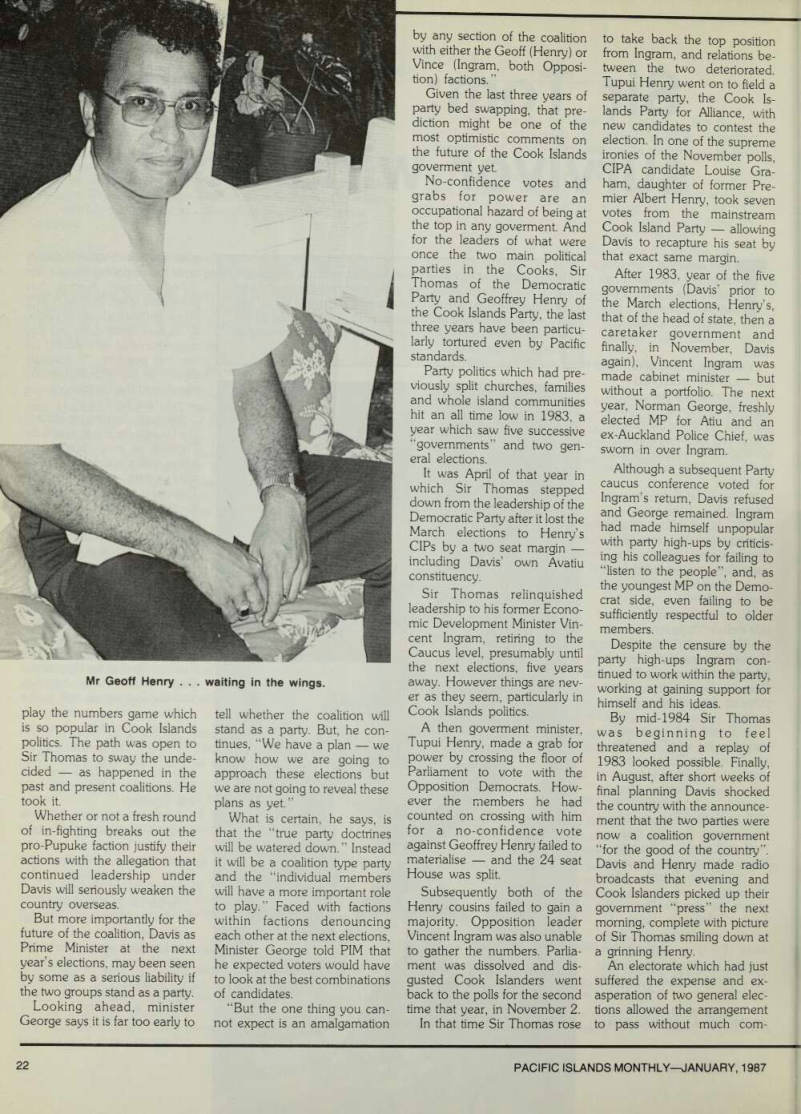
Mr Geoff Henry . . . waiting in the wings.
plaint. Cook Islands News which had until then printed a more or less balanced account of government goings-on, fell under the influence of a gov ernment which proceeded to pump the “press” full of head lines in the vein of “Let’s All Work Together” under the coalition.
Two long-time Democratic ministers, Tangata Simiona and Tangava Tangaroa retired from government service after being promised positions as, respec tively, the Queen’s Representa tive, and as Ombudsman. Tan garoa, who had suffered reshuf fles before took this one philosophically. “I hear the next time I see you I’ll be the Queen’s Representative so I suppose you’ll have to salute me and sing ‘God Save the Queen’ ” he told his education ministry staff at a farewell lunch.
MPs Vincent Ingram and Papa Mama Pokino, who also lost his ministerial post, with drew from the coalition and declared themselves to be the Opposition at the next session
of Parliament, to laughter from the 22 other “coalition” mem bers.
But the coalition needed no help from any free press for the arrangement to become un hinged. Less than 12 months after it was formed and one short month before the crucial Forum conference and the Mini South Pacific Games period in August, deputy Prime Minister Geoffrey Henry and “Opposi tion” leader Vincent Ingram began laying plans to bring down Sir Thomas.
When the public finally got wind of the goings on within the coalition, Sir Thomas threatened to lead the country into another general election if the plotting went on behind his back.
Sir Thomas and his suppor ters must have also made a few deals of their own because only a few days later Ingram with drew his motion of no-confi dence from the House, saying he did not have the numbers to support it. The reason became apparent later when Henry re
moved his party from the coali tion, only to find four of his members staying behind in ministerial positions. Coalition 11, with Dr Terepai Maoate as the new deputy Prime Minister, was born.
Today Coalition II lives on despite the crises of last year.
But even if Sir Thomas Davis, KSE manages to remain in place as Prime Minister the cracks within the Cook Islands government will not disappear.
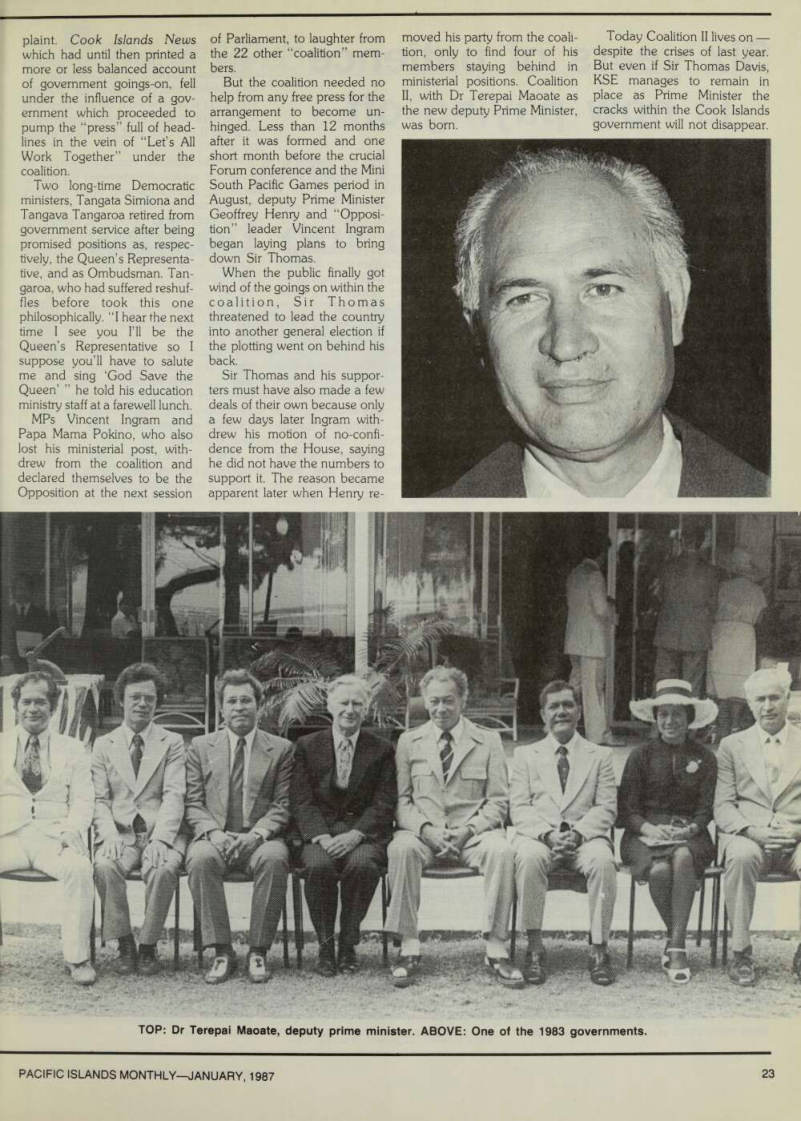
TOP: Dr Terepai Maoate, deputy prime minister. ABOVE: One of the 1983 governments.