Kanak independence
pp. 16-17 · Read in the full issue
Colonial justice: 'It could [?]all end badly'
leader Mr Jean-Marie Tjibaou said he fears that recent events in New Caledonia were an attempt by the extreme Right to destabilise the country and make conditions impossible for the holding of the self-de termination vote in July.
The FLNKS President was referring to the arson of a wharf, loading equipment and a dock belonging to Mr Robert Froin, a member of the North ern Regional Council. (Mr Tjibaou is president of the council). Damage was esti mated at 20 million cfp.
A week later the Noumea headquarters of the FLNKS were fire bombed, with the wooden facade destroyed be fore the fire was put out, and a guard dog belonging to FLNKS spokesman, Mr Yeiwene Yeiwene, was poisoned. Mr Yeiwene is also President of the Loyalty Islands Regional Coun cil, and the dog had been purchased after two Molotov cocktails were thrown at his home.
Tjibaou denounced the attacks, saying they were an attempt to provoke the FLNKS and to create a situation where the Chirac Government could justify the further militarisation of the territory and the post ponement of the referendum.
Tjibaou was speaking to re porters in Australia when he
attended the conference on Australia’s Pacific Connections, held by the Evatt Foundation.
He flew to Sydney from the United Nations HQ where he had spent three weeks lobbying for the relisting of New Caledo nia with the UN decolonisation committee.
“We’ve been lucky to be supported by the Forum and in the past two weeks we’ve had strong backing from other countries such as Indonesia and Vietnam,” he said.
Tjibaou said: “From the mo ment when the UN and its committee accept the resolution for the relisting, France will be obliged to provide information.
UN involvement will be a true test of whether France accepts that the process of decolonisa tion can become a reality.”
Referring to the FLNKS elec tion boycott and disruption of the countryside in November, ’B4, Mr Tjibaou said, “I think on the one hand the events of 1984 and their media coverage made New Caledonia known internationally especially in Francophone countries. Now people in the world know that New Caledonia exists, and that the Kanak people claim their independence.
“And because of our actions the South Pacific Forum coun tries have a stronger sense of
the potential for instability in the region. The Rainbow Warrior affair showed this colonial aspect of France in the Pacific there is now an awareness of the problem.
“Today the countries such as Australia, New Zealand and Fiji which didn’t show so much support in the past, are now much more determined be cause they are aware of the risks of instability. But also these countries now have more sympathy for us, they know us
better. ”
The FLNKS President warned that seeking UN in volvement “is the path prefer red by the Forum and the NAM the peaceful way of decol onising” but that if it was unsuccessful the FLNKS would be obliged to use other means.
During the time Tjibaou was at the UN tensions increased in the territory after the freeing without trial of the 7 men responsible for the December, ’B4, ambush and massacre of ten Kanak militants, including two of Tjibaou’s brothers.
The French state prosecutor failed to appeal against the examining magistrates decision to free the seven anti-independ ence settlers who had admitted the killings. Tjibaou alleged the
French government had inter vened to stop the appeal by the prosecutor, “perhaps to test us or to provoke us.” He said a document had been sighted from the prosecutor’s office which proved this.
Amnesty International had taken up the case. Tjibaou said, “for us it’s extra proof of the reality of colonial justice, that one can kill Kanaks with impun ity, that there is no need to be judged for killing Kanaks like dogs. ”
He added that the released men had returned to the north east coast “this will make more tensions and I fear it will all end badly.”
However, the Appeals Court later ruled that the men must stand trial. Helen Fraser.
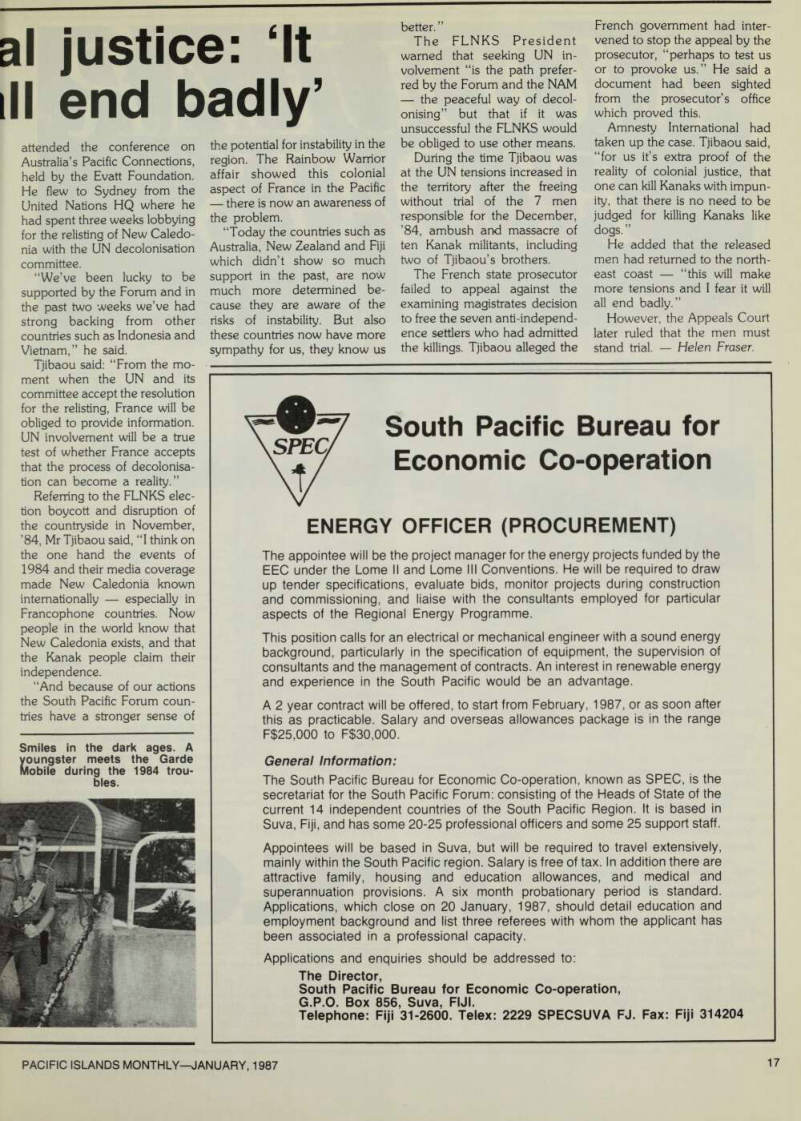
Smiles in the dark ages. A youngster meets the Garde Mobile during the 1984 trou bles.