Conch Shell blows
p. 11 · Read in the full issue
a loud note
In the Old Testament, the trumpets of Joshua brought the walls of Jertcho tumbling down. And in modem Tonga, a new trumpet is having a similar earth shaking effect.
This trumpet, a monthly news sheet called Kele’a (conch shell) has been a resounding success.
At its inception last July it was founded to explain the complexities of the sales tax legislation the print run was 2,000. By last month, 10,000 copies were printed and quickly snapped up by eager readers.
The secret of Kele’a’s success is simple old fashioned discl osure journalism. Indeed, its allegations have incurred the wrath of the nation’s police minister, Honourable Akau’ola.
In a report published by the Tonga Chronicle the minister was quoted as saying that the four-page mimeographed sheet was “doing nothing useful but trying to smear the image of the Legislative Assembly.”
He continued: “These people are against the govern ment and they have been edu cated overseas where a profes sor would have probably told them that it is bad for Tonga to remain a constitutional monar chy and that it should change.”
He urged individual MPs to sue the infant paper for no less than $lOO,OOO. He added that the actions of Kele’a are seen only in countries like some in Africa where there are constant riots and tyrannical dictator ships.
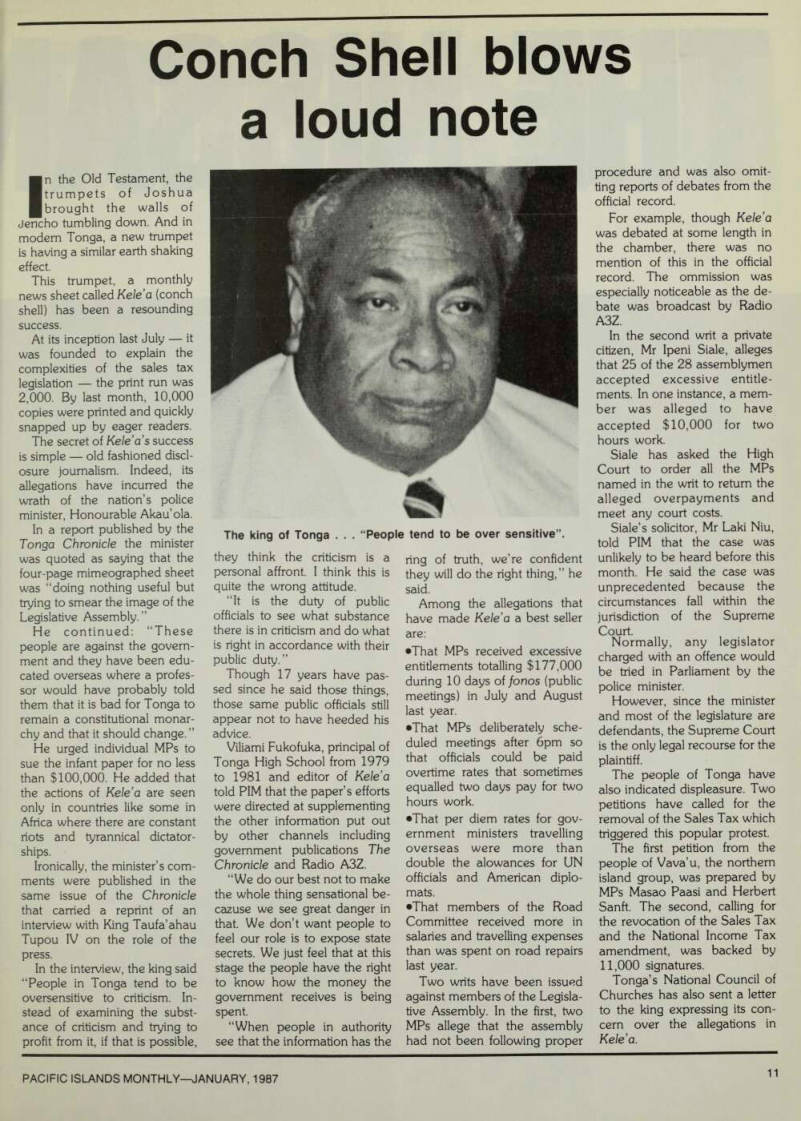
Ironically, the minister’s com ments were published in the same issue of the Chronicle that carried a reprint of an interview with King Taufa’ahau Tupou IV on the role of the press.
In the interview, the king said “People in Tonga tend to be oversensitive to criticism. In stead of examining the subst ance of criticism and trying to profit from it, if that is possible,
they think the criticism is a personal affront. I think this is quite the wrong attitude.
“It is the duty of public officials to see what substance there is in criticism and do what is right in accordance with their public duty.”
Though 17 years have pas sed since he said those things, those same public officials still appear not to have heeded his advice.
Viliami Fukofuka, principal of Tonga High School from 1979 to 1981 and editor of Kele’a told PIM that the paper’s efforts were directed at supplementing the other information put out by other channels including government publications The Chronicle and Radio A3Z.
“We do our best not to make the whole thing sensational be cazuse we see great danger in that. We don’t want people to feel our role is to expose state secrets. We just feel that at this stage the people have the right to know how the money the government receives is being spent.
“When people in authority see that the information has the
ring of truth, we’re confident they will do the right thing,” he said.
Among the allegations that have made Kele’a a best seller are: •That MPs received excessive entitlements totalling $177,000 during 10 days of fonos (public meetings) in July and August last year. •That MPs deliberately sche duled meetings after 6pm so that officials could be paid overtime rates that sometimes equalled two days pay for two hours work. •That per diem rates for gov ernment ministers travelling overseas were more than double the alowances for UN officials and American diplo mats. •That members of the Road Committee received more in salaries and travelling expenses than was spent on road repairs last year.
Two writs have been issued against members of the Legisla tive Assembly. In the first, two MPs allege that the assembly had not been following proper
procedure and was also omit ting reports of debates from the official record.
For example, though Kele’a was debated at some length in the chamber, there was no mention of this in the official record. The ommission was especially noticeable as the de bate was broadcast by Radio A3Z.
In the second writ a private citizen, Mr Ipeni Siale, alleges that 25 of the 28 assemblymen accepted excessive entitle ments. In one instance, a mem ber was alleged to have accepted $lO,OOO for two hours work.
Siale has asked the High Court to order all the MPs named in the writ to return the alleged overpayments and meet any court costs.
Siale’s solicitor, Mr Laki Niu, told PIM that the case was unlikely to be heard before this month. He said the case was unprecedented because the circumstances fall within the jurisdiction of the Supreme Court.
Normally, any legislator charged with an offence would be tried in Parliament by the police minister.
However, since the minister and most of the legislature are defendants, the Supreme Court is the only legal recourse for the plaintiff.
The people of Tonga have also indicated displeasure. Two petitions have called for the removal of the Sales Tax which triggered this popular protest.
The first petition from the people of Vava’u, the northern island group, was prepared by MPs Masao Paasi and Herbert Sanft. The second, calling for the revocation of the Sales Tax and the National Income Tax amendment, was backed by 11,000 signatures.
Tonga’s National Council of Churches has also sent a letter to the king expressing its con cern over the allegations in Kele’a.
The king of Tonga . . . “People tend to be over sensitive”.