bank secrecy
p. 34 · Read in the full issue
Kalsakau vows to preserve bank secrecy
Faced with plummeting prices for its main exports beef, copra and coffee Vanuatu has devalued its currency for the second time in a year.
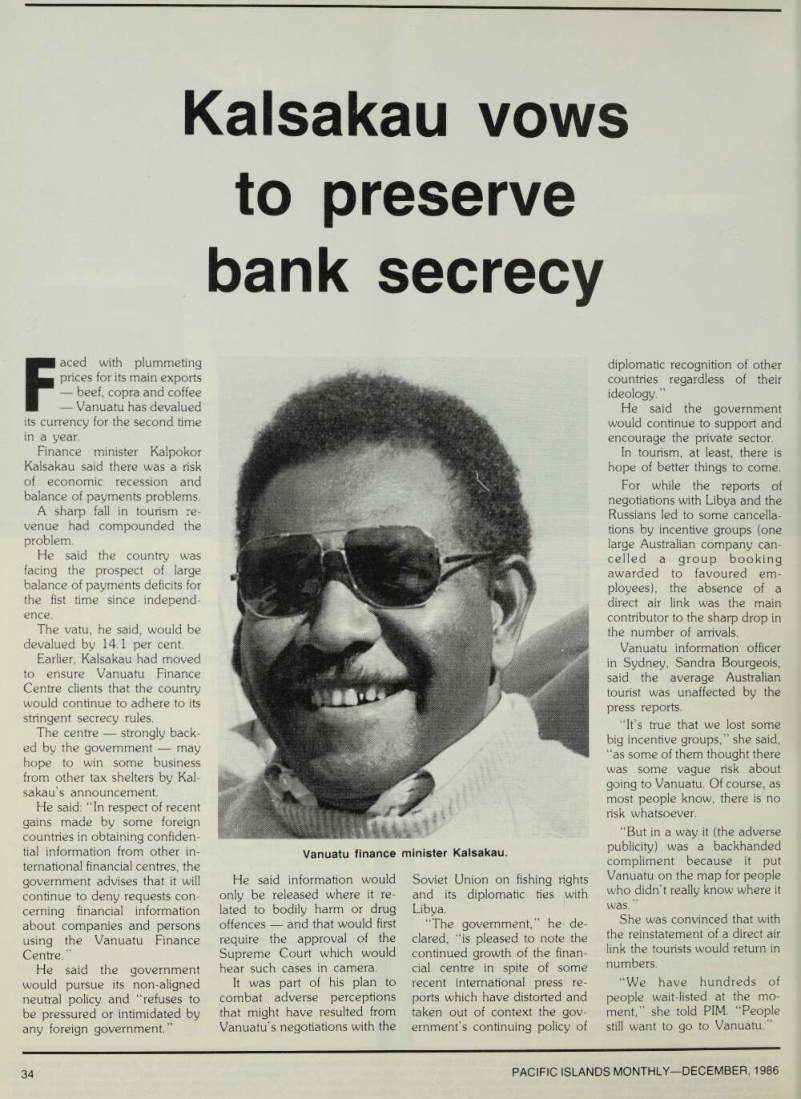
Finance minister Kalpokor Kalsakau said there was a risk of economic recession and balance of payments problems.
A sharp fall in tourism re venue had compounded the problem.
He said the country was facing the prospect of large balance of payments deficits for the fist time since independ ence.
The vatu, he said, would be devalued by 14.1 per cent.
Earlier, Kalsakau had moved to ensure Vanuatu Finance Centre clients that the country would continue to adhere to its stringent secrecy rules.
The centre strongly back ed by the government may hope to win some business from other tax shelters by Kal sakau’s announcement.
He said: “In respect of recent gains made by some foreign countries in obtaining confiden tial information from other in ternational financial centres, the government advises that it will continue to deny requests con cerning financial information about companies and persons using the Vanuatu Finance Centre.”
He said the government would pursue its non-aligned neutral policy and “refuses to be pressured or intimidated by any foreign government.”
He said information would only be released where it re lated to bodily harm or drug offences and that would first require the approval of the Supreme Court which would hear such cases in camera.
It was part of his plan to combat adverse perceptions that might have resulted from Vanuatu’s negotiations with the
Soviet Union on fishing rights and its diplomatic ties with Libya.
“The government,” he de clared, “is pleased to note the continued growth of the finan cial centre in spite of some recent international press re ports which have distorted and taken out of context the gov ernment’s continuing policy of
diplomatic recognition of other countries regardless of their ideology.”
He said the government would continue to support and encourage the private sector.
In tourism, at least, there is hope of better things to come.
For while the reports of negotiations with Libya and the Russians led to some cancella tions by incentive groups (one large Australian company can celled a group booking awarded to favoured em ployees), the absence of a direct air link was the main contributor to the sharp drop in the number of arrivals.
Vanuatu information officer in Sydney, Sandra Bourgeois, said the average Australian tourist was unaffected by the press reports.
“It’s true that we lost some big incentive groups,” she said, “as some of them thought there was some vague risk about going to Vanuatu. Of course, as most people know, there is no risk whatsoever.
“But in a way it (the adverse publicity) was a backhanded compliment because it put Vanuatu on the map for people who didn’t really know where it was. ”
She was convinced that with the reinstatement of a direct air link the tourists would return in numbers.
“We have hundreds of people wait-listed at the mo ment,” she told PIM. “People still want to go to Vanuatu.”
Vanuatu finance minister Kalsakau.