Qionibaravi takes his
p. 32 · Read in the full issue
foot off the brake
Fiji has taken the lid off the wages pot with a budget that, according to finance minister Mr Mosese Qionibaravi, is designed to “generate economic expansion and employment for our people. ”
The minister, whose govern ment must face an election next year, announced tax relief for the lower paid while also in creasing duties on a wide range of imported consumer items including petrol, beer and spir its, tobacco products, televi sions and some foodstuffs.
He also slashed the reserve bank’s minimum lending rate by 2 per cent.
The minister said the “diffi cult and painful” freezes on wages, dividends, rents and service charges brought in two years to help restore the eco nomy had minimised inflation, stabilised the balance of pay ments and brought in high levels of foreign reserves.
This year, increases were limited to 2.25 per cent, based on a formula taking into account real income growth, trade movements and cost of living changes.
The same formula in 1987 will allow a wages guideline of about six per cent, Qionibaravi said.
He stressed, however, that there could be no “catch up” pay increases and in a thinly veiled warning to the country’s trade unions, he added: “Let us not squander, through exces sive demands, what we have achieved. ”
The freeze on company di vidends will be lifted on payouts arising from profits made after January 1 and the rents “thaw” will apply from the same date but will be subject to policing under counter-inflation legisla tion.
Meanwhile the 1984 price controls on certain basic food items will be lifted apart from “a limited number of imported essential” articles.
He also announced a pack age of tax cuts and investment incentives worth about A 56.85 million. These include a 100 per cent tax exemption for farmers in designated areas and the raising of the tax threshold by 25 per cent to A 532,90.
This means that 13,000 Fi jians will be free of the tax burden next year.
To pay for the package, the government intends to raise money through the increased duty on imported luxury con sumer items as well as in creased charges for petrol and lubricating oils, tyres, soft drinks, chemical preparations, paper products, clothing and footwear.
The duty on petrol, pre viousy sold at a pegged 74 cents (Australian) a litre is up by five cents to 40 cents a litre.
However, the minister heeded pleas from the automo tive industry by reducing duty on cars by 10 to 25 per cent depending on engine rating.
To assist the nation’s major growth industries, Qionibaravi
increased the promotions grant to the Fiji Visitors’ Bureau by 34 per cent to A 52.2 million and announced further grants to the sugar and cocoa sectors.
Overall, he budgetted for a deficit of A 5101.4 million.
He summarised: GDP would be up 6.4 per cent; sugar production would be up by 480,000 tonnes (41 per cent); tourist arrivals up 260,000 (14 per cent); domestic exports up A 5222.2 million (18.5 per cent); imports down A 5427.4 million (4 per cent); balance of payments surplus of $26.9 mil lion compared with last year’s deficit of $9.3 million; foreign exchange reserves at a record $258 million; inflation at below two per cent compared with last year’s 4.4 per cent.
However, Fiji’s financial posi tion remained difficult, said Qionibaravi, for three reasons: shortfalls in revenue collection, weak private sector investment and low commodity prices.
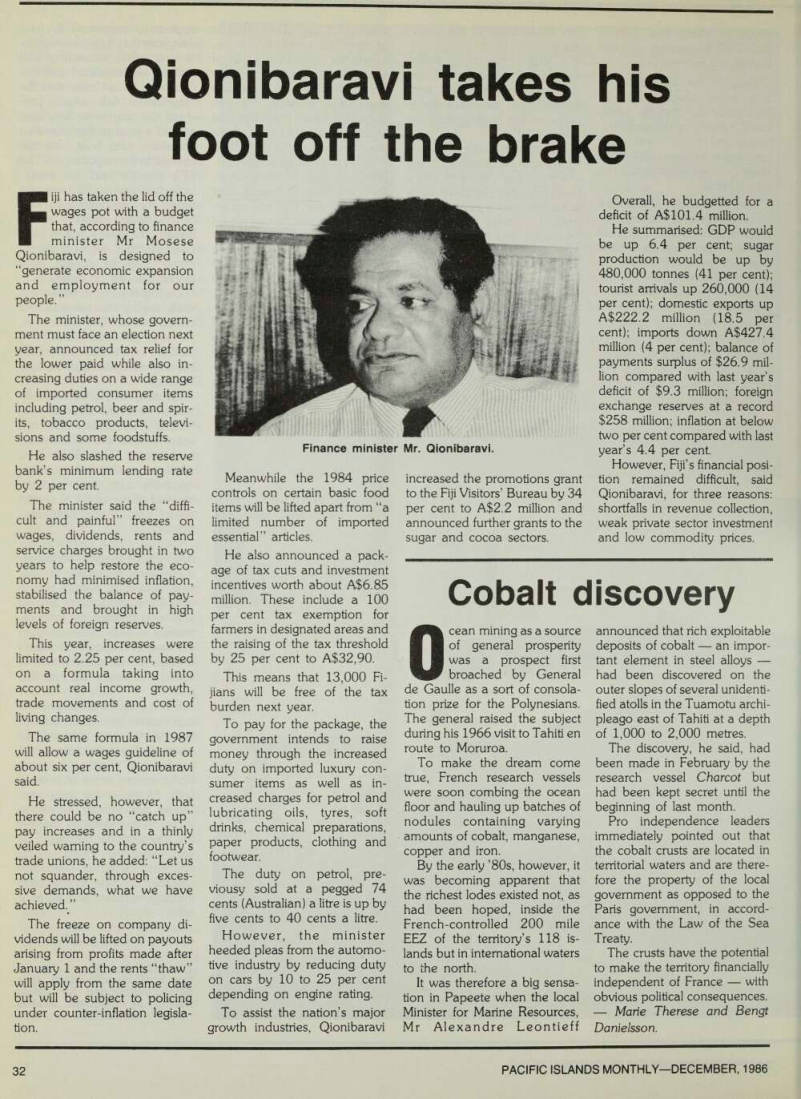
Finance minister Mr. Qionibaravi.