Two years later: A deal is
pp. 29-31 · Read in the full issue
trade winds
Two years later: A deal is made on the price of fish
After two years of wrangling, the United States and the Forum island countries have finally reached agreement on a tuna access deal. But, as MIKE LANE reports, the final negotiating session in Tonga was not all plain sailing.
Nuku’alofa, capital of Ton ga, means in English “Place of Love. ” After 25 months of protracted, some times acrimonious negotiations, it was fitting that the tuna dispute between the United States and member states of the Forum Fisheries Agency was settled in the friendly Islands.
Spokesmen from both sides expressed satisfaction with the five-year, $6O million settle ment that allows the US fleet
access to 20 million square kilometres of the richest tuna grounds in the world. Except for stipulated closed zones, the pact lets American boats fish from Palau in the west, east to
the Cook Islands, north to the Marshalls and south to New Zealand.
Though both sides were optimistic about reaching an accord in Nukualofa, the atmosphere
was tense and strained through out the formal week of negotia tions.
The American side even threatened to leave but Tua Taumoepeau, head of the Paci fic delegation and Permanent Secretary of Foreign Affairs in Tonga, kept the sides talking.
Until Counselor Ed Derwins ki presented the Americans’ final offer of $l2 million per year, the issue was still in doubt.
Even the next day, Ambassador
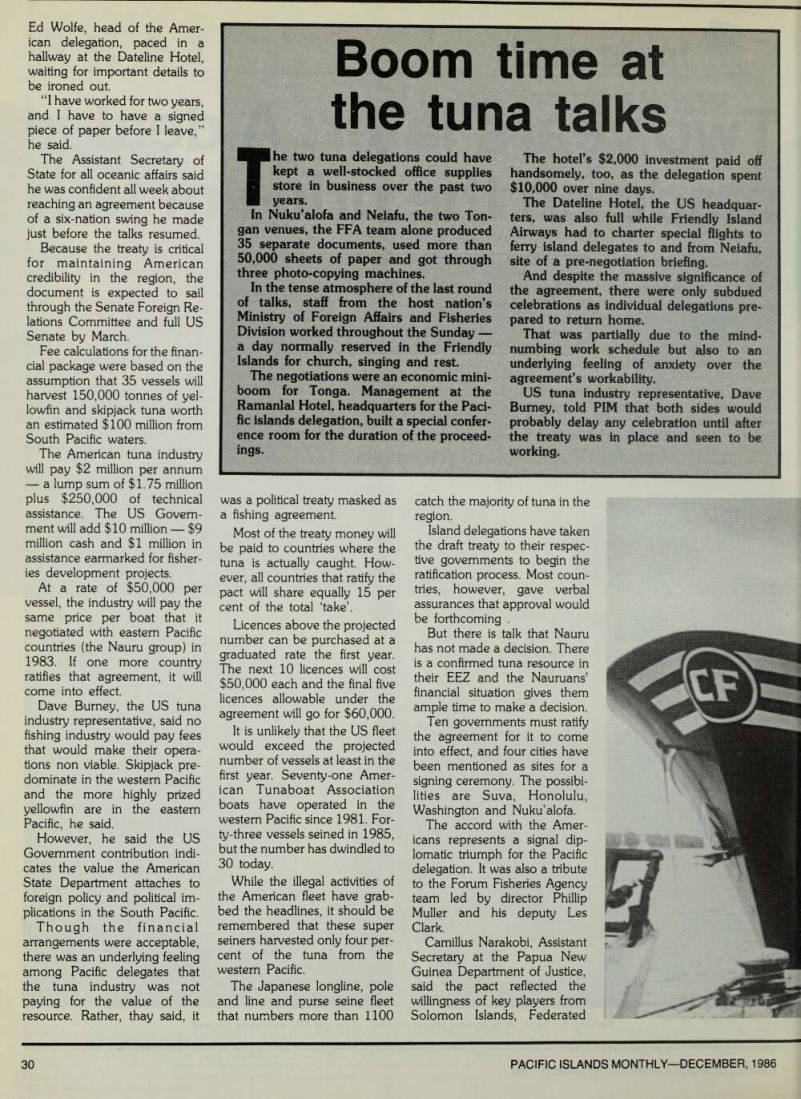
Fishing for tuna in Solomon Island waters. Now the US will have access.
Ed Wolfe, head of the Amer ican delegation, paced in a hallway at the Dateline Hotel, waiting for important details to be ironed out.
“I have worked for two years, and I have to have a signed piece of paper before I leave, ” he said.
The Assistant Secretary of State for all oceanic affairs said he was confident all week about reaching an agreement because of a six-nation swing he made just before the talks resumed.
Because the treaty is critical for maintaining American credibility in the region, the document is expected to sail through the Senate Foreign Re lations Committee and full US Senate by March.
Fee calculations for the finan cial package were based on the assumption that 35 vessels will harvest 150,000 tonnes of yel lowfin and skipjack tuna worth an estimated $lOO million from South Pacific waters.
The American tuna industry will pay $2 million per annum a lump sum of $1.75 million plus $250,000 of technical assistance. The US Govern ment will add $lO million $9 million cash and $1 million in assistance earmarked for fisher ies development projects.
At a rate of $50,000 per vessel, the industry will pay the same price per boat that it negotiated with eastern Pacific countries (the Nauru group) in 1983. If one more country ratifies that agreement, it will come into effect.
Dave Burney, the US tuna industry representative, said no fishing industry would pay fees that would make their opera tions non viable. Skipjack pre dominate in the western Pacific and the more highly prized yellowfin are in the eastern Pacific, he said.
However, he said the US Government contribution indi cates the value the American State Department attaches to foreign policy and political im plications in the South Pacific.
Though the financial arrangements were acceptable, there was an underlying feeling among Pacific delegates that the tuna industry was not paying for the value of the resource. Rather, thay said, it
was a political treaty masked as a fishing agreement.
Most of the treaty money will be paid to countries where the tuna is actually caught. How ever, all countries that ratify the pact will share equally 15 per cent of the total ‘take’.
Licences above the projected number can be purchased at a graduated rate the first year.
The next 10 licences will cost $50,000 each and the final five licences allowable under the agreement will go for $60,000.
It is unlikely that the US fleet would exceed the projected number of vessels at least in the first year. Seventy-one Amer ican Tunaboat Association boats have operated in the western Pacific since 1981. For ty-three vessels seined in 1985, but the number has dwindled to 30 today.
While the illegal activities of the American fleet have grab bed the headlines, it should be remembered that these super seiners harvested only four per cent of the tuna from the western Pacific.
The Japanese longline, pole and line and purse seine fleet that numbers more than 1100
catch the majority of tuna in the region.
Island delegations have taken the draft treaty to their respec tive governments to begin the ratification process. Most coun tries, however, gave verbal assurances that approval would be forthcoming .
But there is talk that Nauru has not made a decision. There is a confirmed tuna resource in their EEZ and the Nauruans’ financial situation gives them ample time to make a decision.
Ten governments must ratify the agreement for it to come into effect, and four cities have been mentioned as sites for a signing ceremony. The possibi lities are Suva, Honolulu, Washington and Nuku’alofa.
The accord with the Amer icans represents a signal dip lomatic triumph for the Pacific delegation. It was also a tribute to the Forum Fisheries Agency team led by director Phillip Muller and his deputy Les Clark.
Camillus Narakobi, Assistant Secretary at the Papua New Guinea Department of Justice, said the pact reflected the willingness of key players from Solomon Islands, Federated
States of Micronesia, Kiribati and PNG to sacrifice national interest for regional gain.
Early in the last round of talks, some delegates from is land states said that the Amer icans’ inability to recognise the importance of national sovereignty to even small island states delayed settlement of the tuna dispute.
The tremendous differences in interests and fishing re sources of the Forum Fisheries Agency members made the final agreement a tribute to island negotiators but the numbers necessitated com promise on nearly every issue.
Semisi Fakahau, principal fisheries officer of Tonga, repre sented a nation that has limited tuna resources. He said the annual cash share that Tonga will receive was the least impor
tant component of the agree ment.
“Tonga is committed to the concept of regional co-opera tion and we will benefit from the technical assistance provi sions of the agreement,” he said.
According to some of the key figures in the negotiations, there were no dramatic breakthroughs. Les Clark said it was a continuous process with a gradual coming together at Rarotonga and Nuku’alofa. “It took time for Washington to come to terms with the damage that a few tuna boats could do to a national image,” he said.
He said the agreement would help Pacific countries get a clearer idea of the size of their tuna resource.
The treaty, once ratified, puts the responsibility on the Amer ican government for ensuring
that the US fleet obeys the laws of other countries. It also re moves the threat of any type of economic retaliation if a Pacific state penalises an American ship for a violation. “It was understood from the outset that without this guarantee, there would be no treaty,” said Clark.
FFA countries have responsi bilities as well. In some cases, they will have to rewrite their laws to fit the regional agree ment. Muller said money wasn’t seriously discussed until the meeting at Kona, Hawaii when the Tongan delegate proposed the ante be raised to $2O million in Canberra.
Pacific delegates said private ly that if the starting point had not been $2O million, the annual treaty fee would have been much lower.
But after the Forum meeting in August, political leaders
apparently suggested to their delegates that they be receptive to any offers exceeding $lO million. Muller, elated with the deal, said it was ironic that the Magnusson Act, which pro vided for economic sanctions against a country that seized an American tuna boat, was the catalyst in the negotiations. The FFA director said the unpre cedented deal would serve as a basis for co-operation with other distant water fishing fleets. It leaves open the possibility that regional agree ments may be sought from Korea, Taiwan or Japan.
During the Tonga talks there were lengthy discussions about closed zones. The Solomons, for example, has closed 90 percent of its 200 mile FEZ because of a growing local tuna industry.
Geoffrey Siapu, Solomon Is lands Permanent Secretary for Natural Resources, said two super seiners will be launched next year. The Solomons, which earns a third of its foreign exchange from tuna exports, maintained its resolve to restrict distant water fishing fleet com petition.
Though the protracted negotiations snagged on issues, there were additional factors.
One sovereign nation talking with 16 is cumbersome at best and legal drafting by subcom mittees in both camps was an exercise in diligence. It wasn’t uncommon for a committee to spend five hours drafting five lines.
Burney said the early meet ings were the most difficult because the tuna industry had no credibility in the islands and needed two years to convince FFA member states of its good faith. However the agreement “is an opportunity for us to show once and for all that we are a responsible industry,” he said. And the Pacific island countries will be watching carefully to see if the tuna industry behaves as well as it talks.
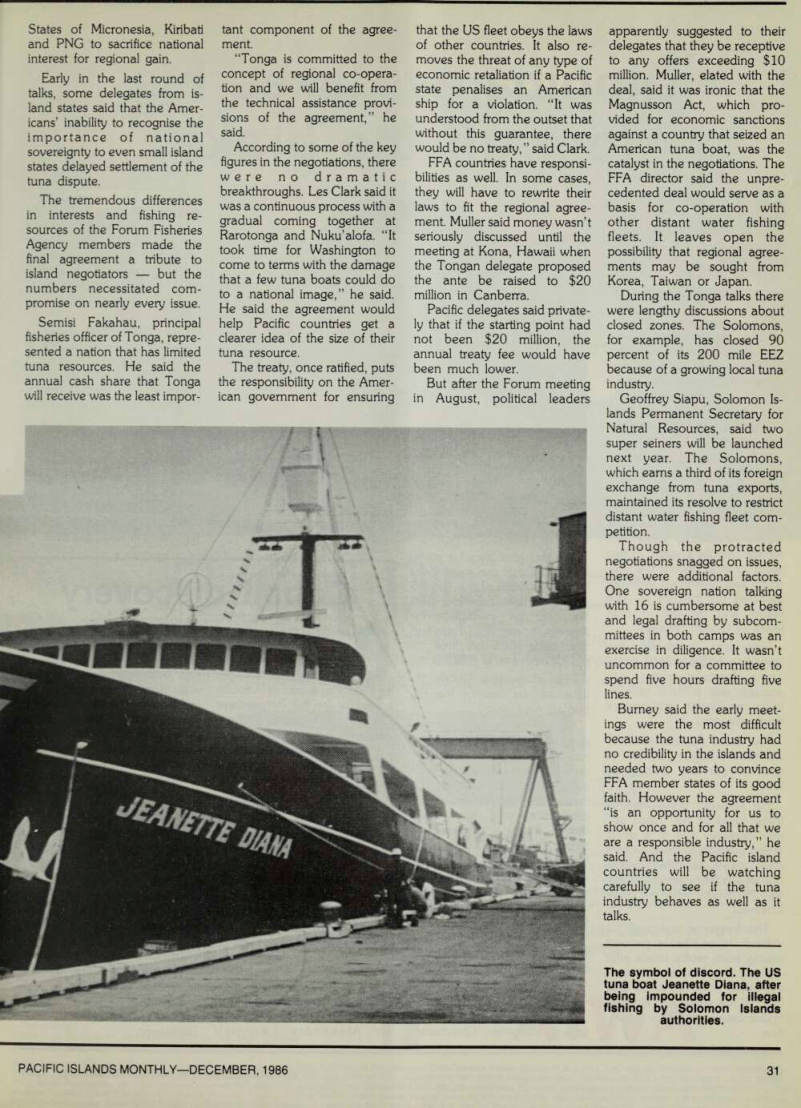
The symbol of discord. The US tuna boat Jeanette Diana, after being impounded for illegal fishing by Solomon Islands authorities.