not protest
pp. 12-13 · Read in the full issue
New moves at KMR
Make progress not protest
A STORMY protests at the Kwajalein Missile Range (KMR) earlier this year propelled the American-controlled military base into headlines around the world. The six month “camp in” protest by Kwajalein land owners on military held land was put down by the Marshall Islands government when it forcibly evicted the islanders with court approved action.
When infuriated landowners responded with a physical blockade of the Ebeye pier, preventing Marshallese KMR workers from getting to their jobs at the base three miles away, the Marshall Islands gov ernment declared an unpre cedented state of emergency.
Calm returned to Ebeye when President Amata Kabua met with landowner leaders, persuading them to give up the protests.
Months after the demonstra tions ended at Kwajalein and Ebeye in May, Kwajalein lead ers are now seeking progress not protest.
Kwajalein leaders have con tended for years that both the United States and their own government ignore the severe social and public health prob lems on crowded Ebeye island.
With 8000 people living on 78 acres (24 hectares) Ebeye has one of the highest population densities in the Pacific.
Of that population, more than 5000 are Kwajalein land owners who cannot use two thirds of their atoll, the largest in the world, and lagoon which is a target for the MX and other US missiles launched from Cali fornia. Many other Marshall Islanders have moved to Ebeye looking for jobs at the missile range.
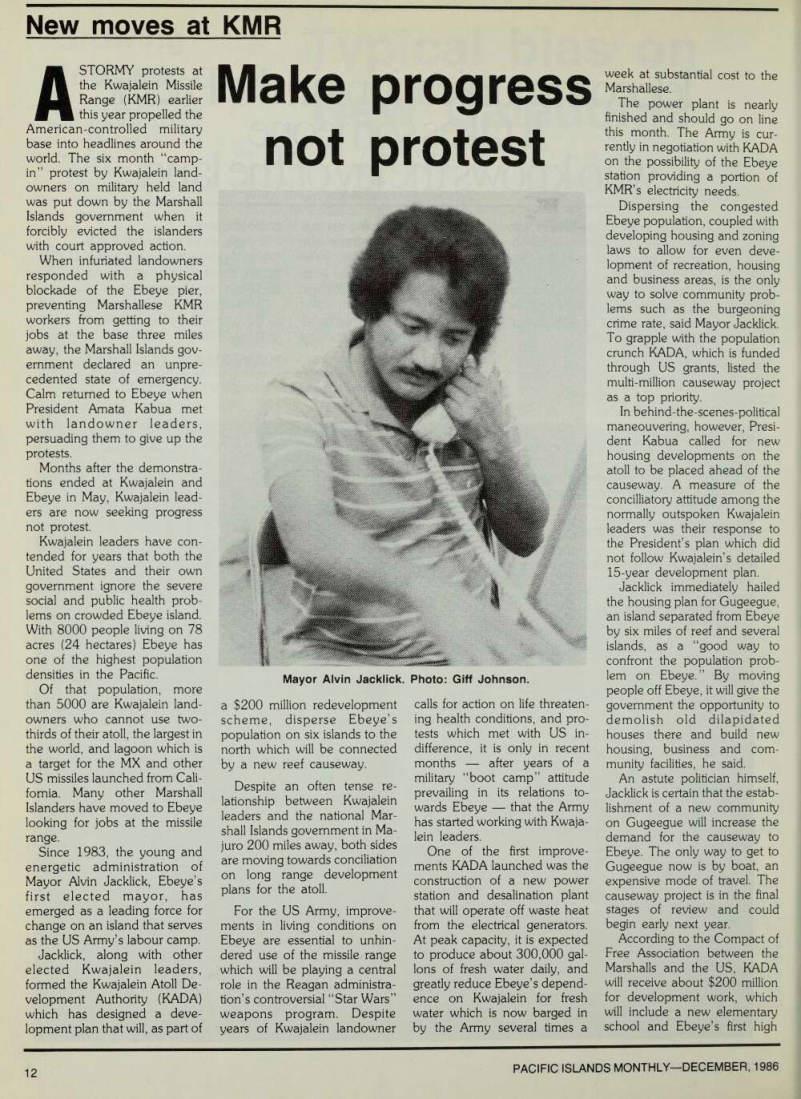
Since 1983, the young and energetic administration of Mayor Alvin Jacklick, Ebeye’s first elected mayor, has emerged as a leading force for change on an island that serves as the US Army’s labour camp.
Jacklick, along with other elected Kwajalein leaders, formed the Kwajalein Atoll De velopment Authority (KADA) which has designed a deve lopment plan that will, as part of
a $2OO million redevelopment scheme, disperse Ebeye’s population on six islands to the north which will be connected by a new reef causeway.
Despite an often tense re lationship between Kwajalein leaders and the national Mar shall Islands government in Ma juro 200 miles away, both sides are moving towards conciliation on long range development plans for the atoll.
For the US Army, improve ments in living conditions on Ebeye are essential to unhin dered use of the missile range which will be playing a central role in the Reagan administra tion’s controversial “Star Wars” weapons program. Despite years of Kwajalein landowner
calls for action on life threaten ing health conditions, and pro tests which met with US in difference, it is only in recent months after years of a military “boot camp” attitude prevailing in its relations to wards Ebeye that the Army has started working with Kwaja lein leaders.
One of the first improve ments KADA launched was the construction of a new power station and desalination plant that will operate off waste heat from the electrical generators.
At peak capacity, it is expected to produce about 300,000 gal lons of fresh water daily, and greatly reduce Ebeye’s depend ence on Kwajalein for fresh water which is now barged in by the Army several times a
week at substantial cost to the Marshallese.
The power plant is nearly finished and should go on line this month. The Army is cur rently in negotiation with KADA on the possibility of the Ebeye station providing a portion of KMR’s electricity needs.
Dispersing the congested Ebeye population, coupled with developing housing and zoning laws to allow for even deve lopment of recreation, housing and business areas, is the only way to solve community prob lems such as the burgeoning crime rate, said Mayor Jacklick.
To grapple with the population crunch KADA, which is funded through US grants, listed the multi-million causeway project as a top priority.
In behind-the-scenes-political maneouvering, however, Presi dent Kabua called for new housing developments on the atoll to be placed ahead of the causeway. A measure of the concilliatory attitude among the normally outspoken Kwajalein leaders was their response to the President’s plan which did not follow Kwajalein’s detailed 15-year development plan.
Jacklick immediately hailed the housing plan for Gugeegue, an island separated from Ebeye by six miles of reef and several islands, as a “good way to confront the population prob lem on Ebeye.” By moving people off Ebeye, it will give the government the opportunity to demolish old dilapidated houses there and build new housing, business and com munity facilities, he said.
An astute politician himself, Jacklick is certain that the estab lishment of a new community on Gugeegue will increase the demand for the causeway to Ebeye. The only way to get to Gugeegue now is by boat, an expensive mode of travel. The causeway project is in the final stages of review and could begin early next year.
According to the Compact of Free Association between the Marshalls and the US, KADA will receive about $2OO million for development work, which will include a new elementary school and Ebeye’s first high
Mayor Alvin Jacklick. Photo: Gift Johnson.
school, sports fields now singularly lacking on Ebeye and community centres, town house clusters for the displaced Kwajalein landowners, and a variety of sanitation improve ments.
While trying to get its 15 year plan underway, KADA also has to fight fires on Ebeye resulting from years of neglect. Sanita tion conditions are woeful, and in mid-September KADA voted $50,000 in emergency funds to immediately construct several blocks of flush toilets for fami lies who use the Ebeye beaches to discharge human waste.
Ebeye’s life line to the out side world is its dock. To stave off the imminent collapse of the Ebeye pier resulting from poor construction and battering by container vessels, KADA is set to begin emergency repairs.
Although frequent disputes over the way the Marshall Is lands government distributes US compensation payments to the Kwajalein landowners could stir future protests, most Kwaja lein leaders are now focusing on giving their atoll a facelift.
But making Ebeye, labelled a “biological time bomb” by the UN during the 19705, and adjacent islands habitable is no small task.
If the US delivers promised financial aid and if the Army command at Kwajalein shows new initiative to aid Ebeye, conditions on Kwajalein afford the US the best chance it has had for achieving stability in what have traditionally been turbulent relations with the Marshallese.
Changing the face of Ebeye won’t solve inherent and visible inequities between Kwajalein’s country-club like atmosphere and high standard of living where the 3000 American technicians live and Ebeye three miles away.
But, observes Jacklick, the proposed developments will do much to alleviate the worst of the rampant disease, high suicide and youth crime rates, and life threatening public health conditions prevalent on Ebeye today.
The development of Kwaja lein Atoll “will give the kids better opportunities for the fu
ture,” said Jacklick.
Giff
Johnson.