Historic houses could
letters
Historic houses could be tourist attraction
Recently, Nahau Rooney, PNG’s minister for tourism, foreshadowed a new program for the industry which she de scribed as a future economic asset of importance.
One of the best attractions any country can offer visitors is the material legacy of its history embodied in historic monu ments. And, in PNG, Milne Bay and China Strait offer several historic buildings of potentially great tourist value.
Their survival however, is now in jeopardy. Overlooking the sea lanes used by cruise ships, these dilapidated buil dings are regularly visited by parties of tourists.
Two of these structures (erected in 1895 and c 1905) may fairly claim to be the earliest surviving buildings on that coast and may well be the oldest complete buildings still standing in PNG.
While many Pacific scholars will be aware of the origins of these buildings, others may be interested to know more.
The first is the resident magis trate’s house at Samarai. Now defaced by smoke and grime, its exact date of construction is unclear, but is probably pre -1914. It may have been partly rebuilt in 1942 when the town was partly demolished.
It appears to need only a coat of paint being structurally sound and could become a focal point for the tourist trade.
The second is St Paul’s Angli can Church at Samarai built in 1914 and the only builiding to survive the war unscathed. The steep-pitched roof is leaking badly leading to general decay inside.
A third at Fife Bay (Isuleilei) was built by the Rev C. F. Rich of the LMS after 1902 and is in excellent structural condition.
With a superb harbour view and being within easy reach of Alotau when the new road is built, this could again be a great tourist attraction. Generations of the Suau people were edu cated there over the past 80 years.
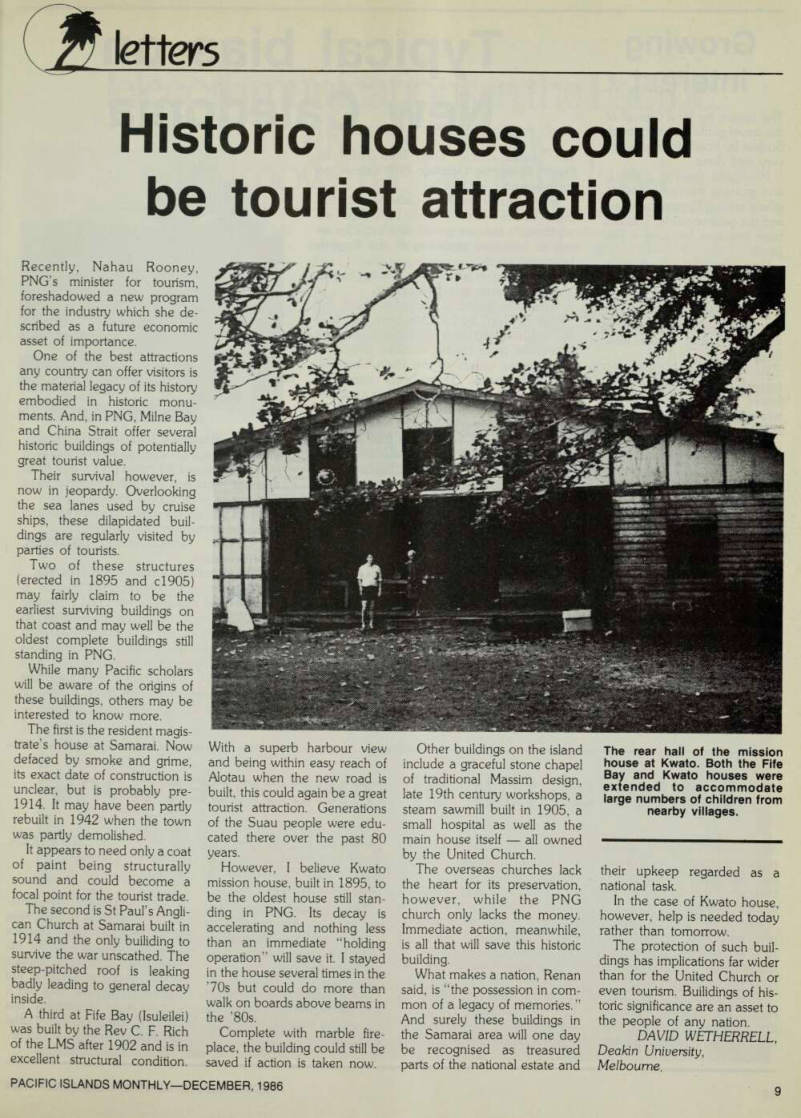
However, I believe Kwato mission house, built in 1895, to be the oldest house still stan ding in PNG. Its decay is accelerating and nothing less than an immediate “holding operation” will save it. I stayed in the house several times in the 70s but could do more than walk on boards above beams in the ’Bos.
Complete with marble fire place, the building could still be saved if action is taken now.
Other buildings on the island include a graceful stone chapel of traditional Massim design, late 19th century workshops, a steam sawmill built in 1905, a small hospital as well as the main house itself all owned by the United Church.
The overseas churches lack the heart for its preservation, however, while the PNG church only lacks the money.
Immediate action, meanwhile, is all that will save this historic building.
What makes a nation, Renan said, is “the possession in com mon of a legacy of memories.”
And surely these buildings in the Samarai area will one day be recognised as treasured parts of the national estate and
their upkeep regarded as a national task.
In the case of Kwato house, however, help is needed today rather than tomorrow.
The protection of such buil dings has implications far wider than for the United Church or even tourism. Builidings of his toric significance are an asset to the people of any nation.
David Wetherrell,
Deakin University, Melbourne.
The rear hall of the mission house at Kwato. Both the Fife Bay and Kwato houses were extended to accommodate large numbers of children from nearby villages.