old explorers
p. 56 · Read in the full issue
In search of the old explorers
Because they guard the two entrances to the South Pacific, Cape Horn and Tasmania fi gure prominently in the history of exploration of the region.
Another thing these islands for as everybody knows today, the Horn is not a cape have in common is that they were discovered by Dutch sea captains who hailed from the small town of Horn, or Hoom, to use the local spelling.
Quite naturally therefore, when we recently toured Hol land during our European holi day, we decided to make a detour to the birthplace of these intrepid navigators, Willem Schouten and Abel Tasman.
From Amsterdam we travelled north to Ysselmeer, the inner portion of what was originally called the Zuyder Zee, until it was sealed off by the 30 kilometre Barrier Dam, com pleted in 1932.
Although Ysselmeer has gra dually become a freshwater lake, Hoom is still an important port, where hundreds of fishing vessels and private yachts are tied up at neat stone jetties along the curved shoreline. In cidentally, it is the crescent or hom-shaped form of the bay that has given the town its name.
Like most other Dutch towns, Hoom has a nucleus of narrow gabled stone houses dating from the 17th and 18th centur ies, cut through by canals with
stagnant brown wter, and is surrounded by a ring of modem apartment houses and factories.
The central Red Stone Square, around which the town grew up, is mentioned in ancient chronicles during the 13th century as an important market place, where the peasants from the surrounding countryside sold their butter, cheese, meat and other farm products.
For taxation purposes, these had to pass through a toll and weigh house. The one which has survived to the present time was erected in 1609 and has today on its ground floor a slightly misnamed coffee house, as most customers seem to prefer beer or chocolate.
Quite surprisingly, however, nowhere in the fine West Frie sian Museum is there a single picture, map or document tell ing the visitor about the interna tionally most famous native sons.
These are, of course, Willem Schouten, who on January 29, 1616 rounded the cape (actual ly only a small rocky island) which he named after his home town, and Abel Tasman, who in 1642 discovered New Zealand and the Australian island state which he named van Diemen’s land after the Batavia governor who sent him out on his momentous voyage of explora tion.
Nor did the townspeople to whom we spoke know anything
about Schouten and Tasman, sometimes not even their names.
At the centrally located tour ist office, where we continued our enquiries, we were given half a dozen slick brochures and glossy folders, which contained such basic facts that the town has a population of 52,000 whose main occupations are fishing and the manufacturing of gold and silver jewellery, cigars, sweets, biscuits, textiles, shoes, foam rubber, boxes, me tal springs and plastic rowing boats.
Much is also made of the historic buildings, with the perti nent advice: “Do not forget to take a look in a little quiet courtyard, or take some pic tures of the quaint little alleys with their romantic gates. Feel free to visit one of the numer ous antique stores. You might enjoy just looking round an outdoor terrace or indulge yourself in one of the many pubs, small restaurants (mostly run by self-exiled Indonesians).
Visit also the workshop of a calligrapher situated in the 15th century Gunpowdertower, or see how coffee is roasted in a century old factory.”
Once more, the only subject never mentioned is how Cape Horn got its name or how Abel Tasman grew up here and became a first rate sailor.
The charming lady in charge of the tourist office listened with great patience but obvious dis
belief to our attempts to make her realise that Willem Schouten and Abel Tasman had more publicity value to Horn than the tulip fields, cheese markets and Rembrandt and van Gogh pictures figuring in the brochures put out by the other and bigger cities of Hol land.
But in the end she became slightly infected with our enthu siasm and admitted that it would probably be a good thing to recall the exploits of Schouten and Tasman by put ting up some plaque or monu ment in the Aquatic Sport Centre which annually attracts thousands of yachtsmen, water skiers and windsurfers from all over Holland.
Unfortunately, our Aquatic Centre may soon be located high up on dry land, she added.
The government keeps telling us that we need more land for our growing population and has recently presented a scheme for filling in Ysselmeer, we are told.
In other words, if this scheme is realised, not only will the people of Hoom continue to neglect their great sons, but the bay that gave the town its name and fame will also disappear forever. Marie-Therese and Bengt Danielsson.
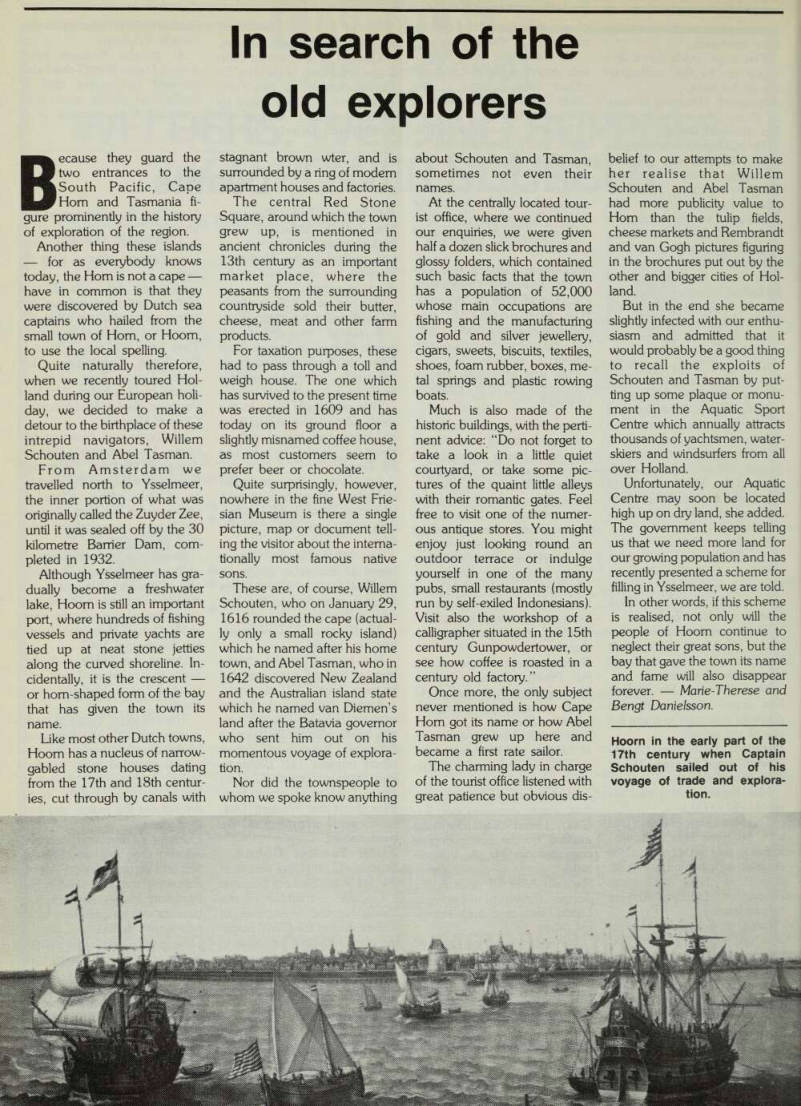
Hoorn in the early part of the 17th century when Captain Schouten sailed out of his voyage of trade and explora tion.