that is walking softly but
pp. 50-51 · Read in the full issue
carrying a big stick.
When war looms, it entails threatening maximum retalia tion, and for “maximum” read “nuclear”, as “conventional and nuclear deterrence are not separable in U.S. forces” (said James Kelly, Deputy Asst. Sec. of Defence for East Asia and Pacific Affairs last year).
Further, the use of nuclear arms is now a conceivable
strategy. For the Reagan ad ministration and the Pentagon believe that a nuclear war can produce a victor, not just a global holocaust and a “nuclear winter” from which no one on earth would be safe. Few scien tists, including American ones, agree with them.
It should not be thought, as their opponents may allege that the authors are simply, left-wing and anti-American. For a start,
they live in the USA (although Hayes is Australian and Bello a Filipino) and clearly appreciate its advantages: “We could not have written this book without the uniquely democratic U.S.
Freedom of Information Act, which allowed us to pry loose many important documents.
Even after security deletions, these documents provided cru cial insights into American nuc lear war planning in the Pacific”.
They go on to criticise the Soviet Union for hampering “this effort at public education and official accountability by denying access to information on its nuclear and military mat ters”, adding that the informa tion access policies of U.S. allies in the Pacific are 4 not much better, “with controls ranging from anti-democratic to totalita rian”.
The wealth of official U.S. information results in the use of many valuable diagrams and charts. Pentagon photographs also punctuate the text to good effect. Conversely, one regrets the paucity of information from the USSR whose activities rate only two out of twenty chap ters.
However this highlights how Russia’s military capabilities are rated poorly by both the au thors and most U.S. analysts.
Not the least problem is that the “Soviet military machine in the Pacific is homebound and vulnerable”.
This holds true despite the oft-mentioned facilities in Viet nam which, says a U.S. military officer, would soon be lost in the case of a protracted war.
Noting that the USSR relies for its defence on a “huge, home based nuclear arsenal”, a chap ter called “The Soviet Threat’” observes that Russia is “vastly inferior to the U.S. in every dimension”. No doubt the lan guage that blue-blooded Amer icans want to hear, but not a thing to admit if you’re a defence lobbyst on Capitol Hill.
Fishing deals with Kiribati notwithstanding, the book argues convincingly that Soviet intentions in the region do not justify the U.S.’s assigning of 320,000 troops to the Com mander-in-Chief Pacific (CINC PAC), based in Hawaii, not to mention the deployment of a host of naval and aircraft equipped with nuclear weapons whose presence, neither con firmed nor denied by the U.S., alienates should be allies like Vanuatu and New Zealand, the latter now expelled from the ANZUS alliance (these days referred to by wits as A**US).
The perpetrators of such angst, in the authors’ view, are not David Lange or govern ments which undertake com mercial dealings with the USSR. They are the “New Militarists” who “swept into Washington DC in 1981 on the coat tails of Ronald Reagan’s presidential election. Seeking nuclear superiority, they have chilled relations with the Soviet Union and upgraded the role of nuclear weapons in American military strategy”.
One fascinating aspect of the book is the unveiling of the inter-service rivalries in the U.S. which have resulted in the Navy’s present dominance,
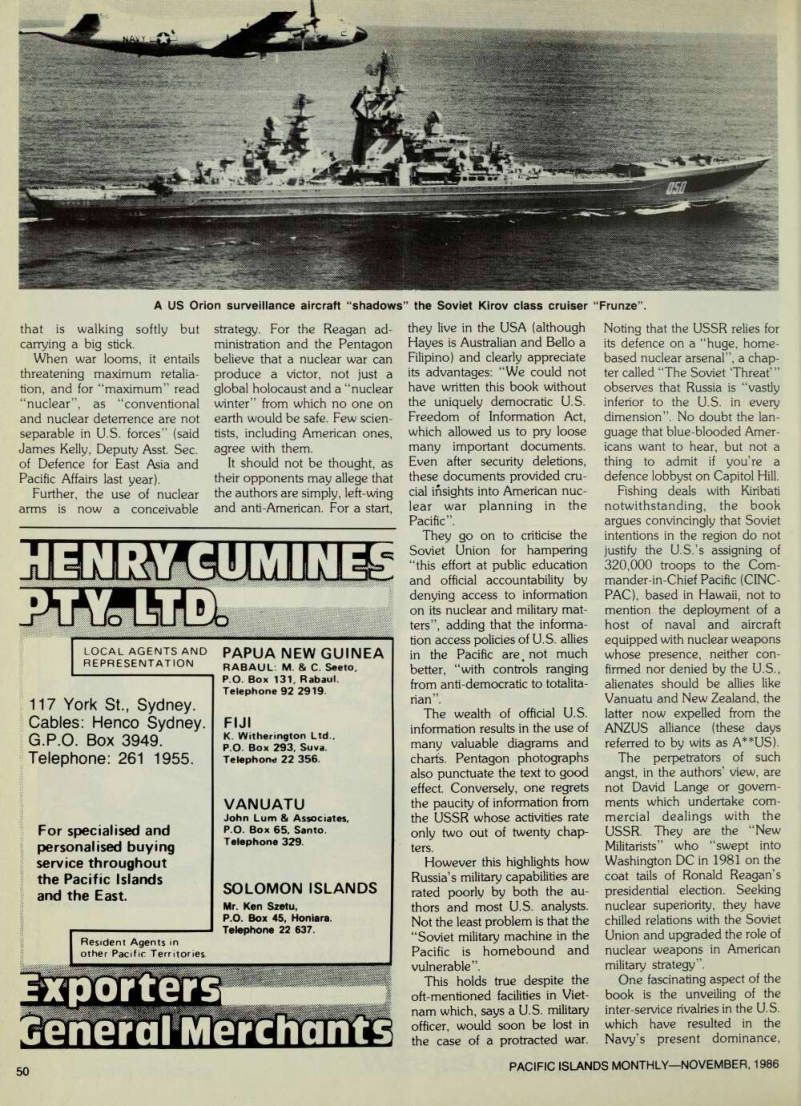
A US Orion surveillance aircraft “shadows” the Soviet Kirov class cruiser “Frunze”
especially in the Pacific where CINCPAC is now traditionally a naval appointment.
In the Navy’s view, it is said, “control of the seas especial ly the Pacific and the Indian oceans is the key to match ing Soviet land-based power on the great Eurasian continent.
Seapower and the quest for global maritime supremacy have become the keynote of the Reagan military build-up”.
By 1984, Navy Secretary Lehman had defeated his Army and Air Force opposition and could boast that: “If challenged, we (the Navy) will be capable of sending any opponent to the bottom”. Again, there is no distinction between nuclear and conventional weaponry. As then senior State Department official Paul Wolfowitz said last year, “We have only one Navy, not one conventionally capable Navy and one nuclear capable Navy”.
Well documented are the post WW2 stages which saw the U.S. first concentrating on nuc lear weapons in which it had a pioneering superiority through a “conventional” phase (the Vietnam war) and
back to nuclear reliance again.
This coincided with moving from the philosophy of “con taining” communism to the pre sent notion of trying to “roll it back”. The 1940 s was the last time that rollback was in vogue.
Now it is having a “militant revival”.
Today’s U.S. planners have stopped licking their wounds from Vietnam and have taken the offensive to show that the world’s strongest power cannot be fooled with. What clearly worries the authors is that attempts to play real life Rambo may one day include a nuclear component, intentional or not, which could trigger the feared WW3.
Much of the book’s detail focusses on the terrifying weaponry in nuclear arsenals and the strategy which might determine their use.
The text is not hard for the lay reader to follow. Indeed, as noted, “this book is in large part a translation of military jargon into plain English”. But for my money, the most interesting parts are where humanity out shines technology, as in the chapter describing the unequal
struggle of the Marshall island ers to resist the nuclearisation of their territory (Kwajalein missile testing range is said to have contributed more to the arms race than any other place on earth).
Do we feel our region has contributed to freedom and democracy when we learn that the Pacific has served as Amer ica’s major site for testing and modernising nuclear weapons systems (until the Atmospheric Test Ban Treaty in 1963) and delivery systems (still in prog ress) since the dawn of the atomic age?
A harder question; What should be done to arrest the present trend? The authors’ view is to spread the “Kiwi Disease” denying port ac cess to nuclear warships as widely as possible, the theory being that “the superpowers are likely to find mutual Pacific disarmament in their interest only when pressed by a regio nal concert of allies and non aligned Pacific states”.
Although there are few pre cedents when it comes to nuc lear conflict “the bomb” has only been dropped twice in
history they cite the restrain ing influence of America’s allies in 1958 when the U.S. came close to using it against China (over the Taiwan straits issue).
They suggest that a real Nuclear Free Zone Treaty, one banning the passage of weapons and the conducting of nuclear related activities, should be adopted.
In this regard, David Lange’s policy on port visits could be adopted, while Australia may reconsider hosting the three U.S. communications bases.
Clearly, however, they have less faith in governments than in the supporters of the nuclear free Pacific movement, regional churches, trade unionists and social democratic political par ties.
Least faith of all is placed in those who control the 50,000 nuclear warheads stationed worldwide. And not only their intentions but their compe tence: “If the world topples over the nuclear brink, it will be because of poor decisions, ter rifying weapons deployed in aggressive fashion, organisa tions running amok, a mis
understanding.
Robin
Osborne.