Court decision
pp. 25-26 · Read in the full issue
sets course for conflict
The French government of Jacques Chirac and New Caledonia’s inde pendence movement, the FLNKS, appear to be on a collision course.
Two vital decisions by the French judicial system have managed to stir the passions of the pro- and anti-independen tists to fever pitch. These de cisions resulted in the release from jail of seven men charged following the deaths of 10 FLNKS militants at Hienghene on December 5, 1984 and in the refusal to recognise a land rights claim which the previous socialist administration in Paris had acknowleged as legitimate.
In the first emotion-charged incident, the examining magis trate investigating the Hien ghene affair found that the eight people charged (including a minor who was not imprisoned) had acted in self defence and should therefore not go to trial.
In the shooting, another four Kanaks were injured while three escaped unharmed. The FLNKS has since maintained that the killings were the result of a deadly premeditated ambush. And certainly the physical evidence appeared to back this claim.
A tree had been felled across the road blocking the two trucks containing the seventeen kanaks. More than 200 bullets as well as buckshot were fired by the attackers who used spotlights and torches to light the scene.
The only evidence of arms
among the kanaks was a gun jammed behind the back seat of one of the trucks. It had not been fired though it was badly burned when the trucks were set ablaze.
Several of the bodies were found dumped in the river some distance from the road where the attack took place.
Some of the victims had been shot up to 30 times, a few at point blank range.
Apart from the autopsy re port, photographs and bullet casings, there is also the testi mony of the seven survivors.
The New Caledonian chapter of the International League of
Human Rights quickly pointed out, though, that none of this testimony was included in the magistrate’s 150-page report.
The league, at a press confer ence after the judgement, not only made public the horrific testimony but also named at least nine others as being in volved. The league accused the magistrate of bias and of caus ing a miscarriage of justice. “He presented only part of the evi dence, and then with partial ity,” said spokesman Jean-Pier re Deteix. “For instance, not only has he completely ignored the evidence of the survivors, but throughout his report he
constantly refers to these vic tims as terrorists and aggres sors.
“He refused to have a recon struction of the crime despite requests from the victims’ lawyers. He took only the evi dence of Lapetite, one of those charged, regarding the nature of the meeting at Hienghene from which the victims were returning home.”
This point is particularly im portant as some of those charged claimed that the meet
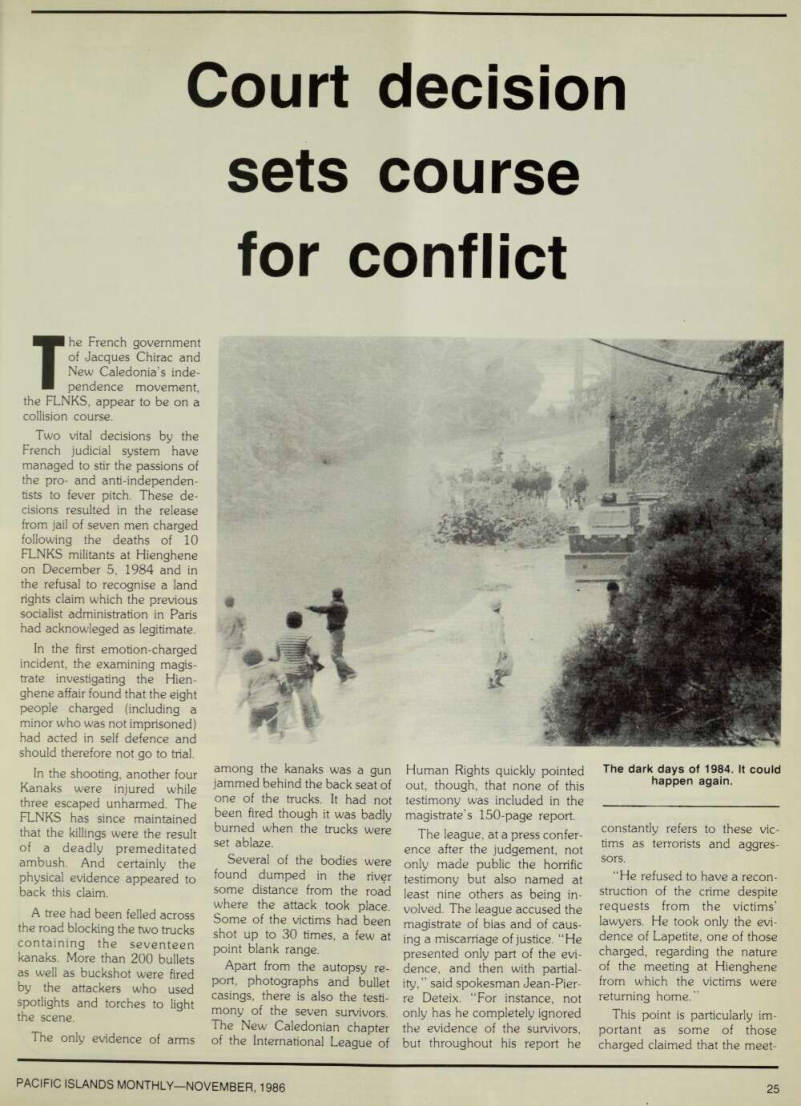
The dark days of 1984. It could happen again.
ing, which they had not attended, resolved to chase all of the whites out of the Hien ghene valley. Survivors’ accounts as well as those of many others claimed the meet ing was held to explain a decision, announced in Noumea the day before by FLNKS leader, Jean-Marie Tjibaou, to end all disruptions around the territory resulting from the boycott of the Novem ber 18 elections. The barriers at Hienghene had already been lifted.
“The magistrate didn’t men tion either that the kanaks had also suffered because of the political unrest,” said Deteix, “that terrified women and chil dren from a village near Hien ghene had slept in the bush for several nights after being told that the militia of Lafleur (the territory’s right-wing strong man) were going to descend on their village.”
The league, along with the Comite Pierre Declercq an FLNKS support group named after a murdered independence leader demanded that those charged over the Hienghene killings be brought to trial, that the examining magistrate be removed from all cases invol ving independence supporters and returned to France and that all FLNKS political prisoners be freed. They also announced their intention to alert Amnesty International, the International League of Human Rights and the European Commission of Human Rights.
By presenting their case to the international community and maintaining calm through
out the territory the front is obviously hoping to beat France at its own game. The movement is convinced that the Chirac regime is deliberately seeking to provoke a violent reaction. France has been placed in the hot seat at the current session of the UN Gen eral Assembly by the South Pacific Forum and the Non aligned Movement which have strongly supported New Cale donia’s reinscription with the UN decolonisation committee.
It is, the front argues, perhaps in France’s interest to be able to paint the front as a terrorist movement in order to justify its continued presence in New Caledonia.
The front cites, as further evidence of provocation, the
land rights decision. The ad ministration has moved to in stall a French loyalist on proper ty which the previous Paris government had agreed should be returned to the kanaks.
But by keeping its militants under control, the front has, to some extent, succeeded in pin ning the aggressor’s tag on France. It remains to be seen whether the front can maintain this position. The next potential test was seen as the appeal against the Hien-ghene judge ment, due to be heard at the beginning of this month.
That appeal was to decide whether the eight charged with murder, attempted murder and wilfull injury will go to trial.
Sue Williams.