The long road
p. 14 · Read in the full issue
to reform
Anew constitution for American Samoa has embarked on the long and uncertain road to ratification.
Sixty-two delegates at the Constitutional Convention have given the 20-year-old document a comprehensive overhaul, expanding the Sen ate and expanding and renam ing the High Court, creating impeachment procedures and making a number of other fundamental changes.
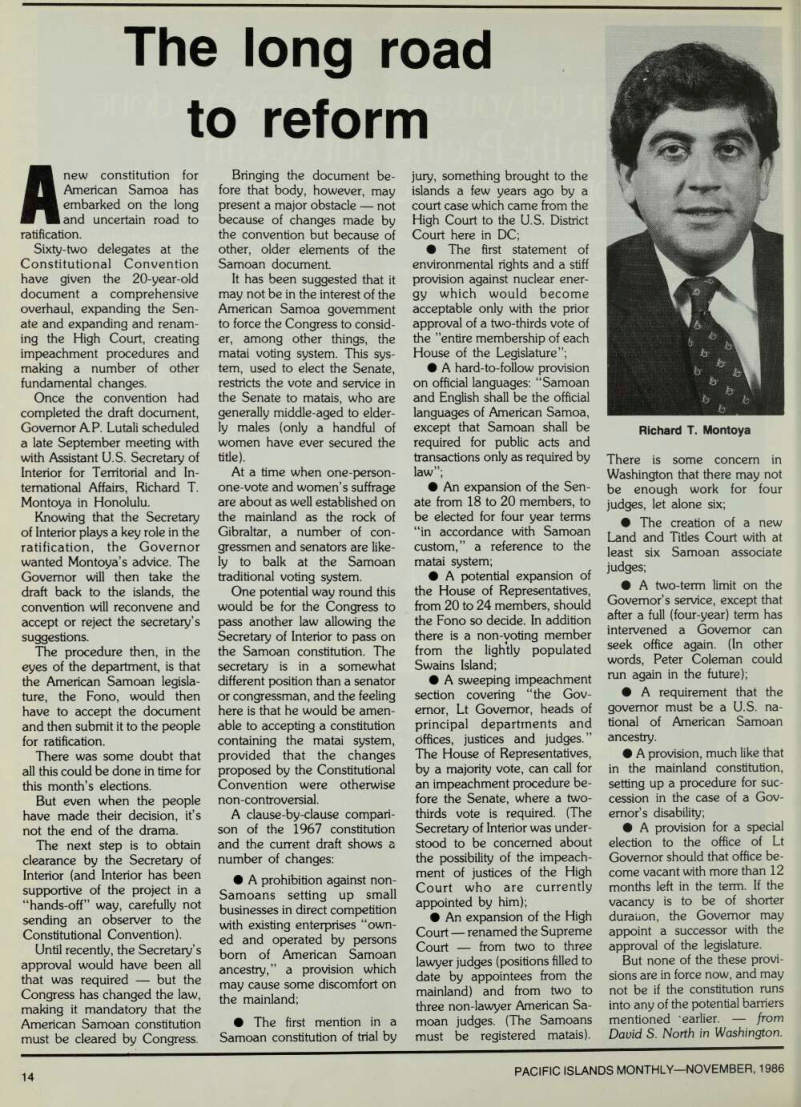
Once the convention had completed the draft document, Governor A.P. Lutali scheduled a late September meeting with with Assistant U.S. Secretary of Interior for Territorial and In ternational Affairs, Richard T.
Montoya in Honolulu.
Knowing that the Secretary of Interior plays a key role in the ratification, the Governor wanted Montoya’s advice. The Governor will then take the draft back to the islands, the convention will reconvene and accept or reject the secretary’s suggestions.
The procedure then, in the eyes of the department, is that the American Samoan legisla ture, the Fono, would then have to accept the document and then submit it to the people for ratification.
There was some doubt that all this could be done in time for this month’s elections.
But even when the people have made their decision, it’s not the end of the drama.
The next step is to obtain clearance by the Secretary of Interior (and Interior has been supportive of the project in a “hands-off” way, carefully not sending an observer to the Constitutional Convention).
Until recently, the Secretary’s approval would have been all that was required but the Congress has changed the law, making it mandatory that the American Samoan constitution must be cleared by Congress.
Bringing the document be fore that body, however, may present a major obstacle not because of changes made by the convention but because of other, older elements of the Samoan document.
It has been suggested that it may not be in the interest of the American Samoa government to force the Congress to consid er, among other things, the matai voting system. This sys tem, used to elect the Senate, restricts the vote and service in the Senate to matais, who are generally middle-aged to elder ly males (only a handful of women have ever secured the title).
At a time when one-person one-vote and women’s suffrage are about as well established on the mainland as the rock of Gibraltar, a number of con gressmen and senators are like ly to balk at the Samoan traditional voting system.
One potential way round this would be for the Congress to pass another law allowing the Secretary of Interior to pass on the Samoan constitution. The secretary is in a somewhat different position than a senator or congressman, and the feeling here is that he would be amen able to accepting a constitution containing the matai system, provided that the changes proposed by the Constitutional Convention were otherwise non-controversial.
A clause-by-clause compari son of the 1967 constitution and the current draft shows a number of changes: • A prohibition against non- Samoans setting up small businesses in direct competition with existing enterprises “own ed and operated by persons born of American Samoan ancestry,” a provision which may cause some discomfort on the mainland; • The first mention in a Samoan constitution of trial by
jury, something brought to the islands a few years ago by a court case which came from the High Court to the U.S. District Court here in DC; • The first statement of environmental rights and a stiff provision against nuclear ener gy which would become acceptable only with the prior approval of a two-thirds vote of the ’’entire membership of each House of the Legislature”; • A hard-to-follow provision on official languages: “Samoan and English shall be the official languages of American Samoa, except that Samoan shall be required for public acts and transactions only as required by law”; • An expansion of the Sen ate from 18 to 20 members, to be elected for four year terms “in accordance with Samoan custom,” a reference to the matai system; • A potential expansion of the House of Representatives, from 20 to 24 members, should the Fono so decide. In addition there is a non-voting member from the lightly populated Swains Island; • A sweeping impeachment section covering “the Gov ernor, Lt Governor, heads of principal departments and offices, justices and judges.”
The House of Representatives, by a majority vote, can call for an impeachment procedure be fore the Senate, where a two thirds vote is required. (The Secretary of Interior was under stood to be concerned about the possibility of the impeach ment of justices of the High Court who are currently appointed by him); • An expansion of the High Court renamed the Supreme Court from two to three lawyer judges (positions filled to date by appointees from the mainland) and from two to three non-lawyer American Sa moan judges. (The Samoans must be registered matais).
There is some concern in Washington that there may not be enough work for four judges, let alone six; • The creation of a new Land and Titles Court with at least six Samoan associate judges; • A two-term limit on the Governor’s service, except that after a full (four-year) term has intervened a Governor can seek office again. (In other words, Peter Coleman could run again in the future); • A requirement that the governor must be a U.S. na tional of American Samoan ancestry. • A provision, much like that in the mainland constitution, setting up a procedure for suc cession in the case of a Gov ernor’s disability; • A provision for a special election to the office of Lt Governor should that office be come vacant with more than 12 months left in the term. If the vacancy is to be of shorter duration, the Governor may appoint a successor with the approval of the legislature.
But none of the these provi sions are in force now, and may not be if the constitution runs into any of the potential barriers mentioned 'earlier. from David S. North in Washington.
Richard T. Montoya