pacific report
pp. 6-7 · Read in the full issue
Tuna Deal At
Tenth Talks
Negotiators for the United States and the Forum Fisheries Agency agreed on a 5-year multilateral tuna treaty at the tenth round of talks in Nuku’alofa. Under the terms of the agreement, Pacific island countries are guaranteed a minimum of US$6O million with more money possible if additional vessels seek licences or if the price of tuna rises. The fee package was calculated on a fleet size of 35 boats. The $l2 million annual fee has two components. The tuna industry will pay $1.75 million and provide an additio nal $250,000 in technical assistance.
The US government will add $lO million $9 million in cash grants and $1 million for development projects in the fisheries sector. The FFA will administer all the funds though 15 per cent of the cash fee will be divided equally among the countries that ratify the treaty. The balance of the money will be paid out to countries where fish are caught. Island delegates left Tonga to report to their respective governments on the draft treaty and to start the ratification pro cess. Pacific states must proceed to ratification before the pact can come into force. US officials said they expect the treaty will pass the full senate by March, 1987. Though an agreement was finally reached, the talks appeared stalled until counsellor Ed Derwinski arrived from Washington with the final American offer.
“I almost exceeded my limit," he told PIM. “We got a temporary black eye from the Jeanette Diana. These negotiations refocussed the relationship between the US and its Pacific friends with a positive end result for everyone,” the State Department’s roving ambassador added. FFA president Phillip Muller said he was elated over the deal as it provided a foundation for improved relations with the United States and established a basis for co-operation with other distant water fishing fleets. Mike Lane.
Salii Issues
Government Bonds
President Lazarus Salii of Palau com pleted a US$4OO million dollar deal for the small republic that has defaulted on its overseas debt (August PIM pl 2). He said after a visit to Hawaii that he “finalised issuance of the revenue bonds” which he called “a great thing for Palau.” The president said the revenue producing bonds would be used to help develop housing, air transport and tele communications for the cash-strapped republic of 15,000. An administration press release added that the projects would include the construction of a new capital city, a government office com-
plex, water and sewer systems, power distribution, health, retirement and tour ism related programs. The president said that since the bond issue was under the aegis of the Palau National Deve lopment Bank, it did not require Palau Congressional approval and that “only the president can handle it directly.” The money for the bonds was held in escrow and could not be released until feasibility studies for each project had been completed, he said. The president said that Wall Street brokers Matthews and Wright had co-operated with the deve lopment bank on the bond issue. The broking firm raised the US$4OO million from mainland financial institutions. The capital, raised in New York, is to be repaid from revenue raised by the various projects. The president said the money would be used to reduce Palau’s staggering debt. Fie added the bond issue was totally separate from the proposed Compact of Free Association between Palau and the United States which is embroiled in legal dispsutes over U.S. defence requirements which Palau’s Supreme Court contends con flicts with the republic’s nuclear-free constitution. The president said he would call another referendum on the issue.
Region’S Health Care
‘A Tragedy’
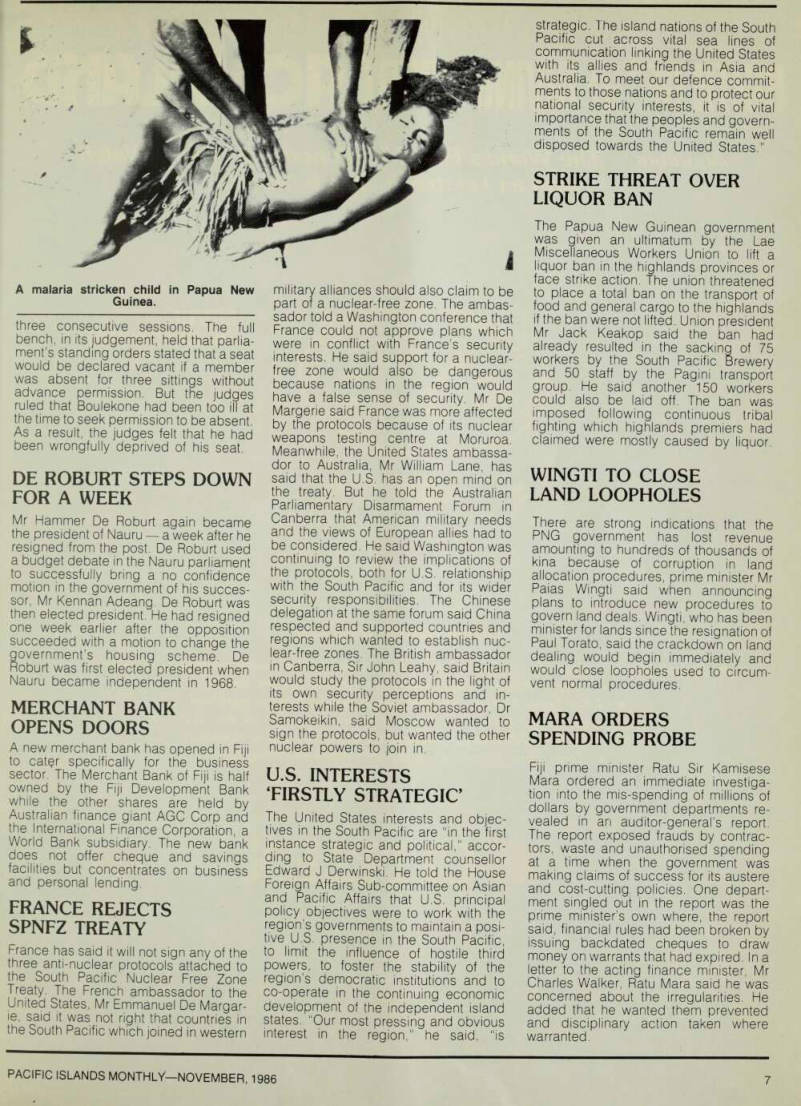
A seminar at the Australian National Centre for Development Studies in Can berra was told that the deteriorating health situation in the South Pacific was a tragedy. Ms Abby Bloom, of Sydney University’s School of Tropical Medicine told the seminar there was a rapid increase in malaria, tuberculosis and respiratory conditions in Papua New Guinea, Vanuatu and Solomon Islands.
In Fiji, Tonga and Western Samoa, she said, rapid life-style changes had
caused an alarming increase in de generative diseases including hyperten sion, diabetes and cancer. Dr Jeff Richardson of the Economics Depart ment at Macquarrie University said Papua New Guinea's health service was near collapse. It was not, he said, committing funds where they were most needed while the health status of PNG's population was worse than that in other nations at similar stages of development.
This could be attributed to an overall decline in health services, a cut in the number of trained personnel, poor de livery of health care and a lack of attention to the improvement of water supplies,- he said.
Australia Joins
Sea Bed Miners
Australia has become a full member of the Suva-based Committee for Co ordination of Joint Prospecting for Mine ral Resources in South Pacific Offshore Areas (CCOP/SOPAC) which comprises most of the Forum nations plus Guam. It was established in 1972 under the auspices of the Economic and Social Commission for Asia and the Pacific (ESCAP) to assist members in policy formation and implementation of prog rams for evaluation, development and management of marine mineral re sources. Australia will contribute A 5250,000 to the committee’s budget for this year and the Australian Department of Foreign Affairs said Australia’s membership refelected its close ties with the countries of the South Pacific.
Move To Outlaw
Cigarette Ads
Dr Balram Iyer of the Fiji Medical Association, has announced that the association plans to campaign for a ban on cigarette advertising. Fie was com menting on a recent directive by the Ministry of FHealth to ban smoking in all patient areas in government hospitals. It was expected that the ministry ban would be extended to all ministry pre mises.
Boulekone Wins
Court Appeal
Vanuatu’s opposition leader, Mr Vincent Boulekone, won a Supreme Court appeal against the loss of his seat in parliament. The full bench of the court comprising the chief justice, Mr Justice Cooke and judges from Fiji and Papua New Guinea, ruled that Boulekone had been unjustly deprived of his seat.
Boulekone, president of the Union of Moderate Parties, had been ruled ineligi ble to return to parliament by the Speaker because he had failed to attend
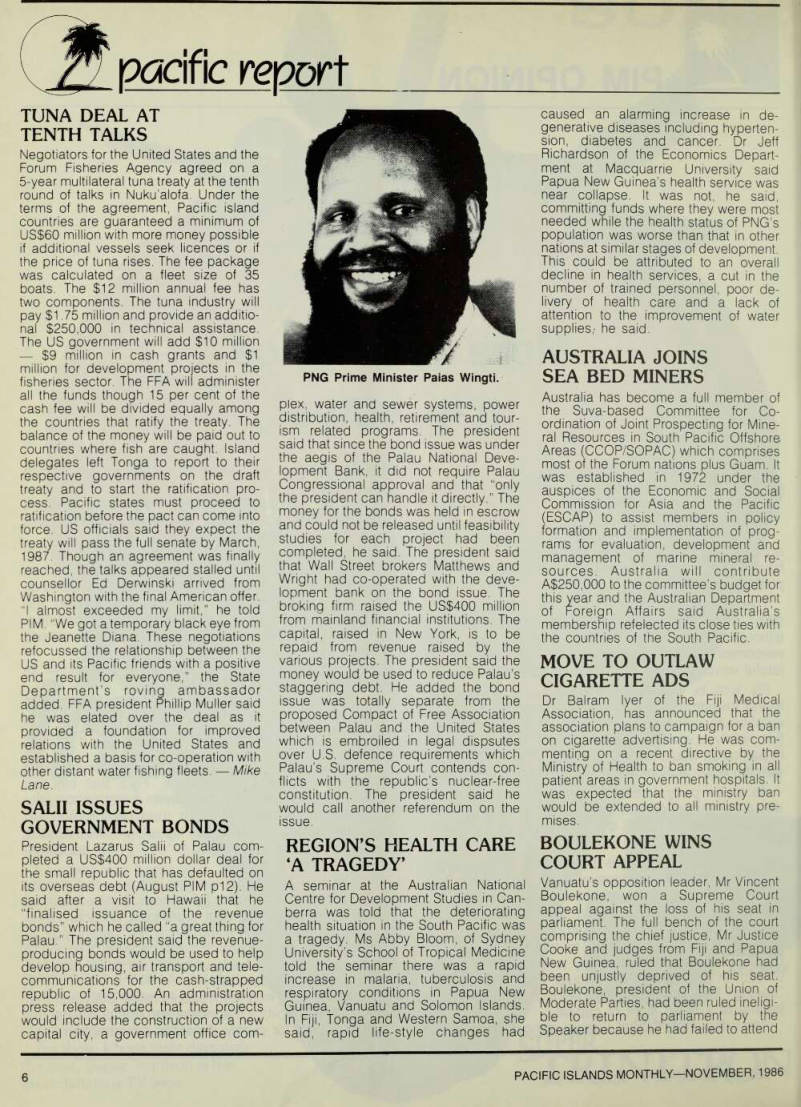
PNG Prime Minister Paias Wingti.
three consecutive sessions. The full bench, in its judgement, held that parlia ment’s standing orders stated that a seat would be declared vacant if a member was absent for three sittings without advance permission. But the judges ruled that Boulekone had been too ill at the time to seek permission to be absent.
As a result, the judges felt that he had been wrongfully deprived of his seat.
De Roburt Steps Down
For A Week
Mr Hammer De Roburt again became the president of Nauru a week after he resigned from the post. De Roburt used a budget debate in the Nauru parliament to successfully bring a no confidence motion in the government of his succes sor, Mr Kennan Adeang. De Roburt was then elected president. He had resigned one week earlier after the opposition succeeded with a motion to change the government’s housing scheme. De Roburt was first elected president when Nauru became independent in 1968.
Merchant Bank
Opens Doors
A new merchant bank has opened in Fiji to catpr specifically for the business sector. The Merchant Bank of Fiji is half owned by the Fiji Development Bank while the other shares are held by Australian finance giant AGC Corp and the International Finance Corporation, a World Bank subsidiary. The new bank does not offer cheque and savings facilities but concentrates on business and personal lending.
France Rejects
Spnfz Treaty
France has said it will not sign any of the three anti-nuclear protocols attached to the South Pacific Nuclear Free Zone Treaty. The French ambassador to the United States, Mr Emmanuel De Merger ie, said it was not right that countries in the South Pacific which joined in western
military alliances should also claim to be part of a nuclear-free zone. The ambas sador told a Washington conference that France could not approve plans which were in conflict with France's security interests. He said support for a nuclear free zone would also be dangerous because nations in the region would have a false sense of security. Mr De Margerie said France was more affected by the protocols because of its nuclear weapons testing centre at Moruroa.
Meanwhile, the United States ambassa dor to Australia, Mr William Lane, has said that the U.S. has an open mind on the treaty. But he told the Australian Parliamentary Disarmament Forum in Canberra that American military needs and the views of European allies had to be considered. He said Washington was continuing to review the implications of the protocols, both for U.S. relationship with the South Pacific and for its wider security responsibilities. The Chinese delegation at the same forum said China respected and supported countries and regions which wanted to establish nuc lear-free zones. The British ambassador in Canberra, Sir John Leahy, said Britain would study the protocols in the light of its own security perceptions and in terests while the Soviet ambassador, Dr Samokeikin, said Moscow wanted to sign the protocols, but wanted the other nuclear powers to join in.
U.S. Interests
‘Firstly Strategic
The United States interests and objec tives in the South Pacific are “in the first instance strategic and political,” accor ding to State Department counsellor Edward J Derwinski. He told the House Foreign Affairs Sub-committee on Asian and Pacific Affairs that U.S. principal policy objectives were to work with the region’s governments to maintain a posi tive U.S. presence in the South Pacific, to limit the influence of hostile third powers, to foster the stability of the region’s democratic institutions and to co-operate in the continuing economic development of the independent island states. “Our most pressing and obvious interest in the region,” he said, “is
strategic. The island nations of the South Pacific cut across vital sea lines of communication linking the United States with its allies and friends in Asia and Australia. To meet our defence commit ments to those nations and to protect our national security interests, it is of vital importance that the peoples and govern ments of the South Pacific remain well disposed towards the United States.”
Strike Threat Over
Liquor Ban
The Papua New Guinean government was given an ultimatum by the Lae Miscellaneous Workers Union to lift a liquor ban in the highlands provinces or face strike action. The union threatened to place a total ban on the transport of food and general cargo to the highlands if the ban were not lifted. Union president Mr Jack Keakop said the ban had already resulted in the sacking of 75 workers by the South Pacific Brewery and 50 staff by the Pagini transport group. He said another 150 workers could also be laid off. The ban was imposed following continuous tribal fighting which highlands premiers had claimed were mostly caused by liquor.
Wingti To Close
Land Loopholes
There are strong indications that the PNG government has lost revenue amounting to hundreds of thousands of kina because of corruption in land allocation procedures, prime minister Mr Paias Wingti said when announcing plans to introduce new procedures to govern land deals. Wingti, who has been minister for lands since the resignation of Paul Torato, said the crackdown on land dealing would begin immediately and would close loopholes used to circum vent normal procedures.
Mara Orders
Spending Probe
Fiji prime minister Ratu Sir Kamisese Mara ordered an immediate investiga tion into the mis-spending of millions of dollars by government departments re vealed in an auditor-general’s report.
The report exposed frauds by contrac tors, waste and unauthorised spending at a time when the government was making claims of success for its austere and cost-cutting, policies. One depart ment singled out in the report was the prime minister’s own where, the report said, financial rules had been broken by issuing backdated cheques to draw money on warrants that had expired. In a letter to the acting finance minister, Mr Charles Walker, Ratu Mara said he was concerned about the irregularities. He added that he wanted them prevented and disciplinary action taken where warranted.
A malaria stricken child in Papua New Guinea.