Long Ghost
pp. 41-45 · Read in the full issue

In search of Doctor Long Ghost
In 1842 Herman Melville spent several months travelling through French Polynesia with an eccentric beachcom ber nicknamed “Doctor Long Ghost”.
Four years after they had parted, never to meet again, Melville immortalised his erstwhile companion in Omoo: A Narra tive of Adventures in the South Seas.
The book went on to become a classic, yet surprisingly little is known about the “Long Doctor”, its most colorful protagon ist. His origins are a mystery, only the barest fragments of his later life have been documented, and even his true identity has never been conclusively established.
Nevertheless, like many of the charac ters in Melville’s works, Doctor Long Ghost was a real person. Various refer ences to him some of them ifntalisingly brief can be found ia, nineteenth century writings on the Pacific, and it is possible, by piecing these together, to produce a shadowy history of his life.
There are numerous gaps, but what remains is often fascinating.
The two men met in the Marquesas on August 9, 1842. Having jumped ship, Melville had been exploring the island of Nuku Hiva, as he later recounted in Typee, his first book. Lame, and fearful for his safety among the reportedly cannibalis tic “Typees”, he signed on as an able seaman aboard the Lucy Ann, a small Australian whaling barque whose crew had been depleted by desertion. Doctor Long Ghost had joined the ship in Sydney, as its surgeon, and Melville was delighted to have him as a shipmate: “His personal appearance was remark able. He was over six feet high a tower of bones, with a complexion absolutely colorless, fair hair, and a light, unscrupulous grey eye, twinkling occasionally with the very devil of mischief. Among the crew, he went by the name of the Long Doctor, or, more frequently still, Doctor Long Ghost.
And from whatever high estate Doctor Long Ghost might have fallen, he had certainly at some time or other spent money, drunk Burgundy, and associ ated with gentlemen.
In May, 1945, PIM pub lished an article by John D.
Earnshaw entitled Who Was Doctor Long Ghost?
Earnshaw had done some research on the character who appears, in various guises, in several stories and accounts of life in the is lands of over a century ago.
Now, more than 40 years after Earnshaw’s question,
Andrew Campbell Can
provide a fascinating answer as a result of re search on Penrhyn Island.
As for his learning, he quoted Virgil, and talked of Hobbes of Malmsbury, besides repeating poetry by the canto, especially Hudibras. He was, moreover, a man who had seen the world. In
the easiest way imaginable, he could refer to an amour he had in Palermo, his lion hunting before breakfast among the Caffres, and the quality of the coffee to be drunk 'in Muscat; and about these places, and a hundred others, he had more anecdotes than I can tell of. Then such mellow old songs as he sang, in a voice so round and racy, the real juice of sound. How such notes came forth from his lank body was a constant marvel.
Upon the whole, Long Ghost was as entertaining a companion as one could wish; and ... an absolute godsend”.
In the early part of the voyage, accoi ding to Melville, Doctor Long Ghost had lived in the cabin, with nothing but his professional duties to attend to, as was customary for ships’ physicians. He had passed his time by drinking “flip”, playing cards, and exchanging yams with the young captain, Henry Ventom.
On one occasion, though, they had an
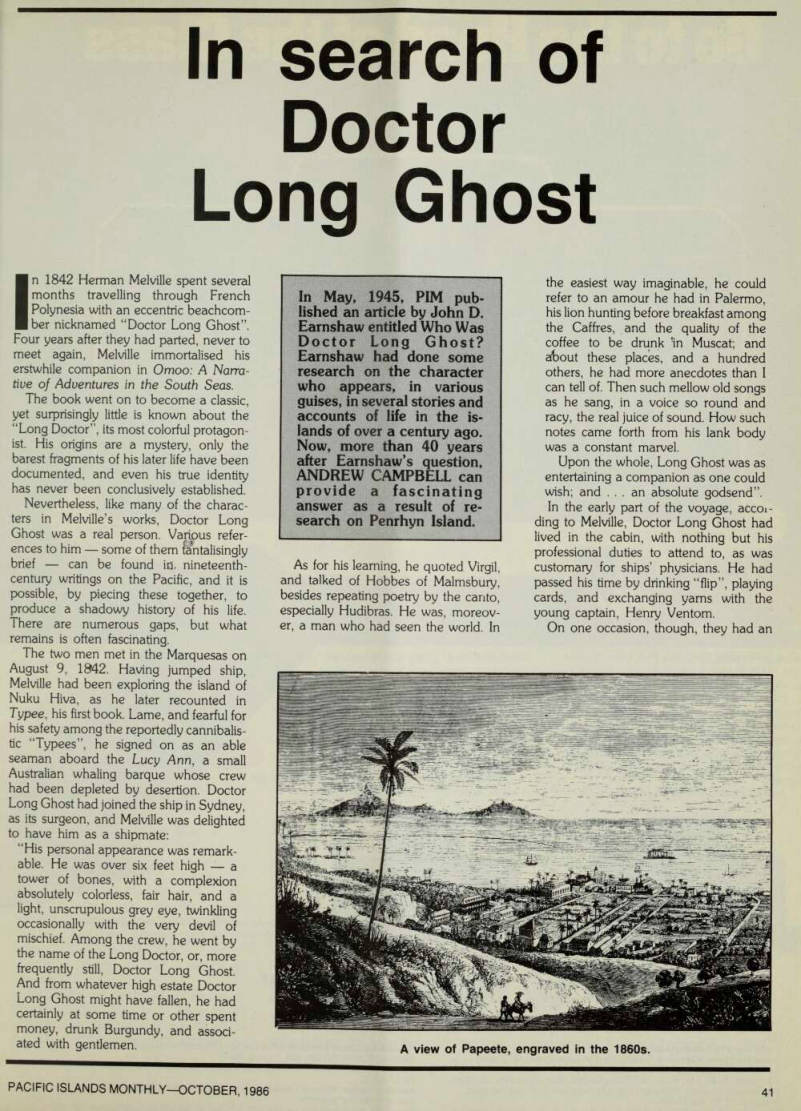
A view of Papeete, engraved in the 1860s.
argument about politics, and Long Ghost, getting into a rage, ended it with his fist, rendering his opponent unconscious. As punishment, he was locked up in his stateroom for 10 days, on a diet of bread and water. Humiliated by the experience, he stole away from the vessel at one of the islands a short time after his release, but was captured and again incarcerated.
Upon being set free for the second time, he swore he would no longer tolerate Ventom’s company, and moved into the forecastle with the men. Having handed in his resignation, he declared himself a passenger for Sydney, and took things easily.
This, at least, is Melville’s version of the events. Other accounts, however, paint a less romantic picture. For a start, Doctor Long Ghost was not the ship’s doctor at all, but its steward. As such, he was the custodian and dispenser of medical stores a position whose occupant was com monly given the name of “doctor” though he may not have been medically qualified.
Furthermore, Long Ghost did not voluntarily withdraw to the forecastle; he was demoted for stealing medical supplies, and jumping ship with three other men, at Nuku Hiva. This sordid episode was later related by Benbow Byme, the Lucy Ann’s Maori harpoonist, in an affidavit. . . which we shall come to shortly.
Melville’s lameness prevented him from taking up active duty straight away, apart from an occasional “trick” at the helm. He therefore spent most of his time in the forecastle, with Doctor Long Ghost for company. The latter’s books, which in cluded a learned treatise on yellow fever and a collection of Sydney newspapers, were invaluable to Melville. Though they were “sadly tom and battered”, he read them repeatedly.
Despite his sophistication and his occa sionally grave manner, Doctor Long Ghost enjoyed a practical joke. He was, as Melville put it, “a decided wag.” When ever the ship’s cook found old boots in his soup pots or “cakes of pitch candying in his oven”, the Long Doctor was never far away. On one occasion, he decided to teach some men who had fallen asleep during the night watch a lesson: Fastening a rope’s end to each sleeper, he rove the lines through a number of blocks, and conducted them all to the windlass; then, by heaving round cheerily, in spite of cries and struggles, he soon had them dangling aloft in all directions by arms and legs . . . like a parcel of pirates gibbeted at sea by a cruiser”.
Conditions on board the Lucy Ann were atrocious. The quarters were over crowded, the mate was a drunkard, five of the 16 seamen were incapacitated by
venereal disease, and the food which had been purchased at an auction of condemned navy stores was almost inedible.
Moreover, Captain Ventom, as well as being incompetent and ineffectual, was sick. Suffering, apparently, from an abs cess in the perineum, he could no longer walk by September 4, and was confined to his cabin. Four days later, recognising the need for medical attention, he gave orders to sail for Tahiti instead of continuing the search for whaling grounds.
On the 20th, having touched at Vaitahu, Hiva Oa and other islands, the ship reached Papeete. To prevent disgruntled sailors from deserting, it remained outside
the harbor, while the mate was sent ashore for a doctor.
Dr Francis Johnstone came aboard several hours later and, after examining the captain, insisted on his removal to the town. So, the following day, Captain Ventom was taken ashore, leaving the first mate, James German, in command.
Realising that the Lucy Ann was to continue its course, merely touching at Tahiti to pick up the captain when he had recuperated, the crew became furious, threatening mutiny. If Melville is to be believed, he and Doctor Long Ghost managed to placate them by proposing that a round robin be sent to the British Consul on shore, stating their grievances and requesting that he come on board immediately and investigate the situation.
This was duly dispatched written on the flyleaf of a book aptly entitled A History of the Most Atrocious Piracies and the Acting British Consul, Charles B. Wilson, duly arrived. He was, however, far from
sympathetic, ruling that the Lucy Ann should resume its voyage, with German as commander.
This was the last straw. By September 23, to cut a long and confused story short, 10 men had refused to do their duty, including Doctor Long Ghost. With mutiny threatened, the mate decided to take the Lucy Ann into the port of Papeete, contrary to the captain’s orders, without even waiting for the harbor pilot to come off to him.
Shortly aftewards, the consul again came on board, where he proceeded to separate the “mutineers” from those who had remained loyal. The former were then transferred to a French frigate lying at anchor nearby, La Heine Blanche, and placed in the brig. After being kept in irons for three days, the recalcitrants, who by now included Melville, were taken ashore and marched to the British jail, the “Calabooza Beretanee,” where they re mained for the next three or four weeks.
On September 28 the consul examined the prisoners, in the vain hope of persuad ing them to return to their duties. For the historian, this was a propitious event, since it resulted in the writing of several docu ments which have survived. One of them was Benbow Byrne’s affidavit, men tioned earlier. Among other things, these papers disclose that Doctor Long Ghost shipped under the name of John B. Troy.
It is clear, however, that he used more than one alias during his rovings around the Pacific, so I shall continue to refer to him by his nickname.
Discipline in the Calabooza was virtually non-existent. For the first few days the men were kept in stocks, but “Captain Bob”, their indulgent Tahitian jailer, sub sequently allowed them to roam freely, providing they returned at night. During this period of enforced idleness, some of the Long Doctor’s idiosyncrasies revealed themselves.
“Like all lank men,” noted Melville, Doctor Long Ghost “had an appetite of his own. Others occasionally went about seeking what they might devour, but he was always on the alert. ” To cope with the lack of salt, which Tahitians seldom used with their food, he took to keeping some in a small leather wallet tied around his neck.
“In my poor opinion,” said Long Ghost, as he tucked the wallet out of sight, “it behooves a stranger, in Tahiti, to have his knife in readiness, and his caster slung.”
The Long Doctor’s appetite for drugs was also unusual. When Dr Johnstone visited the Calabooza’s convalescent sea men, his tall colleague took him aside for a “private confabulation”. Melville couldn’t hear what was said, but “from certain illustrative signs and gestures” he inferred that Long Ghost “was describing the symptoms of some mysterious disor
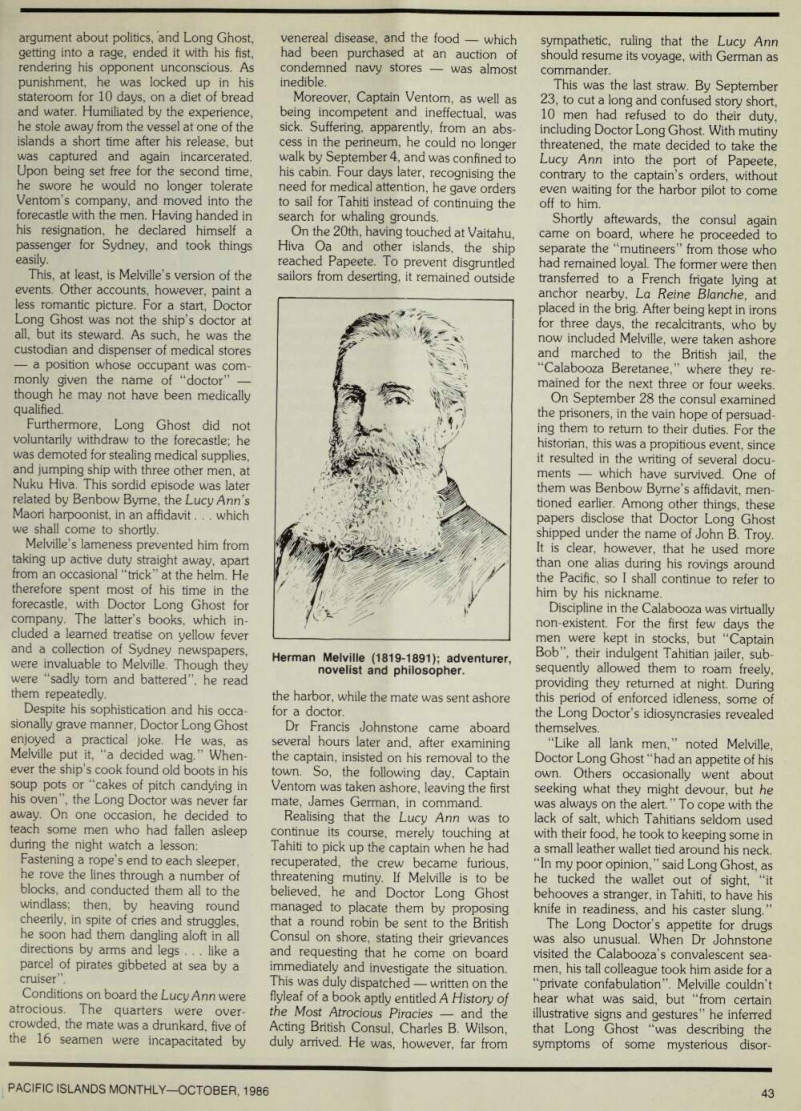
Herman Melville (1819-1891); adventurer, novelist and philosopher.
ganisation of the vitals, which must have come on within the hour. Assisted by his familiarity with medical terms, he seemed to produce a marked impression. “The following morning, a small purple phial was delivered to Doctor Long Ghost, who, after an hour or two, was found “lying behind the stocks ... as if life were extinct. ”
Six years later, Lieutenant Henry A.
Wise discussed this episode with Dr Johnstone during a visit to Tahiti. Accor ding to Johnstone, the “embrocation” so relished by Long Ghost “was a villainous preparation, having the least taste of gin in the world, and made up from laudanum, turpentine, and soap linament!” Doctor Long Ghost, concluded Wise, “must have been seriously indisposed; he had a large quantity. ”
On October 15 the Lucy Ann finally set sail, Captain Ventom having recuperated.
The “mutineers” were never officially released from jail, but they were evidently able to come and go as they pleased.
Before long, Melville and his lanky com panion had done a midnight flit to the neighboring island of Moorea little more than 10 miles away from Tahiti, but far less westernised. Adopting the aliases “Peter” and “Paul”, they obtained work as labor ers on a Matea potato plantation run by a pair of runaway seamen.
After a few quiet days, during which they did sufficient work to whet their appetites, avoiding any severe toil, the two men set off to explore some more of the island. Lacking a supply of European clothes, they were obliged to improvise.
Long Ghost’s outfit consisted of a local tapa-cloth cloak, a pair of huge, dilapi dated boots, and an ancient Panama hat.
By setting the latter at a jaunty angle, he reminded Melville of a “mendicant grandee”.
Tamai, a small, secluded community, was the first port of call. Here they were fortunate enough to witness a clandestine performance of the “Lory-Lory”, a traditional dance that had been banned by puritanical missionaries. While this was going on, Melville could barely manage “to keep the doctor from rushing forward and seizing a partner. ” The next morning, his libido undiminished, Long Ghost went in search of the dancing girls. He even tually succeeded in finding one, but his approach evidently lacked subtlety: “She all at once turned round upon him, and, giving him a box on the ear, told him to . . . be off with himself.”
At “Loohooloo”, the village they visited next, Long Ghost’s luck improved: “With a pleasant companion, he was for ever strolling inland, ostenisbly to collect botanical specimens”. The area of botany in which the doctor specialised was re vealed during a lavish feast held in honor
of the European visitors. Before the meal had even begun, “he snatched a morsel from a sort of fruit of which gentlemen of the sanguine temperament are remarkably fond; namely, the ripe cherry lips of Miss Day-Bom, who stood looking on.”
Doctor Long Ghost’s popularity in this village was not confined to nubile mem bers of the opposite sex. Through “a hundred whimsical oddities”, he became a great favorite among all the people, who “bestowed on him a long, comical title, expressive of his lank figure.” Thus there was a sad leave-taking when he and Melville resumed their journey, heading for the prosperous settlement of Papetoai where they hoped to make the acquaint ance of Queen Pomare. The doctor, aware of the queen’s well-known passion for music, intended to dazzle her with his fiddle playing. In this he was disappointed; her majesty declined an audience with the two beachcombers and had them re moved.
Unsuccessful in his efforts to ingratiate himself with the queen, Melville decided to go to sea. He soon managed to join the crew of the Charles and Henry, a Nan tucket whaler, though the captain dis trusted Doctor Long Ghost and would have nothing to do with him. Having already decided to tarry a while longer, the doctor was not unduly concerned. Melville gave him half of his advance Spanish dollars before the ship set sail on November 6. “As he stepped over the side,” recalled Melville, “I shook the doctor long and heartily, by the hand. I have never seen or heard of him since.”
It is at this point that most people’s acquaintance with Doctor Long Ghost ends; but my story is only half-done.
The doctor’s early history, according to Melville, “was enveloped in the profound est obscurity though he threw out hints of a patrimonial estate, a nabob uncle, and an unfortunate affair which sent him a-roving. All that was known, however, was this. He had gone out to Sydney as assistant-surgeon of an emigrant ship. On his arrival there, he went back into the country, and after a few months’ wander ings, returned to Sydney penniless. ” It was then that he joined the Lucy Ann.
Thomas Trood, a one-time British vice consul in Apia, met Doctor Long Ghost several years after the publication of Omoo. In his autobiography, Island Re miniscences, he claims that Long Ghost was present at the murder of John Williams,, the evangelical missionary, at Eromanga. Although Trood gives no de tails at all, and no supporting evidence exists, it is not inconceivable that the doctor was there. Being an educated man, and one prone to temporary piety when there was something to be gained from it, he may well have befriended the mis-
sionaries for some reason of his own.
The dates tie up: Williams died on November 20, 1839; Melville and Long Ghost did not meet until 1842.
Information about Doctor Long Ghost’s later life is no less fragmentary. One snippet is provided by Edward T. Perkins in his book Na Motu: or, Reef-Rovings in the South Seas. During a visit to Tahiti in 1853, Perkins discovered that, after Melvil le’s departure, the doctor had stayed on a plantation owned by Mr Bell, a character mentioned in Omoo. Bearing in mind his amorous disposition, it is quite possible that Mrs Bell, whom Melville described as “the most beautiful white woman ... in Polynesia”, was the chief attraction. In any case, he “led a free-and-easy life for some time, and afterwards took his departure.”
In November, 1848, Lieutenant Wise, the author of Los Gringos: or an Inside View of . . . Polynesia, also made inquiries about Long Ghost while in Tahiti. “The Ghost”, he reported “was supposed at the period of our visit to be in Sydney, or after gold in California”.
Whether or not the doctor returned to Australia is unknown, but by September, 1850, he was in California. We know this because he wrote to Melville from there.
Unfortunately, the letter itself is lost; only a passing reference to it has survived.
In 1858 the second Pacific classic to have Doctor Long Ghost as one of its principal characters was published, name ly, E. H. Lament’s Wild Life among the Pacific Islanders. He now styled himself Dr Rouke, though Lamont refers to him as Dr R . . possibly to avoid risking a libel suit.
H. B. Sterndale, who wrote a series of articles on the South Sea Islands for the
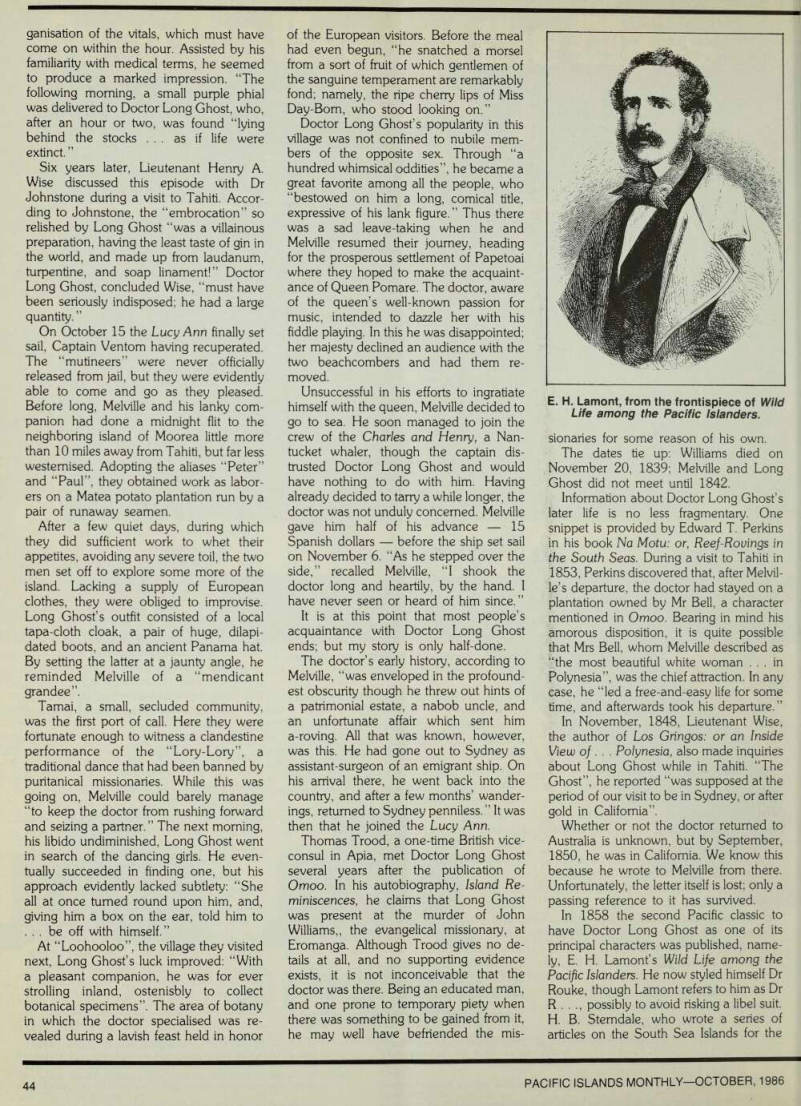
E. H. Lament, from the frontispiece of Wild Life among the Pacific Islanders.
Auckland Weekly News in 1890, was the first person to point out that Doctor Long Ghost and Dr R ... are the same person, but this should be obvious to anyone who has read both books.
Lamont met the doctor in San Francisco during the second half of 1852. He was arranging a trading voyage through the South Pacific and, after hearing about Long Ghost’s knowledge of the region, gladly took him on. The Chatham, an American clipper brig commanded by George Snow, accordingly set sail on October 14 with the two landsmen and a crew of eight on board.
After a month or so at sea, the ship called at the Marquesas, the scene of Long Ghost’s abortive attempt to abscond with his ship’s medicines 10 years before. The voyage then continued through the Tuamotus, the Society Islands, and south ern Cooks, before heading back to Cali fornia.
Lamont, unlike Melville, did not enjoy Doctor Long Ghost’s company. He quar relled incessantly with him, and swore that they would never work together again, even if the doctor “opened ... a path to the wealth of Croesus.” The cause of their mutual dislike is not clear, but perhaps Lamont was simply too strait-laced to enjo\/ the eccentric traits in his partner. It is also likely that Long Ghost’s high-handed ness grated on Lamont, whose own ego was somewhat inflated.
At one stage, the doctor almost caused the expedition to be abandoned. After a series of arguments with Lamont, he irritably ordered the ship’s cook to prepare him some food . The cook refused, pointing out that his fire was out, where-
upon; The Doctor, who had taken an anti pathy to the boy, after some coarse language, knocked him down. The captain, who had already retired to his cabin, now interposed, saying, very properly, that he would not allow any one to interfere with his crew, and that if they did wrong it was his business to correct them. The Doctor replied that he was quite able to correct them himself, and would strike any man on board, from the captain to the cook, who was insolent to him. The captain declared this an act of mutiny, and going on deck, ordered the vessel hard up for Tahiti . . .
Doctor Long Ghost’s mood was not improved by an incident that occurred a few weeks later. On the morning of January 7, as the Chatham proceeded homewards, she struck a reef off Penrhyn Island. Nobody was injured, but the ship was wrecked. Although the island had been on the charts since 1788, Lamont and his companions were probably the first Europeans to go ashore.
Understandably, they were frightened for their lives. Penrhyn Islanders were reputed to be cannibals at that time, and this seemed to be borne out the next morning, when the castaways were round ed up and escorted to an isolated marae.
After a series of rituals had been carried out, Lamont and the doctor were each handed a coconut, which convinced them that they were about to be sacrificed.
Stretching out a “long, bony hand” to his companion, Long Ghost said: “I think we may bid farewell to each other, Lamont; we are selected first to be cooked; I suppose they want to put us in condition by feeding us first.”
In fact, the Americans’ fears were completely unfounded. Penrhyn Islanders were not cannibals; the performance at the marae was simply a kind of ceremonial welcome; and they were treated with kindness throughout their stay.
Doctor Long Ghost did not take to the life of a castaway. There was no alcohol, or other artificial stimulants, and the only other educated man present got on his nerves. Consequently, when his shipmates built a large hut in wich to store materials for constructing a boat, he volunteered to take charge of it, rarely emerging from his self-imposed confinement.
Penrhyn Island’s strict marriage rules were particularly irksome to the doctor.
Since he, like all the other castaways, had been adopted by a local family, he was prohibited from dallying with any of his newly acquired female relatives. When one of them rejected his advances on these grounds, he was piqued, becoming an instant misogynist;
Suddenly, to the surprise of those who had been acquainted with his amorous character in the other islands, he issued a ukase to the effect that whoever harbored a regard for any of the nut-brown maids . . . would fall under his displeasure and forfeit his esteem.
Meanwhile, the captain and some of his crew had been enlarging and decking over the Chatham’s boat, which had been washed ashore, in the hope of escaping from the island. By the middle of March, it was ready, and they decided to set sail as soon as there was a fair trade wind. Before departing, Lamont wanted to explore parts of the atoll he had not yet visited, so he arranged to rendezvous at the boat in ten days’ time.
Lamont kept the appointment, but Doctor Long Ghost did not. With Captain Snow, the mate, and the second mate, he had done another one of his characteristic midnight flits. As the islanders cried, “The boat is gone, the Long Man is gone”, it dawned on Lamont that he had been abandoned.
Contemporary newspaper reports show that the doctor and his fellow deserters reached Manihiki, some two hundred miles to the west-south-west, on March 26.
There they were informed by a Mr Williams, agent for Hort Brothers, that a vessel would soon be arriving to collect mother-of-pearl. After waiting for more than a month, the captain became impa tient and decided to risk sailing to Samoa.
Long Ghost did not relish the idea of another voyage in their frail boat, how ever, so he sabotaged it while the others were away obtaining provisions.
All four were therefore forced to remain on Manihiki until August, when the Caro line Hort finally arrived. Its master, Cap tain Hort, reluctantly agreed to take two of them to Valparaiso, providing they prom ised not to reveal the location of Penrhyn to anyone else, as he wished to establish a pearl fishery on the island before it became widely known. Forty-two days later, Cap tain Snow and Doctor Long Ghost arrived in Chile. ★ Shortly afterwards, the Long Doctor disappears from contemporary records. In 1856 Thomas Trood met him in Concep cion, where he had married and settled, but it is not known whether he ever returned to the South Seas. Although he had revealed to Lamont various “schemes for amassing great fortunes” there such as establishing a pearling operation on Penrhyn, or settling on Mauke to grow “tobacco, coffee, cotton, indigo, and all the spices of the East” none of these appear to have gone beyond the pipe dream stage. In short, unlikely as it seems, the beachcomber finally succumbed to domesticity . . . the Ghost was laid.
Penrhyn Islanders, 1853; despite their fearsome appearance, they treated Doctor Long Ghost and his companions with kindness.