Historic town
pp. 36-37 · Read in the full issue
to be saved for the future
At last it seems as though the beautiful old South Pacific town of Levuka will get its seal of safety when the Fiji government fulfills its prom ise and gazettes the town as a historic site.
This follows a strong com munity effort over the past eight years to preserve the beauty, historic quality and importance of Levuka not only to Fiji but also to the wider world beyond.
The old Morris Hedstrom building is now functioning as a busy and valuable community centre with the beautiful Patter son Gardens alongside.
Recently five eminent in ternational experts completed a survey and report on the his torical value of Levuka. Titled: “Levuka and Ovalau Deve lopment through Community Restoration” it speaks glowingly of the future possibilities.
For many years all who have travelled to old Levuka have been charmed by its beauty, its obvious historical interest and the warmth and friendliness of its inhabitants.
And no wonder. For Levuka is a beautiful place a spread ing half circle of waterfront inside the ridge of reef and stepping steeply up to dramatic hills. Snug in the security of those hills, the town’s old stores cover the narrow level of the foreshore.
At one time as a rip-roaring mid 19th century port and commercial centre, its streets were lined with grog shops and hotels and thronged with sailors from all over the world. Now it is serene and smiling brow sing in the sun. Levuka’s history begins that of modern Fiji. It was here that the proud Ratu Seru Cakabau along with other principal chiefs of Fiji, joined together to sign the Deed of Cession giving the Fiji Islands to Great Britain.
An interesting quote from the 1907 Cyclopedia of Fiji ex plains; “Levuka came to be the most prominent settlement in Fiji before the transference of the seat of government to Suva because of its central position and the unvarying friendliness shown by the lead ing chief of the district, the Tui Levuka.
“The town consists of a double row of houses, three quarters of a mile in length, extending along a narrow strip of beach, which it fully occu pies. There is properly only one street, the open beach, as the buildings at the back have been jumbled together without any order. The Roman Catholic and Anglican Churches are the most imposing structures.
“At the back, a couple of hundred yards from the beach, high volcanic mountain ranges rise abruptly, and it is hemmed in at either end by two immense spurs of rock. As the extreme ends of the town long ago reached these natural bound aries, a more suitable site for a metropolis had to be chosen, and Suva was selected in the early eighties.”
The picturesque ruggedness of its mountains and the beauty of its harbour and reef make Levuka a singularly attractive spot.
“A perfect gem, nestling at the base of mountain ranges, most picturesque, smiling its welcome in the glowing sun shine and inviting us ashore.”
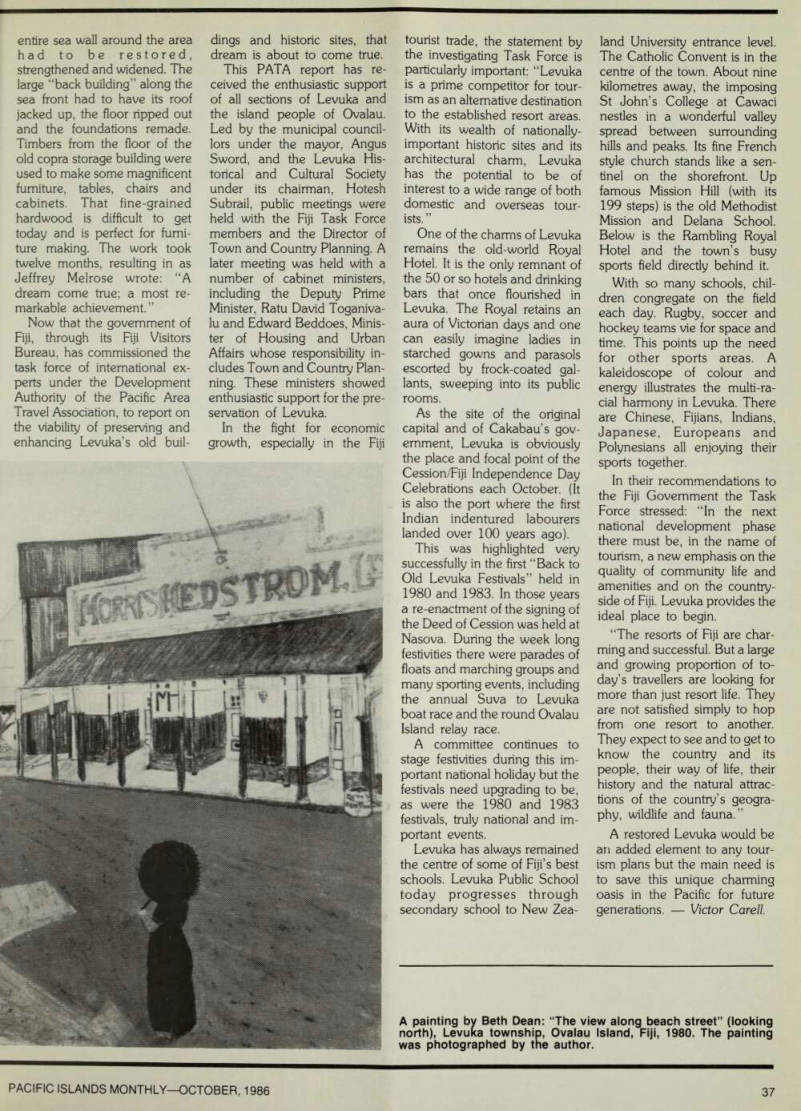
That description by an early traveller is just as true today. To wander along Beach Street past the 100 year old stores with false fronts and some ginger bread verandahs that evoke a taste and fashion of a forgotten era; to pass the lovely churches, among the oldest in the Pacific, the graceful Levuka Public School, the nostalgic Queen Victoria Hall and Municipal Offices standing between the Masonic Temple and the Ova lau Club or to visit Draiba Cemetery, where so many of Fiji’s pioneers are at rest, after passing the hallowed ground of the Cession site where three immense boulders stand, is to
see history as a living part of today’s Fiji.
One of those stones com memorate the signing of the Deed of Cession in 1874, the second the granting of Inde pendence to Fiji in 1970 and the third the Centenary of Ces sion in 1974.
The 1973 Belt, Collins report emphasised the value of old Levuka to tourism in the Paci fic. It was followed by many verbal reports and opinions ex
pressed by a succession of knowledgeable visitors and be came also the subject of a thesis by Jeffrey Melrose, a Town Planner of Hawaii. All of this gave birth to the Levuka His torical and Cultural Society which was formed “to preserve and improve Levuka as the living heart and pride of Fiji”.
This committee realised from the beginning that what was most needed was a town plan to safeguard, and preserve all buildings of cultural and his torical value, and where pos sible to restore them to their original condition. In this aim the society led the way. When the original old Morris Hed strom buildings were transfer red to the National Trust of Fiji, the Society took on the re sponsibility to convert the emp ty shells into a community centre.
The job of restoration and conversion was gigantic. The
entire sea wall around the area had to be restored, strengthened and widened. The large “back building” along the sea front had to have its roof jacked up, the floor ripped out and the foundations remade.
Timbers from the floor of the old copra storage building were used to make some magnificent furniture, tables, chairs and cabinets. That fine-grained hardwood is difficult to get today and is perfect for fumiture making. The work took twelve months, resulting in as Jeffrey Melrose wrote: “A dream come true; a most remarkable achievement.”
Now that the government of Fiji, through its Fiji Visitors Bureau, has commissioned the task force of international experts under the Development Authority of the Pacific Area Travel Association, to report on the viability of preserving and enhancing Levuka’s old buil-
dings and historic sites, that dream is about to come true, This PATA report has re ceived the enthusiastic support of all sections of Levuka and the island people of Ovalau.
Led by the municipal council lors under the mayor, Angus Sword, and the Levuka His torical and Cultural Society under its chairman, Hotesh Subrail, public meetings were held with the Fiji Task Force members and the Director of Town and Country Planning. A later meeting was held with a number of cabinet ministers, including the Deputy Prime Minister, Ratu David Toganiva lu and Edward Beddoes, Minis ter of Housing and Urban Affairs whose responsibility in eludes Town and Country Plan ning. These ministers showed enthusiastic support for the pre servation of Levuka.
In the fight for economic growth, especially in the Fiji
tourist trade, the statement by the investigating Task Force is particularly important: “Levuka is a prime competitor for tour ism as an alternative destination to the established resort areas.
With its wealth of nationally important historic sites and its architectural charm, Levuka has the potential to be of interest to a wide range of both domestic and overseas tour ists.”
One of the charms of Levuka remains the old-world Royal Hotel. It is the only remnant of the 50 or so hotels and drinking bars that once flourished in Levuka. The Royal retains an aura of Victorian days and one can easily imagine ladies in starched gowns and parasols escorted by frock-coated gal lants, sweeping into its public rooms.
As the site of the original capital and of Cakabau’s gov ernment, Levuka is obviously the place and focal point of the Cession/Fiji Independence Day Celebrations each October. (It is also the port where the first Indian indentured labourers landed over 100 years ago).
This was highlighted very successfully in the first “Back to Old Levuka Festivals” held in 1980 and 1983. In those years a re-enactment of the signing of the Deed of Cession was held at Nasova. During the week long festivities there were parades of floats and marching groups and many sporting events, including the annual Suva to Levuka boat race and the round Ovalau Island relay race.
A committee continues to stage festivities during this im portant national holiday but the festivals need upgrading to be, as were the 1980 and 1983 festivals, truly national and im portant events.
Levuka has always remained the centre of some of Fiji’s best schools. Levuka Public School today progresses through secondary school to New Zea
land University entrance level.
The Catholic Convent is in the centre of the town. About nine kilometres away, the imposing St John’s College at Cawaci nestles in a wonderful valley spread between surrounding hills and peaks. Its fine French style church stands like a sen tinel on the shorefront. Up famous Mission Hill (with its 199 steps) is the old Methodist Mission and Delana School.
Below is the Rambling Royal Hotel and the town’s busy sports field directly behind it.
With so many schools, chil dren congregate on the field each day. Rugby, soccer and hockey teams vie for space and time. This points up the need for other sports areas. A kaleidoscope of colour and energy illustrates the multi-ra cial harmony in Levuka. There are Chinese, Fijians, Indians, Japanese, Europeans and Polynesians all enjoying their sports together.
In their recommendations to the Fiji Government the Task Force stressed: “In the next national development phase there must be, in the name of tourism, a new emphasis on the quality of community life and amenities and on the country side of Fiji. Levuka provides the ideal place to begin.
“The resorts of Fiji are char ming and successful. But a large and growing proportion of to day’s travellers are looking for more than just resort life. They are not satisfied simply to hop from one resort to another.
They expect to see and to get to know the country and its people, their way of life, their history and the natural attrac tions of the country’s geogra phy, wildlife and fauna.”
A restored Levuka would be an added element to any tour ism plans but the main need is to save this unique charming oasis in the Pacific for future
generations.
Victor Carell.
A painting by Beth Dean: “The view along beach street” (looking north), Levuka township, Ovalau Island, Fiji, 1980. The painting was photographed by the author.