on the deep slopes
pp. 32-33 · Read in the full issue

Fortunes to be made on the deep slopes
The fishery resources of Pacific islands are often thought, even by people familiar with the Pacific, to consist only of the open ocean species such as tuna and billfish and the near shore fishes and crustaceans found on shallow coral reefs.
However, on the deep slopes of the islands, there are fishery resources which are heavily ex ploited in only a few places, such as Hawaii. These re sources represent an opportun ity to expand island fisheries for small and medium sized multi purpose vessels.
The ex-vessel value of the fisheries for the deep slope resources in Hawaii for 1985 was conservatively estimated to be over $lO million.
The Southwest Fisheries Center Honolulu Laboratory, National Marine Fisheries Service (NMFS) has conducted research on deep slope re sources in Hawaii and the Marianas.
One aspect of this work has been to estimate the maximum sustainable yields for a number of the deep slope resources.
Many of the same deep slope fish and invertebrates occur throughout the Pacific.
The maximum sustainable fishery yields per area of appropriate habitat appear fair ly constant among the Pacific islands. Thus the yields found in Hawaii and the Marianas can be used as first approximations for fishery devlopment in other Pacific islands.
Perhaps the most common to all the islands are the bottom fish jacks, snappers, and
groupers found along the deep slopes at depths from 80 to 300 m. These fish usually weigh from 2 to 10 kg although some of the groupers can weigh over 100 kg.
The South Pacific Commis sion’s outer reef fishing prog ram, together with NMFS sur vey work, has produced data for over 20 island archipela goes. These show that most of the same species are found all across the Pacific but that the
relative contribution of any spe cies to the group at any island
varies considerably.
In Hawaii the bottom fish resource is fished by recreatio nal and commercial fishermen from vessels primarily in the 6 to 15 m range; hook-and-line gear operated with electric or hydraulic gurdies is used.
These fish command a high price. In 1984, the average wholesale price was $5.83/kg, while the two highest priced
species averaged $B.BO and $7.37/kg. However, these prices vary considrably with supply.
Based on our research in Hawaii and the Marianas we have found that it is useful to measure the habitat for these fishes as the length of the 100 fathom depth contour. We esti mate that a yield of 250 kg of bottom fishes per nautical mile of 100 fm isobath appears to represent a reasonable
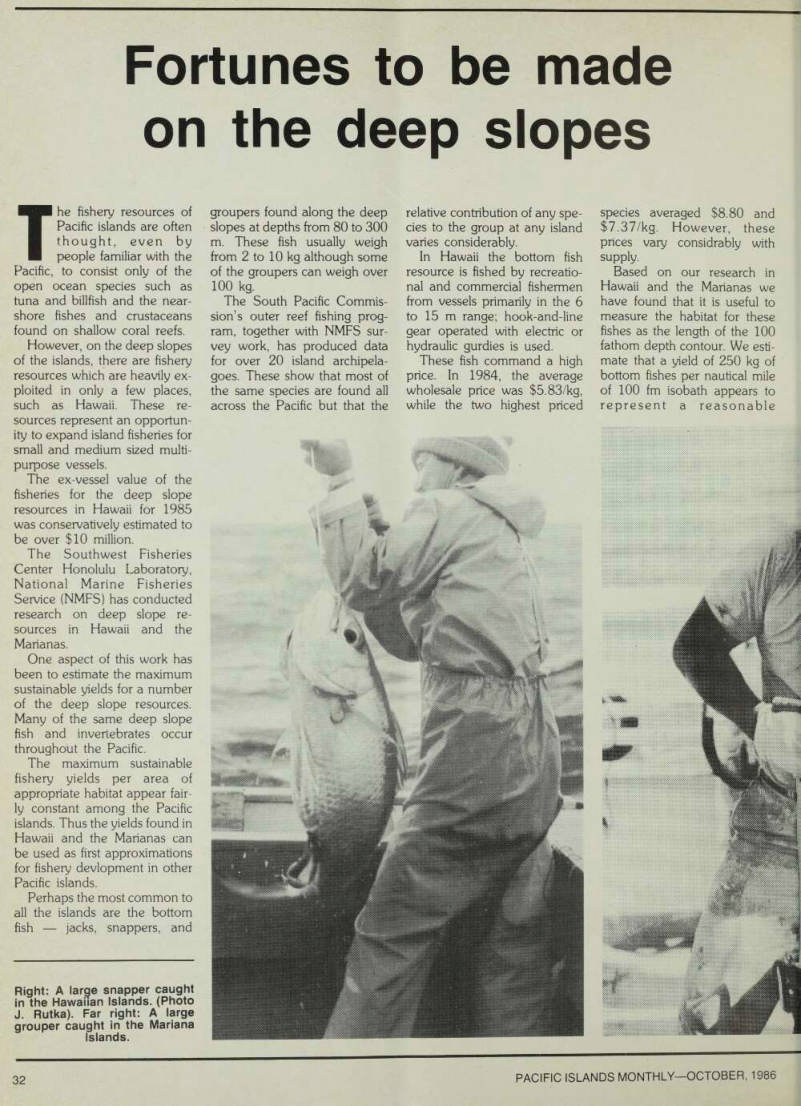
Right: A large snapper caught in the Hawaiian Islands. (Photo J. Rutka). Far right: A large grouper caught in the Mariana Islands.
achipelago average for the maximum sustainable yield that can be expected from the bot tom fish resource.
Thus an island chain with a length of 100 fm isobath of 500 nmi (about the size of the Marianas) can expect a maxi mum sustainable yield of 125 metric tons per year from its deep slope bottom fish fishery.
At a price of $5/kg this landing would be valued at $0.6 million. If the resource were fished by a fleet of 20 vessels the average landing per vessel would be 6.3 metric tons valued at $31,250.
Another deep slope resource which appears Pacific wide is deepwater shrimp. These are caught in baited traps in depths from 400 to 750 m. Although these shrimps (there are several related species) command a
premium price (about $5.50/kg in Hawaii), the depth at which they are caught makes fishing for them an expensive propositi° n - There have been several commercial ventures for these resources both in Hawaii and the Marianas but most have not proven successful. We estimate an archipelago average maximum sustainable yield of 200 kg of shrimp per square nautical mile of habitat.
Thus for an archipelago which has 1000 square nautical miles of habitat in the appropriate depth range (which is about the area of the deepwater shrimp habitat in the Marianas) the annual maximum sustainable yeild for the deepwater
shrim resource is 200 metric tons. At a price of $5.50/kg the value of this landing would be $l.l million.
Again, a fleet of 20 vessels harvesting this resource would have an average annual landing per vessel of 10 metric tons with a value of $55,000.
Although the value of these deep slope resources is very small in comparision to tuna, they are significant compared to the shallow water reef resources. Further they can be fished with small to to medium sized vessels and can be marketed locally on most islands to hotels and restaurants.
The biggest concerns facing development of deep slope fisheries are over capitalisation
and overfishing. Initial catch rates in certain areas may be very high and when extrapo lated over the habitat area of the archipelago may encourage large capital investment in the fishery, However, these initial catch rates should not be taken to represent long term averages, Due to the limited habitat area it is easy to heavily fish the deep slope resources; to avoid the boom and bust cycle which often occurs in island fisheries it may be necessary to regulate the fishery. Jeffrey Polouina.
The author is leader of the Artificial Reef and Enhance ment Program at the National Marine Fisheries Service, Hon olulu Laboratory.