the TV race
pp. 25-26 · Read in the full issue
trade winds
New runner enters the TV race
It’s a troubled time for television. With PNG effectively banning broadcast TV until 1988 and Fiji hinting that the exclusive deal with PBL of Australia may not be so exclusive after all, the picture is hazy.
Adding to the interference has been the TV New Zealand proposal to broadcast public service television to the whole region.
The proposal was received by the Suva forum meeting with some countries known to be broadly in favour.
This, coupled with PNG prime minister Paias Wingti’s adamant opposition to the immediate introduction of broadcast televi sion, has made most observers think again.
The TVNZ plan, as outlined by consul tant Allan Martin in a keynote address at the 1986 Parkinson Memorial Lecture series at USP, is to broadcast to the region by means of its Instelsat facility.
Societies such as those in the Pacific, he said, “have a right to expect that such a medium as powerful as television will be used to protect local culture.
“The stimuli for behaviour and stan dards should still come from local pulpits and platforms and not from the West Coast of America.
“It is important for every nation to see itself on television if that country’s national cultural identity is not to be eroded ... ultimately, political sovereignty rests on cultural sovereignty.”
But where will the money come from?
The proposal now in place would require increased or diverted funding from the forum with support from other agen cies.
Critics point out, however, that without long term guarantees, the forum would not be in a position to commit itself to funding such a service because if the funds dry up the forum could be left with a financial millstone.
Also, there may simply not be enough
spare cash in the forum kitty.
One man undeterred by the New Zealand plan is PBL managing director, Mr Lynton Taylor. “I don’t view them as competition,” he told PIM. “That’s not because they’re not commercial, but be cause, at the moment there’s no indication of where the money will come from.
“As I understand it, they are asking the forum countries to come up with some money. And I don’t know if any of the forum countries are eager to do that.”
Mr Taylor is of the view, also, that Fiji has not specifically reserved the right to enter into something like the TVNZ propo sal as it stands. “Fiji has retained the right
to establish its own internal service,” he said.
But if the Fiji parliament decides to proceed with a New Zealand option?
“That’s a hypothetical question and I don’t propose to answer it.”
In any case, the TVNZ plan is still some way in the distance.
The paper read to the forum has been referred to a SPEC sub committee to evaluate and report. This effectively ended its discussion in the forum meetings in Suva.
SPEC director, Mr Henry Naisali, told PIM: “The experts will examine the various aspects of the proposal and report back to the full SPEC committee. I don’t think that’s likely to happen before the end of this year.”
The New Zealand proposal contained a costing, he explained, but the question of funding “is still up in the air.”
Meanwhile, in PNG, Niugini Television Network (NTN), the first TV broadcaster to be granted a licence, has been stymied by legislation.
The company had challenged the deci sion by Wingti to suspend broadcasting until after a commission of inquiry into its likely effects had reported probably next year.
The PNG national court looked as though it would find in favour of the company, so Wingti, as predicted by several insiders, promptly took his case to a higher court Parliament and passed a Bill outlawing broadcast TV before 1988.
The National Court, two days after the Bill was passed, did find in favour of NTN, a subsidiary of the Parry Corporation’s Newcastle Broadcasting Network (NBN) in Australia.
The agreement with the previous So mare government should stand, ruled chief justice Sir Buri Kidu. NTN then moved to challenge the new legislation on con stitutional grounds. With an election in
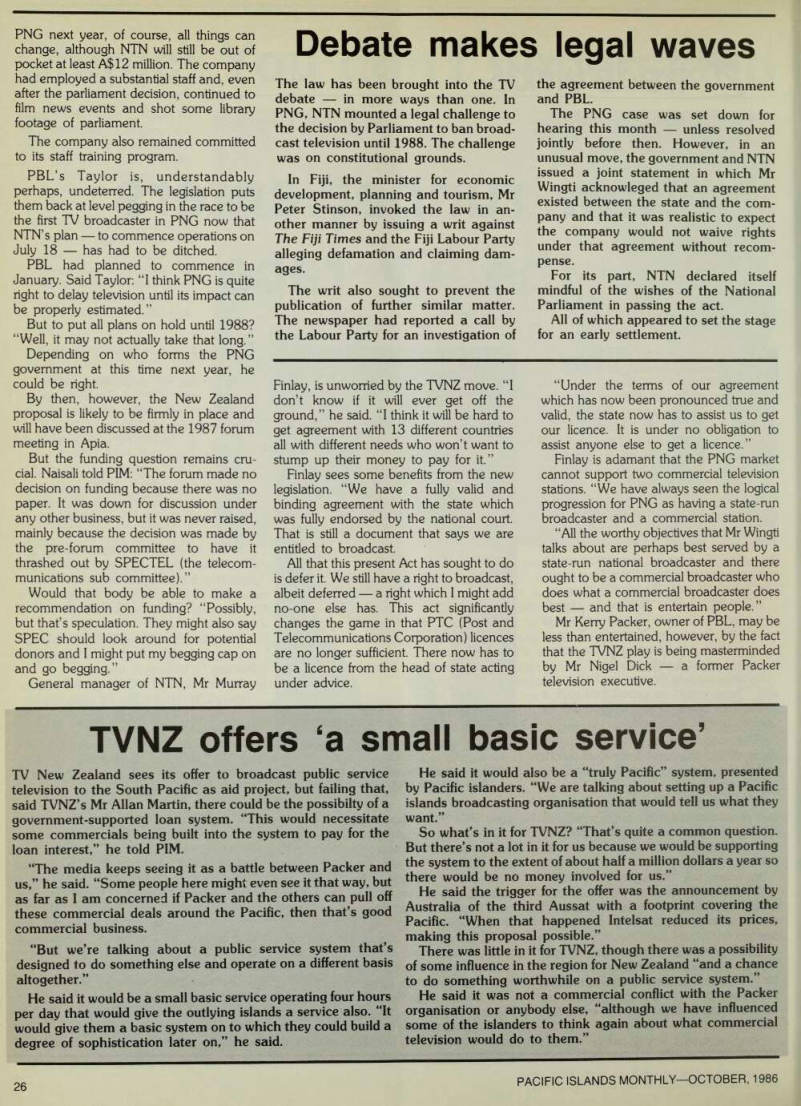
Media magnate Kerry Packer. His PBL Ltd. has several proposals in place.
PNG next year, of course, all things can change, although NTN will still be out of pocket at least Asl2 million. The company had employed a substantial staff and, even after the parliament decision, continued to film news events and shot some library footage of parliament.
The company also remained committed to its staff training program.
PBL’s Taylor is, understandably perhaps, undeterred. The legislation puts them back at level pegging in the race to be the first TV broadcaster in PNG now that NTN’s plan to commence operations on July 18 has had to be ditched.
PBL had planned to commence in January. Said Taylor: “I think PNG is quite right to delay television until its impact can be properly estimated.”
But to put all plans on hold until 1988?
“Well, it may not actually take that long. ”
Depending on who forms the PNG government at this time next year, he could be right.
By then, however, the New Zealand proposal is likely to be firmly in place and will have been discussed at the 1987 forum meeting in Apia.
But the funding question remains cru cial. Naisali told PIM; “The forum made no decision on funding because there was no paper. It was down for discussion under any other business, but it was never raised, mainly because the decision was made by the pre-forum committee to have it thrashed out by SPECTEL (the telecom munications sub committee).”
Would that body be able to make a recommendation on funding? “Possibly, but that’s speculation. They might also say SPEC should look around for potential donors and I might put my begging cap on and go begging.”
General manager of NTN, Mr Murray
Finlay, is unworried by the TVNZ move. “I don’t know if it will ever get off the ground,” he said. “I think it will be hard to get agreement with 13 different countries all with different needs who won’t want to stump up their money to pay for it.”
Finlay sees some benefits from the new legislation. “We have a fully valid and binding agreement with the state which was fully endorsed by the national court.
That is still a document that says we are entitled to broadcast.
All that this present Act has sought to do is defer it. We still have a right to broadcast, albeit deferred a right which 1 might add no-one else has. This act significantly changes the game in that PTC (Post and Telecommunications Corporation) licences are no longer sufficient. There now has to be a licence from the head of state acting under advice.
“Under the terms of our agreement which has now been pronounced true and valid, the state now has to assist us to get our licence. It is under no obligation to assist anyone else to get a licence.”
Finlay is adamant that the PNG market cannot support two commercial television stations. “We have always seen the logical progression for PNG as having a state-run broadcaster and a commercial station.
“All the worthy objectives that Mr Wingti talks about are perhaps best served by a state-run national broadcaster and there ought to be a commercial broadcaster who does what a commercial broadcaster does best and that is entertain people.”
Mr Kerry Packer, owner of PBL, may be less than entertained, however, by the fact that the TVNZ play is being masterminded by Mr Nigel Dick a former Packer television executive.