Dien Bien Thio:
p. 23 · Read in the full issue
calm returns
The French called it Dien Bien Thio a bitter recollection of the pro longed siege and then defeat of their armed forces by Ho Chi Minh during the Viet namese war of independence 30 years earlier.
For three weeks in late 1984 the FLNKS held the east coast mining town of Thio under siege.
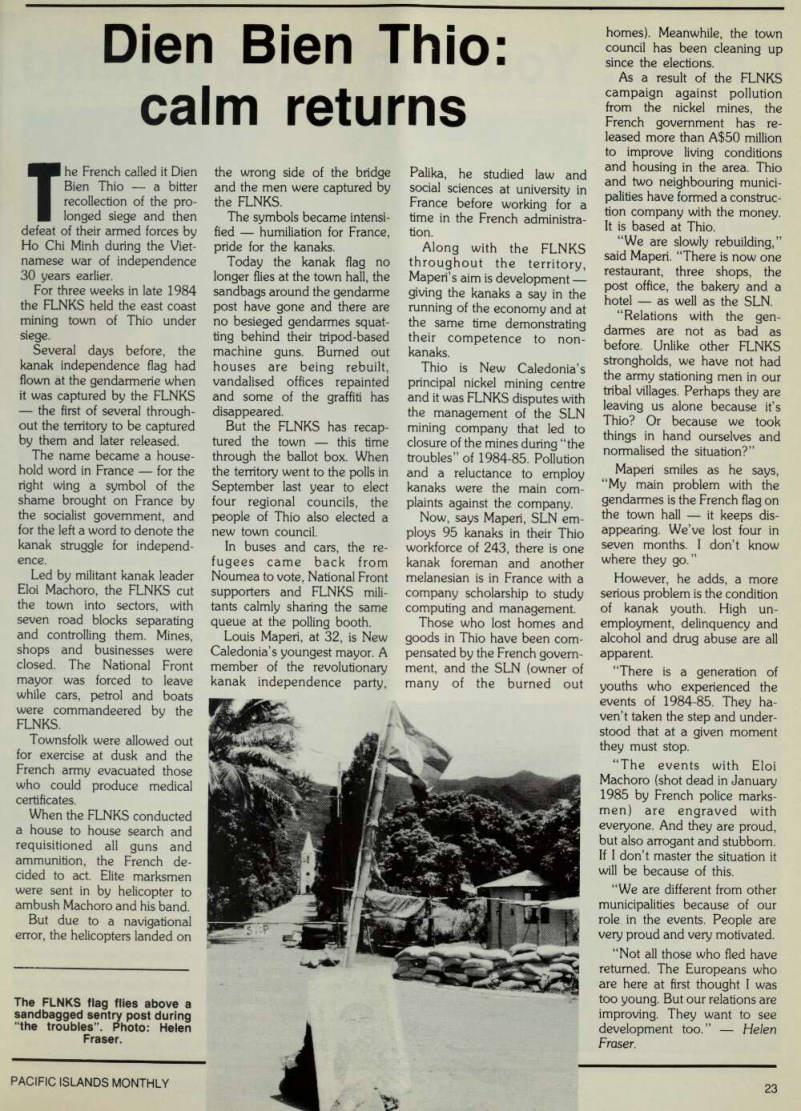
Several days before, the kanak independence flag had flown at the gendarmerie when it was captured by the FLNKS the first of several through out the territory to be captured by them and later released.
The name became a house hold word in France for the right wing a symbol of the shame brought on France by the socialist government, and for the left a word to denote the kanak struggle for independ ence.
Led by militant kanak leader Eloi Machoro, the FLNKS cut the town into sectors, with seven road blocks separating and controlling them. Mines, shops and businesses were closed. The National Front mayor was forced to leave while cars, petrol and boats were commandeered by the
Flnks.
Townsfolk were allowed out for exercise at dusk and the French army evacuated those who could produce medical certificates.
When the FLNKS conducted a house to house search and requisitioned all guns and ammunition, the French de cided to act. Elite marksmen were sent in by helicopter to ambush Machoro and his band.
But due to a navigational error, the helicopters landed on
the wrong side of the bridge and the men were captured by the FLNKS.
The symbols became intensi fied humiliation for France, pride for the kanaks.
Today the kanak flag no longer flies at the town hall, the sandbags around the gendarme post have gone and there are no besieged gendarmes squat ting behind their tripod-based machine guns. Burned out houses are being rebuilt, vandalised offices repainted and some of the graffiti has disappeared.
But the FLNKS has recap tured the town this time through the ballot box. When the territory went to the polls in September last year to elect four regional councils, the people of Thio also elected a new town council.
In buses and cars, the re fugees came back from Noumea to vote, National Front supporters and FLNKS mili tants calmly sharing the same queue at the polling booth.
Louis Maperi, at 32, is New Caledonia’s youngest mayor. A member of the revolutionary kanak independence party,
Palika, he studied law and social sciences at university in France before working for a time in the French administra tion.
Along with the FLNKS throughout the territory, Maperi’s aim is development giving the kanaks a say in the running of the economy and at the same time demonstrating their competence to non kanaks.
Thio is New Caledonia’s principal nickel mining centre and it was FLNKS disputes with the management of the SLN mining company that led to closure of the mines during “the troubles” of 1984-85. Pollution and a reluctance to employ kanaks were the main com plaints against the company.
Now, says Maperi, SLN em ploys 95 kanaks in their Thio workforce of 243, there is one kanak foreman and another melanesian is in France with a company scholarship to study computing and management.
Those who lost homes and goods in Thio have been com pensated by the French govern ment, and the SLN (owner of many of the burned out
homes). Meanwhile, the town council has been cleaning up since the elections.
As a result of the FLNKS campaign against pollution from the nickel mines, the French government has re leased more than Asso million to improve living conditions and housing in the area. Thio and two neighbouring munici palities have formed a construc tion company with the money.
It is based at Thio.
“We are slowly rebuilding,” said Maperi. “There is now one restaurant, three shops, the post office, the bakery and a hotel as well as the SLN.
“Relations with the gen darmes are not as bad as before. Unlike other FLNKS strongholds, we have not had the army stationing men in our tribal villages. Perhaps they are leaving us alone because it’s Thio? Or because we took things in hand ourselves and normalised the situation?”
Maperi smiles as he says, “My main problem with the gendarmes is the French flag on the town hall it keeps dis appearing. We’ve lost four in seven months. I don’t know where they go.”
However, he adds, a more serious problem is the condition of kanak youth. High un employment, delinquency and alcohol and drug abuse are all apparent.
“There is a generation of youths who experienced the events of 1984-85. They ha ven’t taken the step and under stood that at a given moment they must stop.
“The events with Eloi Machoro (shot dead in January 1985 by French police marks men) are engraved with everyone. And they are proud, but also arrogant and stubborn.
If I don’t master the situation it will be because of this.
“We are different from other municipalities because of our role in the events. People are very proud and very motivated.
“Not all those who fled have returned. The Europeans who are here at first thought I was too young. But our relations are improving. They want to see
development too.”
Helen
Fraser.
The FLNKS flag flies above a sandbagged sentry post during “the troubles”. Photo: Helen Fraser.