More to this island than caves
letters
Tofua is known as the place in Tonga where Captain Bligh came ashore 196 years ago. In PIM of June last year, Bengt Danielsson claimed the re discovery of the Bligh cave, without being able to produce a photograph of it.
In PIM of September last year, again attention is paid to Tofua and again to the Bligh cave. This time with a photo graph that indicates that Kim Gravelle and Bill Verity have been there, although no cave is shown, but the opposite island Kao is.
All this might give the im pression that there is nothing more interesting on Tofua than
the “might-have-been-Bligh
cave”. Tofua has many caves with stony beaches, as do many other less remote islands.
Tofua is a magnificent island with dense unspoiled jungle on steep slopes with huge ferns, parrots and wild pigs. There is one village, Hokula (10 houses and three churches), plus two smaller settlements called Ha’amatu’a and Manaka.
Tofua is, in fact, a half sunk en volcano, almost round and five miles in diameter. The crater is two-thirds lake (called Lofia) and-one third active vol cano. Very few people on Tofua have been down to the lake.
Last July we went there ourselves a zigzag voyage with whatever was available on boats which took us 13 days.
Traffic to and from Tofua goes mainly over the nearest inhab ited island of Kotu.
There are several places to go ashore on Tofua, but all are difficult and tricky. Approaching
In August PIM the source quoted in the article “Foreign business beats a slow re treat,” was wrongly identified as John Bailey. This should have read John Hailey whose report “Indigenous Business in Fiji” was quoted in the article. The error is regretted.
a possible landing place from a little fishing boat makes you think you’re heading for a steep cliff and that you need to be a seal to get ashore.
Very close to the beach the helmsman says “puna ki lalo palangi”, then, you’ve got to jump. If you miss that you wait for the next right wave.
Going to the east side of Tofua, passing a little settlement of kava-planters called Manaka, to the top takes three to four hours climbing over a foot-wide almost invisible track.
From the top it has a beauti ful view over the lake and the impressive smoking volcano below. Going down into the crater over loose gravel is tricky.
The slopes are steep. You’ve got to watch every step.
In the part of the crater that is still active, a desert of red brown gravel, are in fact three little volcanoes. The two small est are dead. The biggest pro duces constant sulphur fumes which can be seen on islands 50 miles away.
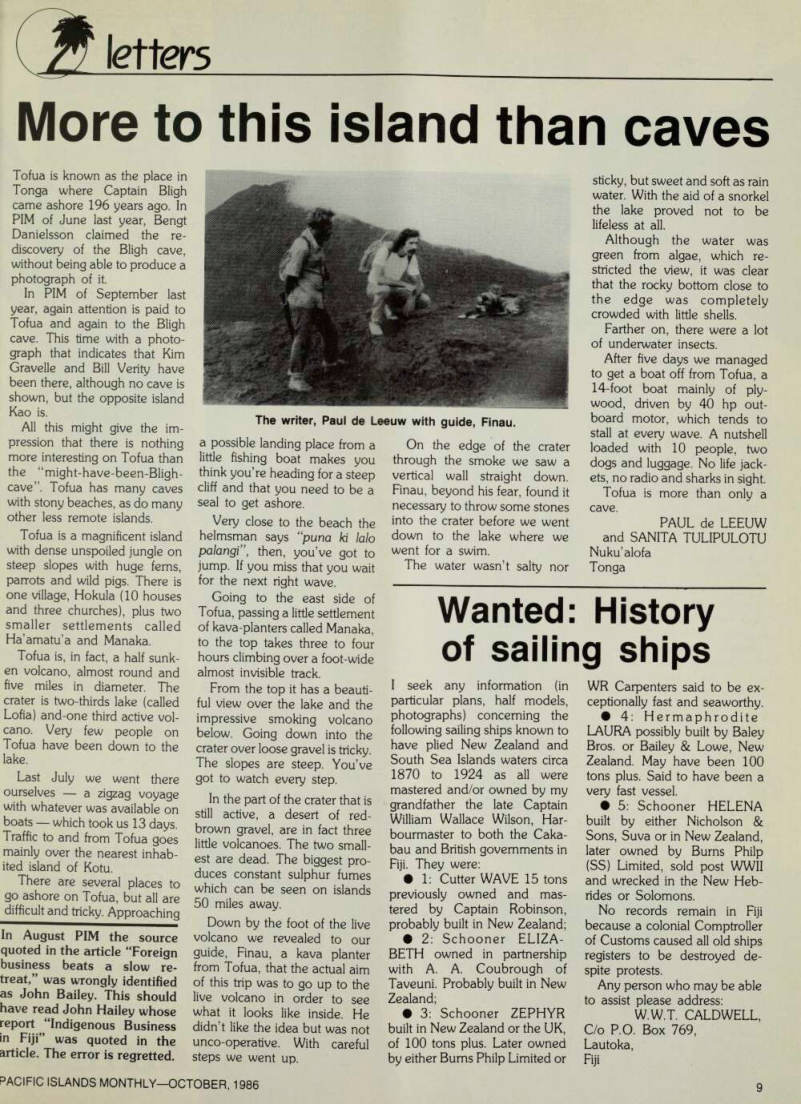
Down by the foot of the live volcano we revealed to our guide, Finau, a kava planter from Tofua, that the actual aim of this trip was to go up to the live volcano in order to see what it looks like inside. He didn’t like the idea but was not unco-operative. With careful steps we went up.
On the edge of the crater through the smoke we saw a vertical wall straight down.
Finau, beyond his fear, found it necessary to throw some stones into the crater before we went down to the lake where we went for a swim.
The water wasn’t salty nor
sticky, but sweet and soft as rain water. With the aid of a snorkel the lake proved not to be lifeless at all.
Although the water was green from algae, which re stricted the view, it was clear that the rocky bottom close to the edge was completely crowded with little shells.
Farther on, there were a lot of underwater insects.
After five days we managed to get a boat off from Tofua, a 14-foot boat mainly of ply wood, driven by 40 hp out board motor, which tends to stall at every wave. A nutshell loaded with 10 people, two dogs and luggage. No life jack ets, no radio and sharks in sight.
Tofua is more than only a cave.
Paul De Leeuw
And Sanita Tulipulotu
Nukualofa Tonga
The writer, Paul de Leeuw with guide, Finau.