yachts
pp. 51-52 · Read in the full issue
Judith Sellars
reports from Suva:
Picture the classic English sailor, compulsive rum swiper and all, and you have the correct image of solo yachtsman, Charlie Smith, aboard his 27 ft British Nova design sloop, Aquila Nova.
A Royal Navy officer for 13 years, the last eight in the submarines, Charlie purchased Aquila Nova for £7OOO during his final year in the service, and after reading books on sailing and navigating, and a couple of successful runs up the English coast to Ireland, he sailed out of Plymouth on his first offshore passage.
He crossed the Atlantic in 32 days and headed for South America and the Caribbean.
Once he dropped anchor at the port of Tortola, in the British Virgin Islands, he got himself a
job at the newly established Pusser’s Rum factory.
The job suited him down to the ground since Pusser’s Rum (Pusser’s being slang for the Royal Navy), had been an old tradition in the navy until it was abolished in the 19705.
A wealthy American then came along, bought the rights to commercialise the tradition of more than 300 years and opened up a factory in Tortola.
Charlie, of course, acquired many benefits with the job, and used to mix his own special rum potions of 160 proof, from the usual 95.5 proof of which Pus ser’s Rum is so proud.
After working at the factory for 18 months, Charlie met his Canadian crew, Robyn, ended his reputation as a solo sailor, for a while at least, and via the Panama Canal, cruised through the Pacific to Tahiti, Tonga and then Fiji.
After a short stay in Fiji, where Charlie seems to be
enjoying the local Bounty Rum, he plans to sail to Adelaide to visit his family, who he has not seen in over 10 years since they left England to settle in Aus tralia.
Charlie says he plans to get a temporary job there and hopes to fulfil some of his sailing dreams such as a trip through the East to Russia or a cruise around the Antarctic.
Fibreglass hulled Aquila Nova is quite ship-shape con sidering her small size. And with Charlie’s engineering special ties, he has made her a very efficient and independent cruiser.
Without much faith in electri cal appliances, Charlie’s home made refrigerator is an Igloo icebox, fitted with compart ments and an electrical com pressor which is powered by a wind generator, purchased in the United States.
His two burner propane gas stove is complete with a grill and oven, and Charlie proudly bakes his own bread every couple of days while at sea.
For navigation, the solo sailor relies totally on a plastic sextant he bought in England for £2l and a watch, for which he paid £l7.
Aquila Nova is also equipped with a VHF radio, a Seafarer depth sounder, and an Aries wind vane self steering system, which Charlie says is in opera tion the very minute he hoists his sails.
For auxiliary power, a Saab single cylinder diesel 10 horsepower engine is installed, although Charlie says he rarely finds a need for it.
After three years of sailing, Charlie says that the Atlantic crossing was far easier than the Pacific, for he experienced rough seas and gales, although he boasts that his 27-footer handled it quite well, consider ing she was designed as a day sailor.
• ISH-KA-BIBBLE. Husband and wife team, Dawn and Orron Hickling, recently cruised into Suva harbor aboard their 39 ft Caraff Vulcane 111 centre cockpit cutter-rig Ish-Ka-Bibble.
Steel-hulled Ish-Ka-Bibble, which is an American Yiddish expression for “What the hell!”, which according to Dawn, ex presses their life-style really well, was purchased in Panama in 1983.
The couple first began sailing more than eight years ago in Pleiades, a wooden hulled sloop which they owned at the time.
They cruised the Alaskan coast extensively for about two years before they decided to break out and sailed from Homer, their home town on their first ocean passage.
They cruised the U.S. West Coast, down through Mexico, then sailed about 100 miles off-shore to Costa Rica and South America.
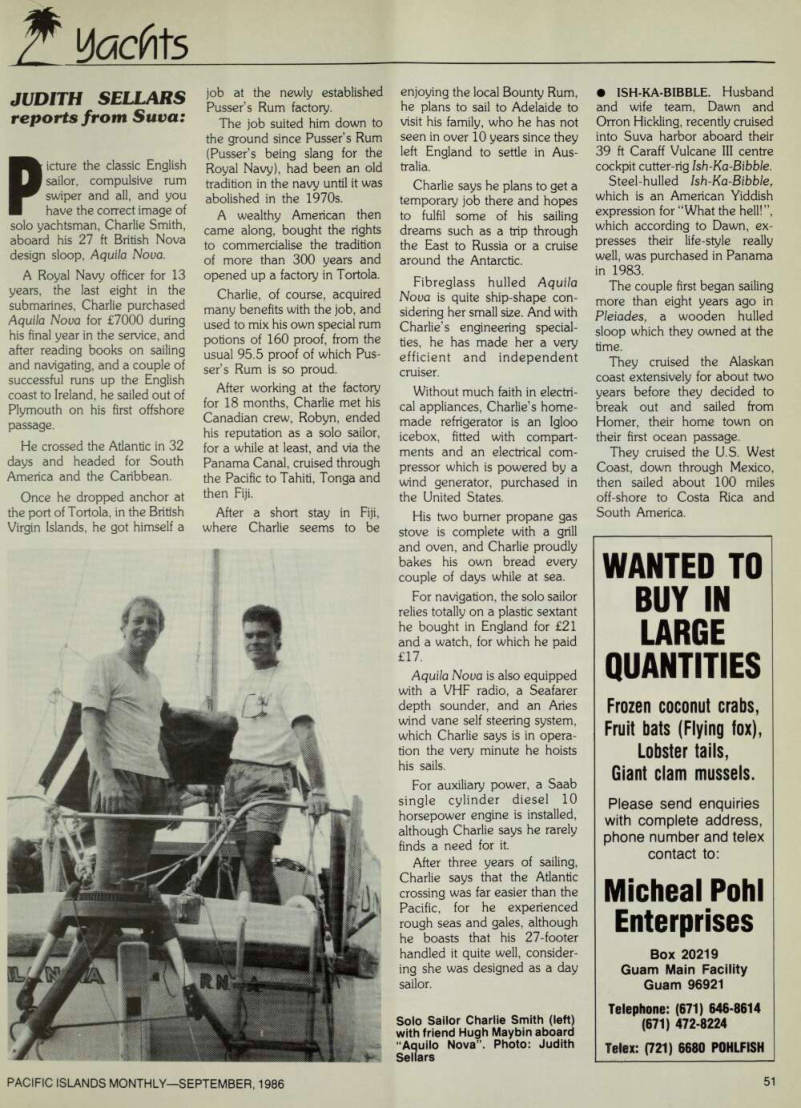
Solo Sailor Charlie Smith (left) with friend Hugh Maybin aboard “Aquilo Nova”. Photo: Judith Sellars
After cruising between Costa Rica and Panama for about a year and a half, Dawn and Orron were home-sick and headed for Alaska, stopping along the way to visit family and friends.
They embarked on their first pacific voyage last September, and headed for Hawaii, before sailing on a 10 day passage to Palmyra.
The island atoll, which is privately owned by an Hawaiian family, was once a U.S. naval base, so a number of buildings are still standing, with fresh water from tanks always available.
Dawn described an old log book that has been on the island for many years, in which they faithfully entered their visit alongside other yachties, and seamen from navy ships and research vessels.
They finally sailed on to American Samoa for provi sions, before continuing to Ton ga and Fiji.
After a short stay in Fiji, the couple plan to vist New Caledo
nia before sailing to New Zea land and Australia, where they hope to stay for a year in each country.
Ish-Ka-Bibble’s comfortable interior consists of the main saloon, which is surprisingly very spacious with no bulk heads, and is nicknamed the “mountain cabin” because of its cosy wood finish.
The master cabin is located aft, while a small stateroom, now a workshop and the galley is located amidships.
The yacht is well equipped with a satellite navigator and a sextant, while for communica tion, the Hicklings have a VHF and a ham radio, which Dawn proclaims is the best thing to have ever happened to ocean cruising.
She says she makes at least two calls per week to friends and family all over the world, and never has to worry about missing out on birthdays.
For refrigeration and cook ing, power is supplied by prop ane tanks located at the stern, while a propane detection unit and a shut-off safety valve is installed in both units.
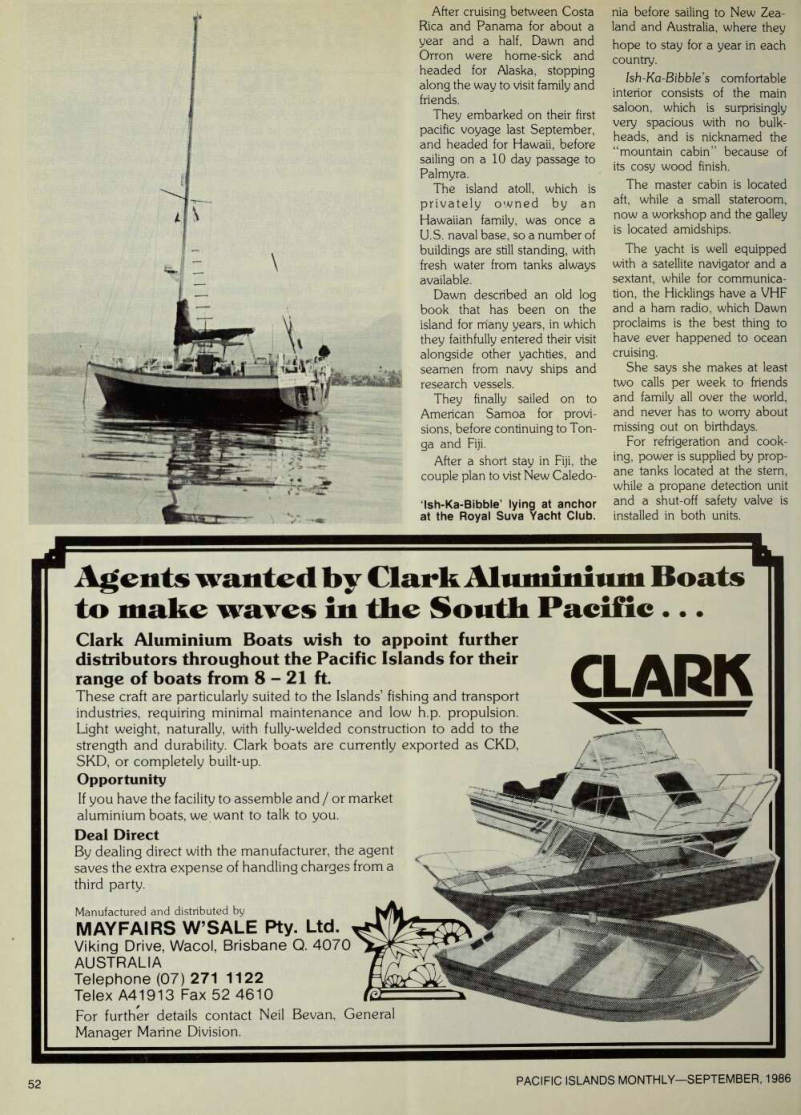
Ish-Ka-Bibble’ lying at anchor at the Royal Suva Yacht Club.