A white man caught
pp. 43-44 · Read in the full issue
books
A white man caught in the middle
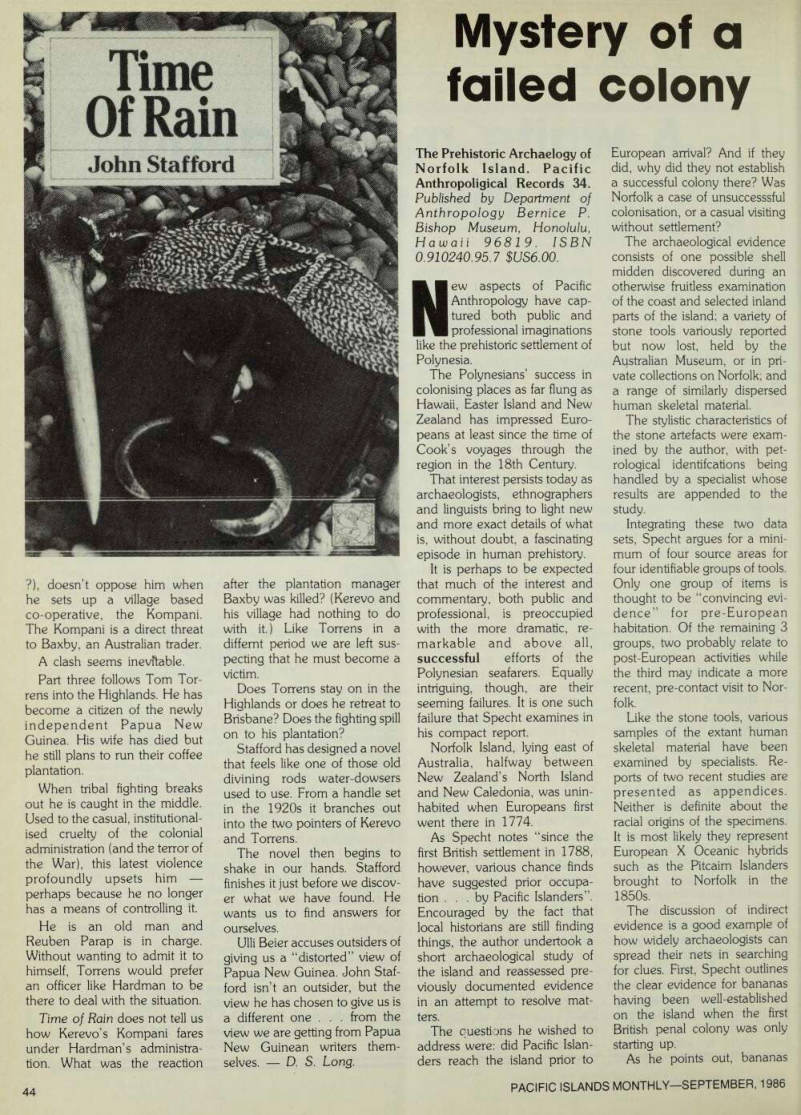
Time of Rain by John Staf ford. Published by R/gby, Syd ney. 326 pp. ISBN 0 7270 2035 8.
In 1972 I discovered the literature of Papua New Guinea through the work of Ulli Beier. Forced to leave Europe he had gone first to Nigeria where he founded a remarkable journal, Black Orpheus.
He gave voice to a second people’s literature when he moved to Papua New Guinea and created his Papuan Pocket Poets series and another jour nal, Kouaue. (Marjorie Cro combe paid tribute to his work in the August, 1980 issue of
Pim).
The silence of Papua New Guineans was broken when Albert Maori Kiki published his autobiography Kiki: Ten thousand years in a lifetime, in 1968. In Black Writing from New Guinea (1973) Beier tells us that among the colonial circles of the day Kiki’s book “was received with a great deal of distrust and sometimes hostility. ”
John Stafford was bom in Sri Lanka and was educated in New Zealand. He became a Cadet Patrol Officer in Papua New Guinea ten years before Kiki appeared. He later became a plantation manager. Stafford currently lives in Brisbane.
Many of the characters in Time of Rain are developed with great authenticity. When Tom Torrens first enters the valley of the Tengit in 1938 we can imagine Stafford discover ing such a valley himself, on one of his own patrols. When the Tengit smear their bodies with earth to express their farewell the details seem so
striking we feel we have almost been there ourselves.
He is sensitive to tribal differ ences and seems to describe all his characters even-handedly.
No one is deliberately stripped of their dignity. Not the alcoho lic manager McMullin nor the vada Gigira.
Torren’s difficulties with the present administration are no more than Kerevo’s with an earlier Australian one. (If there are villians in Time of Rain they are usually government admi nistrators of whatever era. We are reminded that the author left the government service for a civilian life.) Time of Rain is about people (Torrens and Kerevo in particu lar) who wish to put the mis takes of the past behind them, but who are confronted with the difficulties inherent in change.
Time of Rain is written in those two lingua franca of Papua New Guinea: English and Pidgin. Stafford has caught the way Australians spoke in “the Territory”. He has an ear for such things.
In 1949 a “Territorian” shouts to another as he leaves a Sydney pub, “Eh, twopela, noken play nogood long all meri, laka?” Pigdin had be come their badge of identifica tion down in the “Big Smoke”.
Reuben Parap is the Police Commander in Kurimba. There is a patch of conversation be tween him and his wife Lena which admirably establishes their relationship. Just listen to them: . . . Reuben looked at her with fury.
“Bloody, bigheaded Papuan bitch?” He stood up, his fists clenched,. . . He had never yet struck his wife, but he felt the time was near.
“Don’t call me those names!”
Lena turned, furious. “You big black pig! Go to your stupid kanaka party. Go and celebrate a little girl’s first menstruation, and help her father make plans for selling her off.”
Close to tears, Lena bit her lip to regain control of herself.
No Pidgin. But Lena and Reuben come from different linguistic areas and presumably use both English and Pidgin when they are talking to each other. They are believable nonetheless.
This novel takes us through three different times. It falls into
three sections. It opens on the Torrens family property several miles out of Port Moresby in the 19205.
They employ a Papuan named Kerevo among their workers. He becomes a friend of one of the sons, Tom.
In the next section, set in the 19505, Kerevo returns to his village after serving with the police. He has been to Bris bane, fought the Japanese and represents the future for his people, or, at least, someone who understands it.
The local Assistant District Officer, Bill Hardman (Stafford
?), doesn’t oppose him when he sets up a village based co-operative, the Kompani.
The Kompani is a direct threat to Baxby, an Australian trader.
A clash seems inevitable.
Part three follows Tom Tor rens into the Highlands. He has become a citizen of the newly independent Papua New Guinea. His wife has died but he still plans to run their coffee plantation.
When tribal fighting breaks out he is caught in the middle.
Used to the casual, institutional ised cruelty of the colonial administration (and the terror of the War), this latest violence profoundly upsets him perhaps because he no longer has a means of controlling it.
He is an old man and Reuben Parap is in charge.
Without wanting to admit it to himself, Torrens would prefer an officer like Hardman to be there to deal with the situation.
Time of Rain does not tell us how Kerevo’s Kompani fares under Hardman’s administra tion. What was the reaction
after the plantation manager Baxby was killed? (Kerevo and his village had nothing to do with it.) Like Torrens in a differnt period we are left sus pecting that he must become a victim.
Does Torrens stay on in the Highlands or does he retreat to Brisbane? Does the fighting spill on to his plantation?
Stafford has designed a novel that feels like one of those old divining rods water-dowsers used to use. From a handle set in the 1920 s it branches out into the two pointers of Kerevo and Torrens.
The novel then begins to shake in our hands. Stafford finishes it just before we discov er what we have found. He wants us to find answers for ourselves.
Dili Beier accuses outsiders of giving us a “distorted” view of Papua New Guinea. John Staf ford isn’t an outsider, but the view he has chosen to give us is a different one . . . from the view we are getting from Papua New Guinean writers them
selves.
D. S. Long.