Misima:
pp. 38-41 · Read in the full issue
The Island Of
A Story Of
Many Mines
Misima, the largest of the Louisiade Islands, lies some 140 miles east of Samarai.
It was also known as St Aig nans Island and is mountainous (the highest point, Mt Oatou, rises to 3400 feet) with a difficult shore surrounded by very deep water.
The island is some 20 miles long and eight miles wide at its widest point.
Although gold was found there in 1884, the island was then better known as a supplier of labour for the Queensland sugar trade the blackbirders knew Misima well enough.
The islanders, possibly as a result, had acquired a reputation for what was then regarded as treachery and the Royal Navy shelled and burned homes and canoes on Misima and neighbouring islands in 1886.
Two years later, miners from the Sudest Island field moved to Misima, their num bers rapidly expanding to 80 by the following year.
They had been working alluvial gold in St Patricks Creek but had found no heavy metal. Most was small, almost flour, gold and the miners moved on to Woodlark Island which was richer and more suitable for these “grass roots” miners.
The Massive Lode, or Umuna Lode, however, was found early in the Misima action and several attempts were made to sluice it profitably where it crossed Cook town Creek. None were successful as the gold was too fine to be caught in the usual sluice boxes.
In 1911, however, one Robert Boyd came over from Woodlark on behalf of a syndicate based there to prospect Misima.
Placer Pacific, owner of the exciting Misima gold prospect in PNG, which was launched last month in the largest ever Australian share float, is not the first company to extract gold from the island. JOHN D WILKINSON has charted the history of mining on the island since the last century.
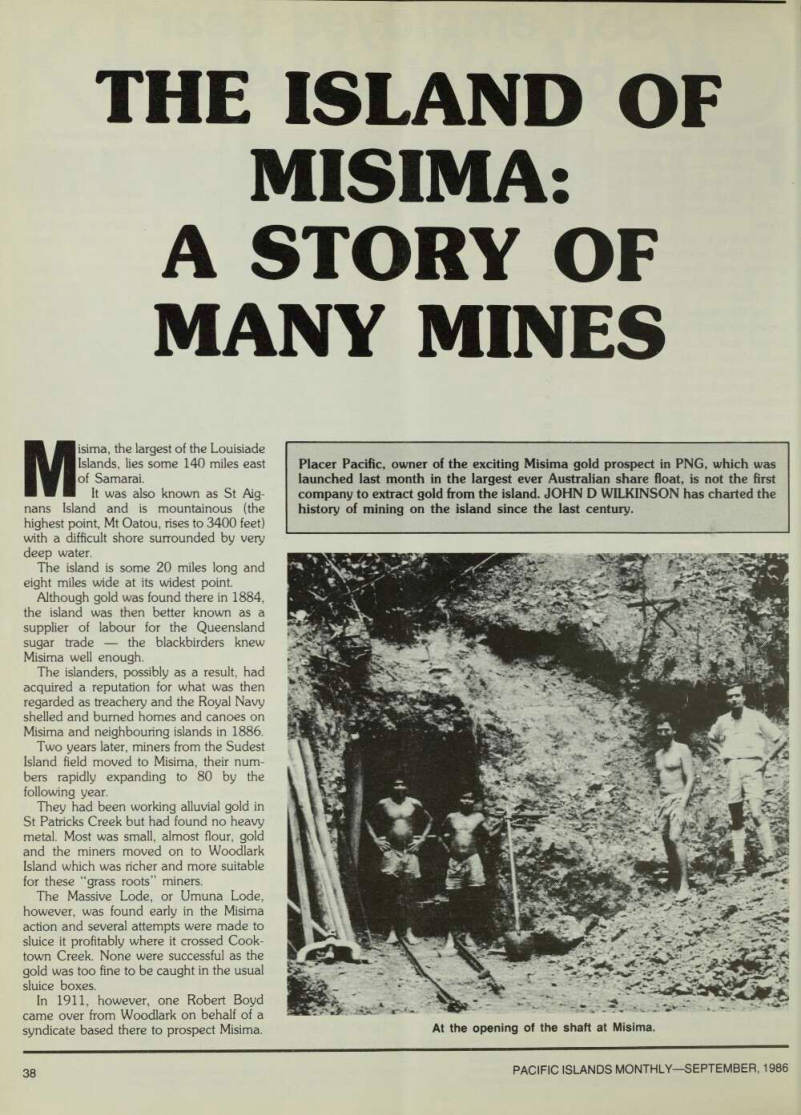
At the opening of the shaft at Misima.
The sheer size of the Massive Lode so impressed him that he immediately took up, with the syndicate’s consent, a ten-acre lease on the northern side of the creek.
The Woodlark syndicate was already overcommitted and instructed Boyd to sell the show while continuing sluicing on his own behalf as agreed.
The following year Boyd was able to sell the lease to a small company composed mainly of retired mining men from Charters Towers called the St Aignans Gold Mining Co Ltd.
This company took over the lease, the Woodlark syndicate to receive a paid up interest and royalties. The company installed a Huntington mill and a 25hp suction gas engine, hoping to recover the gold on amalgam plates in the orthodox way.
But although the head values were high, the recovery was too low to be commercia l- It was then that William Griffiths Jr, an ex-assayer from Gympie, embarked on a series of experiments before deciding that the cyanide process was the only way to recover the Misima gold.
It was discovered that most of the values were in the friable lode material with
comparatively little in the stone. So the miners screened the ore through a grizzly and took the fines direct to vats where they were pickled in a cyanide solution for five days.
The stone was stacked for later crushing.
The method paid well and was probably one of the first places in the world where ore was cyanided direct from the mine without crushing.
Several adjoining leases were taken up by various teams, both to the north and south along the line of the lode, and it was from the Number 2 South, taken up in the name of Charlie Coppard from which much of the gold was later to be won.
Coppard himself died on Misima during World War Two.
In 1913 a Mr Munt, who had started a general store at the island’s only safe anchorage at Bwagaoia about five miles from the mine site, offered to build, with his associates, cement vats at the Coppard lease together with the necessary offices and buildings for a cyanide process.
In return, Munt and his partners would take a 50 per cent interest. The deal was agreed and another company, the Massive Samarai Syndicate, was formed to hold
that interest, Munt taking 25 per cent of that.
Orders were placed in Sydney for the agreed equipment but while the miners were waiting for it to arrive, a Mr McGeorge arrived in Papua on the lookout for a large low grade show for a Melbourne syndicate composed of directors of various large scale mining interests, A visit to Misima convinced him that he need look no further and negotiations that led to an option agreement began at once.
The option was later transferred from the McGeorge syndicate to the Block 10 Broken Hill Company of Melbourne, In 1914, Block 10 decided to exercise their option, but the title was by now much complicated. It was found that a man called Paddy Dunn, then in the Dulwich Home for Indigents near Brisbane, had become possessed of the full right and title to the Massive principle lease, having been given a compassionate half interest in the original share in Boyd’s Woodlark Syndi cate all those years before, The title weakness caused a consider able delay and the vendor’s share was steadily whittled down,
Continued on page 40
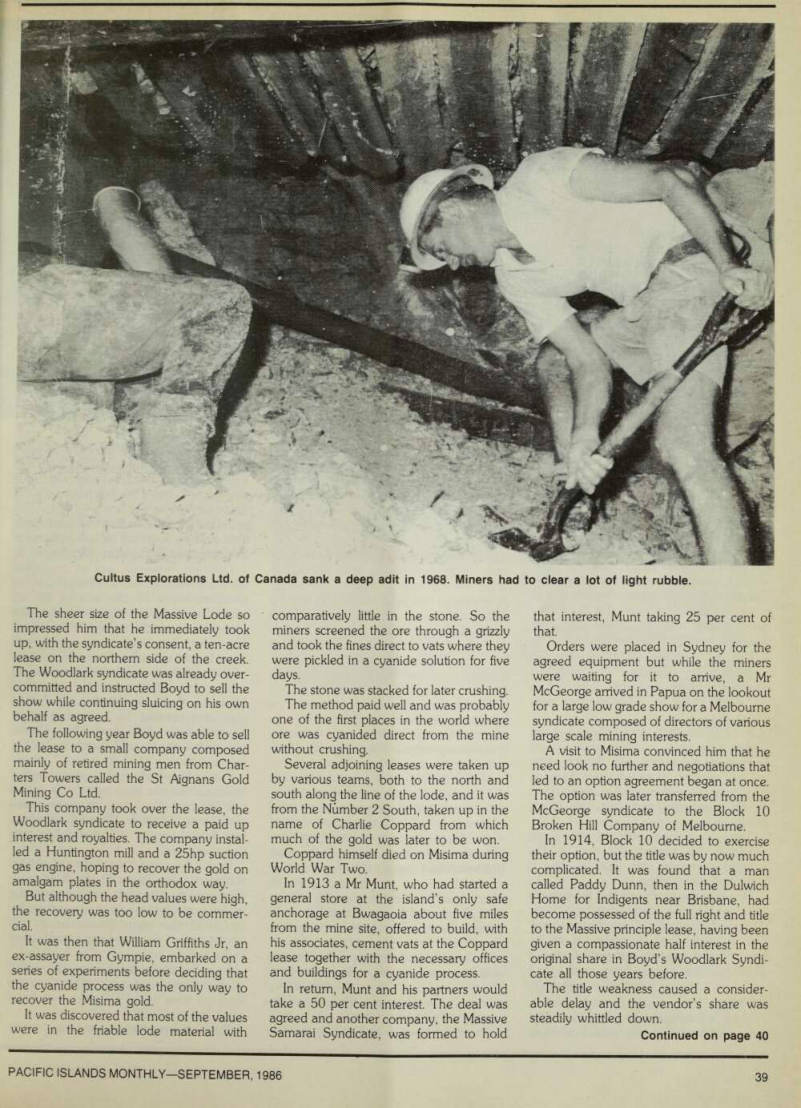
Cultus Explorations Ltd. of Canada sank a deep adit in 1968. Miners had to clear a lot of light rubble.
When the advance party of Block 10 arrived on Misima, they carried the news of the Great War of which the people there had been, until then, in total ignorance.
By 1915 the titles were clear and the company began to erect an extensive plant under the management of Osmer B Ward.
Sadly, however, Ward fell down a shaft and later died of his injuries. He was an extremely capable man who knew the local conditions well and it was ignorance of these that was to cause the company much trouble later.
The war led inevitably to higher costs and the company was in financial trouble just as it was scheduled to reach profitable production. For a time all but urgent and necessary operations were closed down, and eventually these too were halted.
The last underground work to cease was the shaft that was being sunk to the lower levels. It was estimated at the time that only two more sets of timber were needed to strike the lode but when the big Pulso meter pump was withdrawn the water followed rapidly, filling the shaft.
And so it remained. Block 10 had committed an enormous sum and had installed a railway line from Bwagaoia to the mine where an excellent plant now stood idle.
In 1919 the plant, stock, railway line and leases were sold to Miller and Co. of Sydney for a nominal sum, though some of the original Woodlark and Samarai syndicates formed a small company and bought some plant including vats, pipes, pumps etc.
They were later able to pay small dividends by treating the ore by the method pioneered by Griffiths. But it wasn’t all plain sailing.
There was so much rain that the cyanide solutions in the uncovered vats were diluted which interfered with the treatment.
The solutions had continuously to be brought up to strength and costs increased alarmingly due to landslides on the road and the amount of water running through the mine.
Then, an intrusion of sulphates in the main and best drive,‘or tunnel, brought
production practically to a standstill. The big question was whether to raise more capital to cover the vats and install more suitable plant or to close down and look for a buyer.
They decided to sell. Gilbert Wilkinson of Gympie, the mine manager, was de puted to travel south. After talking with several groups, he reached agreement with Fred W Cuthbert of Croydon fame and they returned together to decide on a plant.
Fart of the deal was that Wilkinson would invest a modest amount and remain at the mine as manager. From then on, Cuthbert’s proverbial luck was evident.
The heavy rain had eased and the sulphide intrusion was found to be small, the drive soon entering oxidised ore once again.
But there was one event which all but stopped the new company before it had started.
The Bums Philp ship Morinda was the only vessel on the run small enough to enter the harbour at Misima, so all the heavy cargo had to be shipped on her. On the trip prior to shipping the Cuthbert machinery, the Morinda ran on to the reef at Dedele on the Papuan coast and had to be dry docked for extensive repairs, causing considerable delay to the Misima project.
On her first trip out of dry dock, the machinery was loaded but Cuthbert, now strapped for cash, decided against insuring it on the principle that “lightning never struck in the same place twice.”
Maybe lightning didn’t, but the Morinda did run on to the same reef at exactly the same place, and all the gear was unloaded at Dedele where it remained for months.
Cuthbert decided to cut his losses and call the deal off. Meanwhile, however, Wilkinson had managed to raise enough money locally to get the machinery to Misima and the company began mining.
By 1928 most of the machinery was on the lease and a motor road linked the mine to the wharf.
In the early stages of this road, the truck always travelled with a large team of Misima Island men whose task was to haul it across difficult stages. They were fre quently called upon.
The original cost of building the five
miles of road was 5,000 pounds. Constant improvements over the years brought it to a reasonable standard, but originally it took two hours to travel the five miles on a dry day.
In the rain, the journey, at least once, took a whole month. This was because of landslides along the steep hillsides.
Cuthbert, however, was so impressed with the work of his small staff that he promised them 10 per cent of the di vidend, a pledge he honoured when the gold price jumped and New Misima Gold Mines began to pay. It was now a gold mine in fact as well as in name.
The gold boom of the 30s brought more companies to Misima, but only one, Gold Mines of Papua at Mt Sisa, a Pratten company, reached the production stage.
Several people offered for the New Misima Mines, but none could match the asking price.
Frank Hambridge of Sydney visited Misima about this time and took an option over the property. From this option a new compamy, Cuthberts Misima Gold Mine, was floated and by 1936 had taken over the operations.
Under the careful management of Cliff Rutledge, with James Quintrell as mine manager, the old plant was kept running while considerable extensions were made.
By 1938 the extra plant was in full operation and the company’s production increased.
From the time of the demise of Block 10, all the underground work had been in the southern lease until 1940 when the north ern was re-opened.
The longest drive south was nearly
6,000 feet long and the total length of the southern drives was over five miles. In the upper levels, the ore grew poorer, but carried payable values 5,000 feet from the shaft.
The northern side did not extend so far but the total length of the lode worked would be altogether over 6,000 feet. From the lowest level to the highest on the south side was approximately 400 feet, with another 450 feet to the top of the hill.
Cuthberfs mine had a 20-head stamper battery and the throughput of ore aver aged 3,300 tons per month. In 1940 the company toyed with the idea of opening up the lower level 100 feet below the existing workings. This was the shaft that Block 10 had sunk before closing down.
Preliminary surveys were carried out before a tentative plan was forthcoming.
But a new war intervened. In 1942 the company closed down and evacuated its staff to Australia.
Until then Cuthberts Misima had paid dividends of $350,000.
During the shutdown period many of the drives and adits collapsed and, shortly before the end of the war, two men were sent in to clean up and get the buildings in order for resumed gold mining.
But the Cuthbert luck had run out. High costs after the war and, to an extent, mismanagement put the company into liquidation.
Cuthberts Misima Mine, as it had been worked, was very dependent on under-
ground operations. But heavy rainfall caused the ground to swell and timbers to break. Every drive had to be carefully and regularly checked and repair work carried out.
The amount of timber required was large and it would not have ben too many years before logs would have to have been imported. Two motor trucks and a workforce of 80 village men were constantly employed in cutting wood and carting it to the mine.
Very little explosive was used in the mine although some hard places were encountered. Most of the work, though, was done with pick and shovel. So although the treatment plant had been modernised, the underground work had not altered.
One strange thing about Cuthberts Misima was that no gold specimens were ever found. No gold showed in the stone,
although the values were there for sure, One manager said in 1928: “Since I have been here we have treated over 20,000 tons and not seen one specimen, yet the values are there.”
Misima was proclaimed a gold field in 1889, Woodlark in 1895 and Yodda in 1900. On Misima the village people sluiced for gold in several of the creeks and were able to show small returns, In the years since Cuthberts Misima closed down several companies have prospected the island, the last being Placer, the Canadian mining giant who are now going ahead in a big way.
With the big barges available these days it will be much easier to land heavy equipment on the island than it was in the early days.
And there is no doubt that there is still a lot of gold on Misima. But there is also a lot of Misima earth still mixed with it.
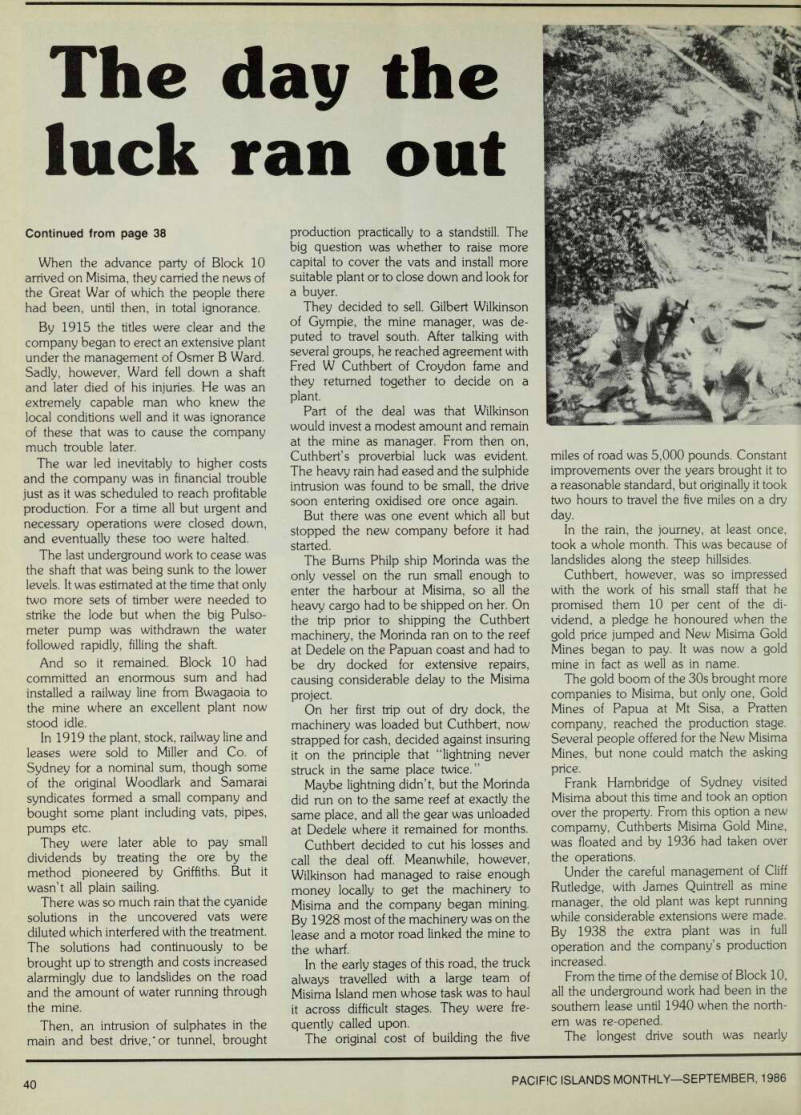
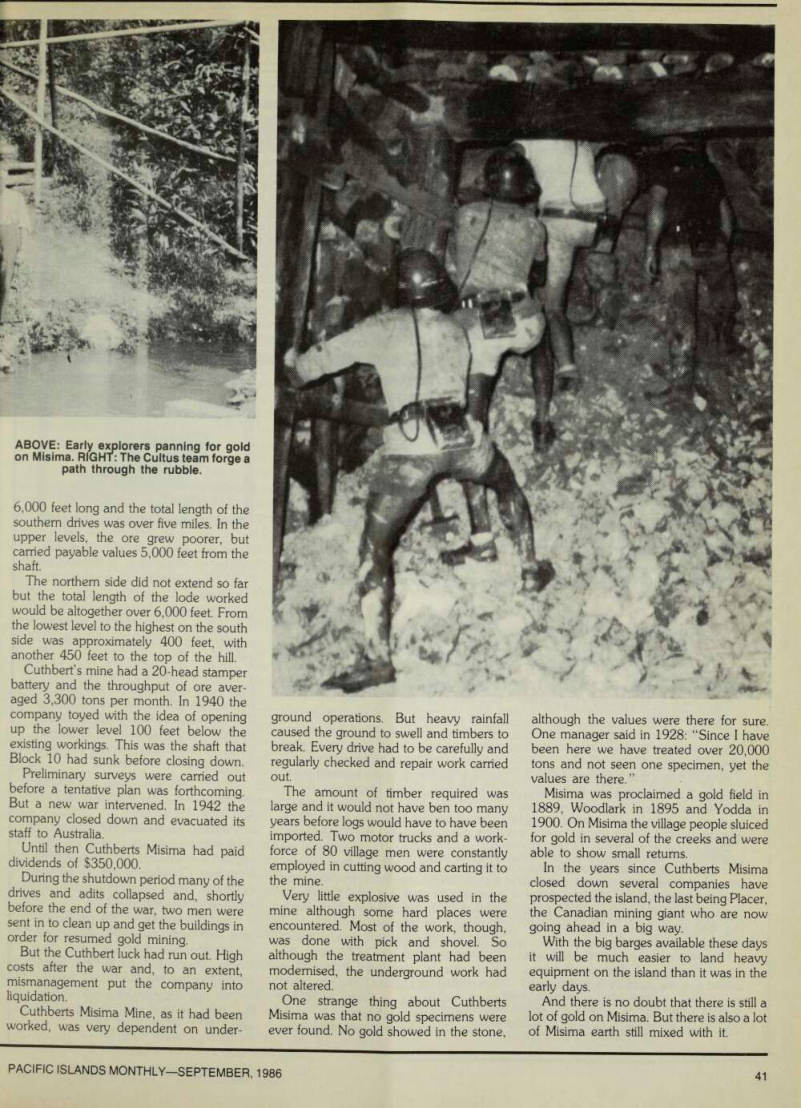
ABOVE: Early explorers panning for gold on Misima. RIGHT: The Cultus team forge a path through the rubble.