After Namu: Life must go on
p. 20 · Read in the full issue
More than 1000 people dead, 90,000 that’s one third of the popu lation homeless and damage to property put at Asloo million.
The bald statistics are the measure of the worst cyclone in living memory and, indeed, in oral legend that hurled itself against the east coast of the Solomon Islands on May 18 this year.
The trauma of lives lost, homes destroyed and property damaged is bad enough, but the long term repercussions of Cyclone Namu go further.
Entire communities are now dependent on international re lief agencies, on hand-outs of food, clothing, shelter and cooking implements.
In the absence of thatch, plastic sheeting is used for roof ing. Where swollen rivers have swept away food gardens, where soils are leached, where villagers must wait five years for new sago palms to mature, their staple diet is now tinned meat or fish and hard biscuits.
Will they ever return to their traditional subsistence liveli * Chris Ashton is an Austra lian freelance journalist who was based in Papua new Guinea before its independ ence. He has travelled through out the Pacific.
The devastation caused by Cyclone Namu caught the attention of the world when it struck Solomon Islands on May 18. Here, CHRIS ASHTON* discusses the aftermath of the tragedy as seen through the eyes of an Australian documentary film unit who landed in the disaster area within days of Namu’s deadly arrival.
hoods, or will they now acquire a taste for the imported fare?
And how is this island state, with a fragile cash economy at the best of times, to recover so much lost ground?
These are among the ques tions posed by a one-hour documentary program pro duced by the Australian Gov ernment film unit, Film Austra lia, with funding by the Austra lian Development Assistance Bureau.
The central focus of the film is the aftermath of Cyclone Namu. A four-man film crew flew into Honiara six days after the cyclone struck and spent 18 days recording the havoc left in its wake.
Villagers, impressively fluent English speakers, told them what had happened and what their communities must now do to rebuild their shattered lives.
A doctor flown in by the National Safety Council of Aus tralia tells of an operation car ried out under near-impossible conditions in the early hours of the morning to save the life of a small girl suffering from an abcess.
Prime Minister Sir Peter Kenilorea tells of his country’s commitment to recovery.
One of the hazards of a calamity like Cyclone Namu was the breakdown of the traditional sanitary systems and the consequent spread of dis ease.
The nation’s health depart ment and the National Council of Women broadcast warnings to the village people to boil all drinking water, to wash their hands after the toilet and to drain off stagnant pools, breed ing grounds for malaria carrying mosquitoes.
But the old adage that every cloud has a silver lining also applied. The National Disaster Council and the public services swung into action and were equal to the crisis.
The Solomons also drew support from a wide variety of neighbours: Red Cross person nel from PNG, Australia and New Zealand; Hercules air transports from the Australian and New Zealand air forces carrying fuel, medical teams and supplies.
Other emergency relief came
from the Australian and French navies. Australian sailors de fused explosives that, until the arrival of Namu, had lain buried since World War Two, blew up log jams where swollen rivers had swept whole forests down stream, repaired buckled bridges and brought in vital water purification plants.
The film is not solely about Cyclone Namu and its aftermath, however. This is set, rather, against a profile island mini-state in many ways typical of its South Pacific neighbours.
A Methodist mission film, shot in 1910, offers splendid re-enactments of tribal fighting, blackbirders recruiting and abducting islanders for the Queensland and Fiji canefields and the activities of the Christ ian missions.
Other archival film shows the ferocity of the war fought be tween the Allies and Japan while more recent material shows how vulnerable are is land economies to slight fluctuations in world commodi ty prices and the fragile equilib rium between the traditional ways and the western ’pop’ culture and the cash economy.
The issues are familiar enough. But against the stark background of Cyclone Namu they will raise consciousness among television audiences beyond the South Pacific.
To the wider world, the stereotype image of palm-fring ed beaches, blue lagoons and bounteous nature will be jolted by the effects of a disastrous cyclone.
Cyclone Namu goes some way towards correcting the tourist’s image of the islands.
But at a more practical level, it is a teaching aid that may be valuable in other island states that have also, and will again, face the fury of a cyclone.
The Australian Broadcasting Corporation screened Cyclone Namu in two parts in successive weeks in July. It is now avail able as a video cassette in Fiji, PNG, New Zealand and Solo mon Islands. The price will be less than As2o.
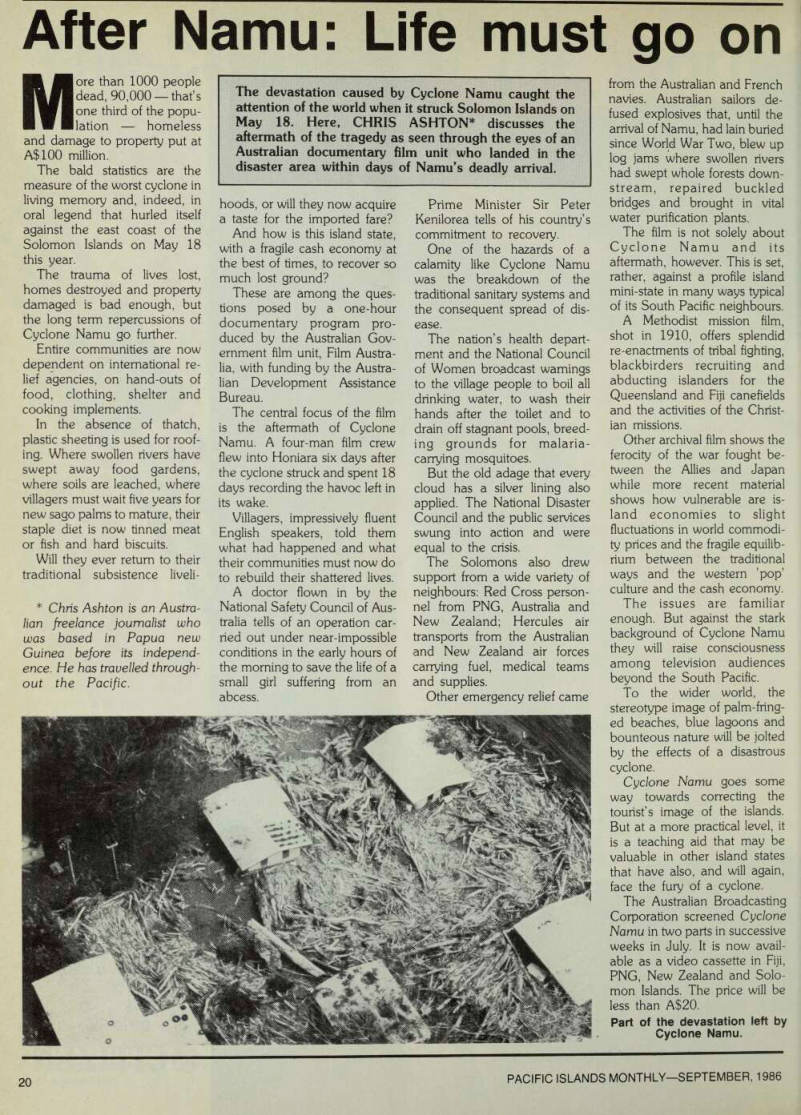
Part of the devastation left by Cyclone Namu.