Politics simmer
pp. 11-12 · Read in the full issue
in US islands
GUAM faces two hotly contested rounds of elections this year, while American Samoa may have an interesting, one round election.
The political fates of Guam’s governor, Ricardo Bordallo, its congressman, Ben Blaz, and Samoa’s congressman, Fofo unia, will be on the line.
Guam’s voters will elect both a governor and a lieutenant governor, a congressman and all 21 members of the one house legislature, the senate.
At least two slates for gov ernor and It. governor are ex pected to run in both the Republican and Democratic pri maries this month with the surviving tickets competing with each other in the November general elections.
The two mainland political parties are well-organised on Guam and are roughly evenly matched. The incumbent con gressman is a Republican, while the sitting governor is a Demo crat. The current line-up in the Senate is 11 to 9 Democratic, with one vacancy.
The governorship of Samoa is not up for grabs until Novem ber, 1988; this year Congress man Sunia is running for re election to his seat in the House of Representatives and may be opposed by former governor Peter Tali Coleman.
Sunia sits with the Democrats in the National House, while Coleman is the chairman of the newly organised Republican Party of Samoa. The Samoan legislature, historically not elected along party lines, is to be chosen as well.
Facing off against each other in Guam’s September 6 pri mary are the four govemor/lt. governor slates; Democratic: Governor Ricardo Bordallo, Carl Gutierez. Lt. Governor Ed ward Reyes, John Aguon.
Republican: Governor Joe Ada, Tommie Tanaka. Lt. Gov ernor Frank Bias, Tony Unpingco.
Bordallo and Reyes are the incumbents; Gutierez is Speaker of the Senate, and all five of the other candidates are members of the Senate. (That six of the twenty current mem bers of the Senate, all men, are not running for re-election is a plus for the four women in the Senate, all of whom are run ning for re-election.) The race for the seat in the House of Representatives may be a hot one again this year; Blaz, after losing once to the longtime House member, Won Pat, narrowly defeated him in November, 1984. Pat then tried to use his contacts among the Democrats of the House (who have controlled that body for 52 of the last 56 years) to overturn the Blaz victory, claim ing that Blaz needed an abso lute majority of the vote, not the plurality that he enjoyed. Pat’s efforts were in vain.
This year the Democratic candidate is expected to be General Frank Torres, the head of Guam’s unit of the U.S.
National Guard.
Torres has announced for the seat and appears to have no contest in the primary, as Blaz has no contest in the Republi can primary.
The Democrats have apparently decided that Guam voters like Generals (Blaz won his star in the U.S. Marines, the first islander to secure flag rank in the American’s regular armed forces). Governor Bor dallo appointed Torres Adjutant General of Guam’s National Guard.
Torres announced that he was taking a leave of absence from this position when he declared his candidacy (on June 30); Torres’ non-resigna tion from the Guard may be a subject of controversy as the mainland tradition has been
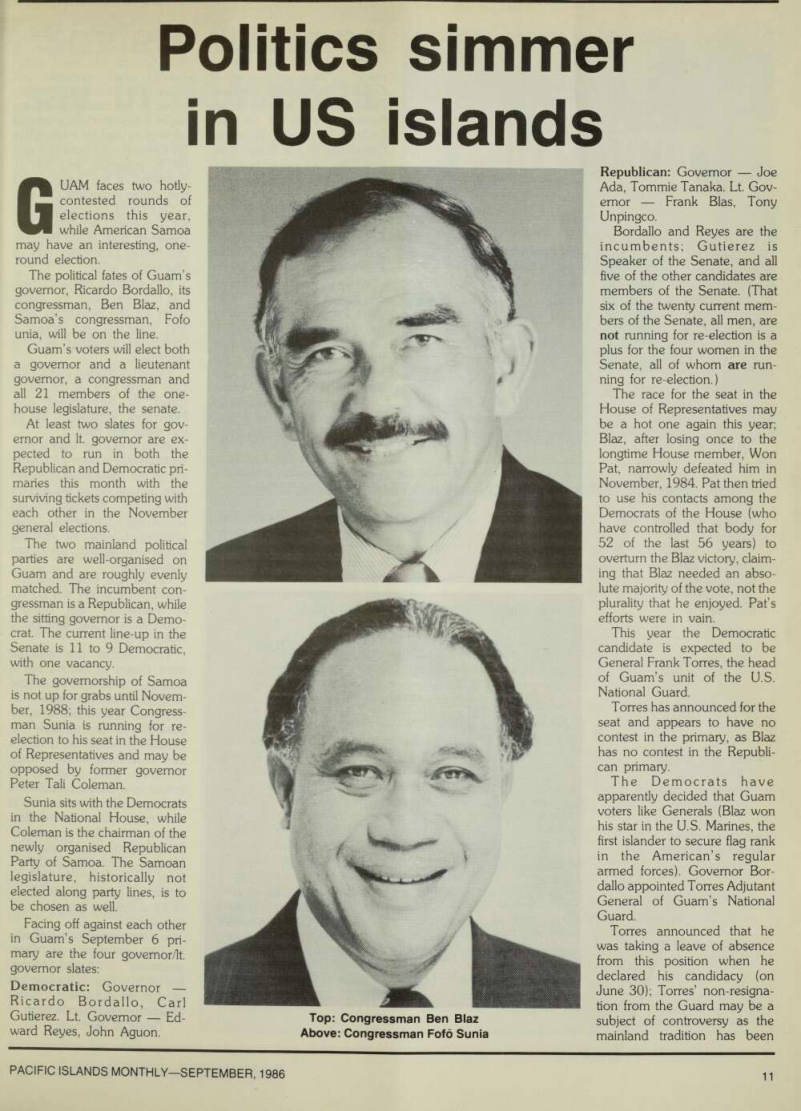
Top: Congressman Ben Blaz Above: Congressman Fofo Sunia
that one does not run for political office in uniform.
Although Blaz has not yet made an issue of it, one of Guam’s Democratic senators, Frank Santos, has done so.
Santos is chair of the key Federal-Territorial Relations Committee of the Guam Sen ate. (Blaz had retired from the Marine Corps when he ran for Congress.) Guam’s primary election is a political institution introduced from the mainland, and is prob ably not used elsewhere in the Pacific (except in Hawaii).
While in most nations politi cal parties select their candi dates for public office through party-created systems, in Guam, and on the mainland, the government creates a sys tem for selecting such candi dates by all interested voters.
On the mainland one usually states a preference for a given party, and then votes in only in
that party’s selection process.
But this year, on Guam, a new system has been intro duced, which certainly will prove to be interesting and may prove to be confusing. As we heard it described each voter is allowed to vote for a candidate for Congress, for governor and for It. governor, and for 21 members of the Senate, and may do so regardless of party.
One could, for instance, vote for Governor Bordallo, Con gressman Blaz, seven Republi can Senate candidates, and 14 Democratic ones.
This month’s primary, then, will not only select the candi dates for the November elec tion, they will also provide a preliminary indication of voter sentiment.
This is particularly true for the Blaz-Torres race, as the candi dates in September and November, apparently, will be the same two men.
While it is clear who is run ning against whom in Guam, things are less settled in Amer ican Samoa. Sunia will run for re-election. Perhaps former Governor Coleman (who apparently yens to become governor again) may run against him.
Or perhaps Coleman’s ally, Soli Aumoeualogo will do so.
Aumoeualogo was Sunia’s opponent two years ago, losing 5946 to 3120.
That neither the delegate from Guam or Samoa has a vote on the floor of the House of Representatives apparently does not dim interest in these positions. While they lack that crucial vote, they can (and do) vote in the committees where Congress does most of its bread-and-butter decision making; further they can vote in their party caucuses, and Blaz, as a matter of fact, was elected President of the Republican House members’ freshman class in January of 1985, a minor but unprecedented hon or for a voteless delegate from the islands.
In Washington their staff refer to Blaz and Sunia as “Con gressman”; in Guam, at least, the older term “Delegate” is used in the publications of the Guam Election Commission.
David S. North.