Pacific stamp box
p. 51 · Read in the full issue
I can remember taking one of those 15-day special cruise ship tours of the Pacific many years ago, just after I left high school.
One of the highlights was getting off at each point and posting off a card bearing stamps of that particular coun try, and then adding the card to my stamp collection when it arrived.
Of greatest excitement was the Niuafo’ou tin can mail service. When we arrived off the island a dug out canoe arrived and took all our carefully marked commemorative stamped en velopes. A long time later the envelopes arrived back home.
We were told that this was the “tin can mail service”. Not many know of its origins.
Stamps of Tonga never were too popular except with a handful of advanced philatelists since the first ones were issued by the small Pacific Kingdom in 1886.
Nevertheless, the archipelago has one claim to postal fame. It resulted from a most unusual mail service that carried letters to and from a nine square-mile volcanic out-cropping cal led Niuafo’ou, as isolated a place as any on earth.
It was in 1882 when trader W.
Travers, working at Niuafo’ou for the firm of Osterman Dewy & Co., based at Sydney, Australia, arranged with Ton gan Postal Officials to use kerosene cans or biscuit tins as mail “bags” in the transit of mail from the island to passing steamers and vice versa.
Sailor W. Hetting, on the T. S. Opolu soldered the tins to make them waterproof and when Captain Croshaw slowed his ship near the island and dropped them overboard, Tin Can Mail was born.
It was C. Stuart Ramsay, manager of Morris Hedstrom Ltd., copra exporters, who further developed this service in order to get letters to his wife and children in New Zealand. A powerful swimmer, he attached his mail to a wooden pole and with two native companions, pushed it to passing once a-month steamers on the Fiji-Samoa run. Crewmen would fish it aboard; if they had any mail for him, it was tossed overboard, retrieved by Ramsay and brought to shore.
Next came Walter George Quensell, an altruistic yet enterprising trader who came to the island not only to produce copra but to serve as a government radio operator.
Instead of swimmers, he engaged willing natives to carry letters to passing ships in dugout canoes and then recov er inbound mail that had been sealed in cookie tins.
At first he marked envelopes with a simple handstamp inscribed “Tin Can Mail”. It did not take collectors very long to learn of their existence, and he began to get requests for these unusual covers from every corner of the world and with the Postal Centre now at Niuafo’ou the demand has escalated tremendously.
Missionaries feature on stamps of two Pacific countries in June and July.
Pitcairm Island released a set of four stamps in June to commemorate the centenary of the first Seventh-Day Adventist Missionary movement in the Islands. Today the Pitcairm Islands still hold to the faith brought to them so long ago. There is a resident pastor sent from America every two years whose wife acts as a nurse.
Featured on the stamps are John Tay, the first missionary, the early churches and missionary ship and a baptism.
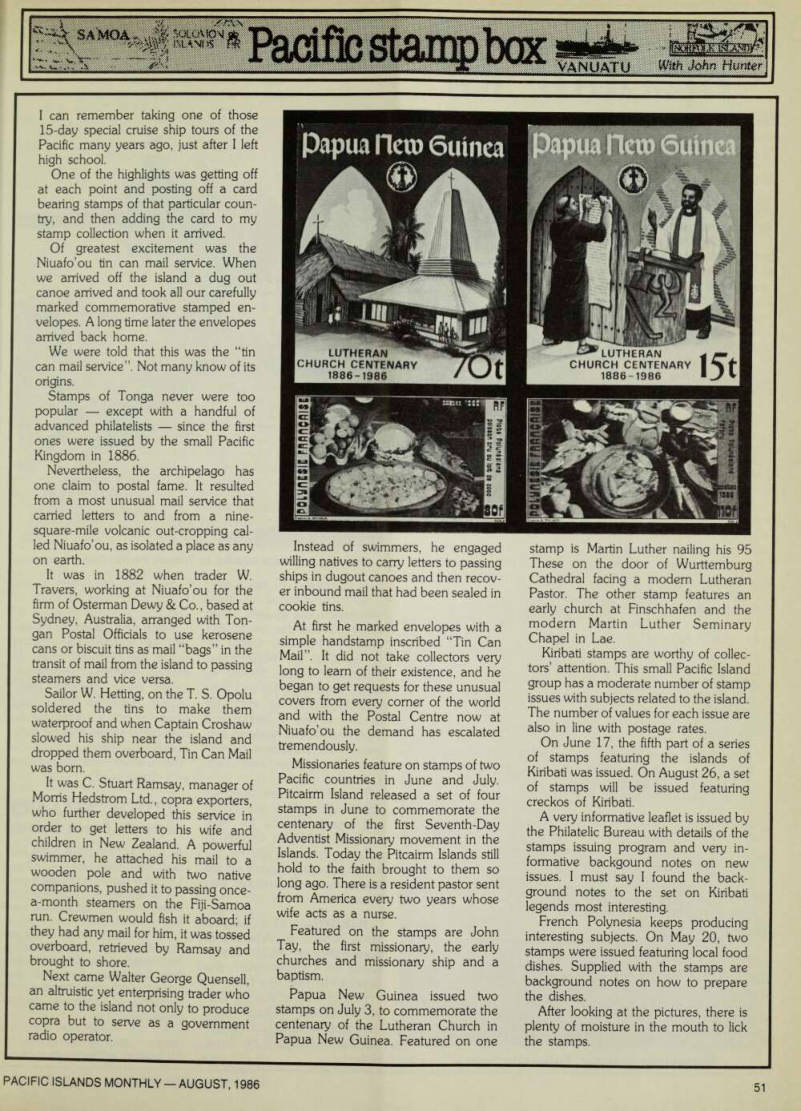
Papua New Guinea issued two stamps on July 3, to commemorate the centenary of the Lutheran Church in Papua New Guinea. Featured on one
stamp is Martin Luther nailing his 95 These on the door of Wurttemburg Cathedral facing a modern Lutheran Pastor. The other stamp features an early church at Finschhafen and the modern Martin Luther Seminary Chapel in Lae.
Kiribati stamps are worthy of collec tors’ attention. This small Pacific Island group has a moderate number of stamp issues with subjects related to the island.
The number of values for each issue are also in line with postage rates.
On June 17, the fifth part of a series of stamps featuring the islands of Kiribati was issued. On August 26, a set of stamps will be issued featuring creckos of Kiribati.
A very informative leaflet is issued by the Philatelic Bureau with details of the stamps issuing program and very in formative backgound notes on new issues. I must say I found the back ground notes to the set on Kiribati legends most interesting.
French Polynesia keeps producing interesting subjects. On May 20, two stamps were issued featuring local food dishes. Supplied with the stamps are background notes on how to prepare the dishes.
After looking at the pictures, there is plenty of moisture in the mouth to lick the stamps.