Statistics tell story of trsde imbalance
pp. 40-41 · Read in the full issue
Statistics gathered by SPEC show an increasing trade imba lance between Fiji and Australia and New Zealand.
Although the figures used are supplied by Australia and New Zealand and do not altogether match those of SPEC a picture emerges of small developments in some areas though gold, sugar and coconut oil are still by far Fiji’s biggest exports to its nearest metropolitan neighbours.
Out of a total export of some As 33 million in 1984 (and the same in 1985), about $2O million was accounted for by gold while coconut oil took up $5 million.
Fiji’s export commodity in creases over the past two years, however, have been insignifi cant when compared with Aus tralia’s growth in exports to Fiji
Growth ‘insignificant’
up from A 5166.9 million in 1984 to A 5204.7 million last year.
In New Zealand’s case, SPEC’s figures indicate a dras tic percentage drop in Fiji’s exports.
In 1981, about $29 million worth of products, including sugar, left Fiji’s shores for New Zealand.
By last year, however, this had dropped to $l6 million, a decline of 28 per cent.
This is directly attributable to sugar exports which alone accounted for $26 million in the 1980 figure but was down to $4 milllion in 1984.
Without sugar, Fiji’s export to New Zealand has been worth only about $5 million over the SPARTECA period.
With gold dominating ex ports to Australia (over 60 per cent of the total in the SPARTE CA period), smaller increases have been seen in garments, preserved ginger, furniture, sawn timber, fresh produce, yaqona, soaps, leathers, wood veneer and plywood.
And if gold dominates the Australian exports, sugar has been even more important in the New Zealand market, though its percentage share has dropped in recent years.
In 1980 sugar represented a massive 93 per cent of Fiji’s export to New Zealand.
That figure was down to 75 per cent in 1981, and went up to 82 per cent in 1982 before falling again to 61 per cent in 1983 and 40 per cent last year.
Increases were recorded in preserved fish, biscuits, fruit and vegetables, sawn timber, storage batteries, soaps, veneer, plywood, dessicated coconut, rum and orange juice.
The value of Fiji’s exports to Australia as a percentage of total Forum island countries’ exports has been increasing from 18.6 per cent in 1981 to 40.8 per cent last year.
New Zealand is the opposite.
There the figure is down from 53.8 per cent in 1981 to 18.9 per cent last year.
Fiji’s imports from New Zea land, meanwhile, rose from $75 million in 1981 to $B5 million last year.
The trend of trade, then, is still in favour of Australia and New Zealand.
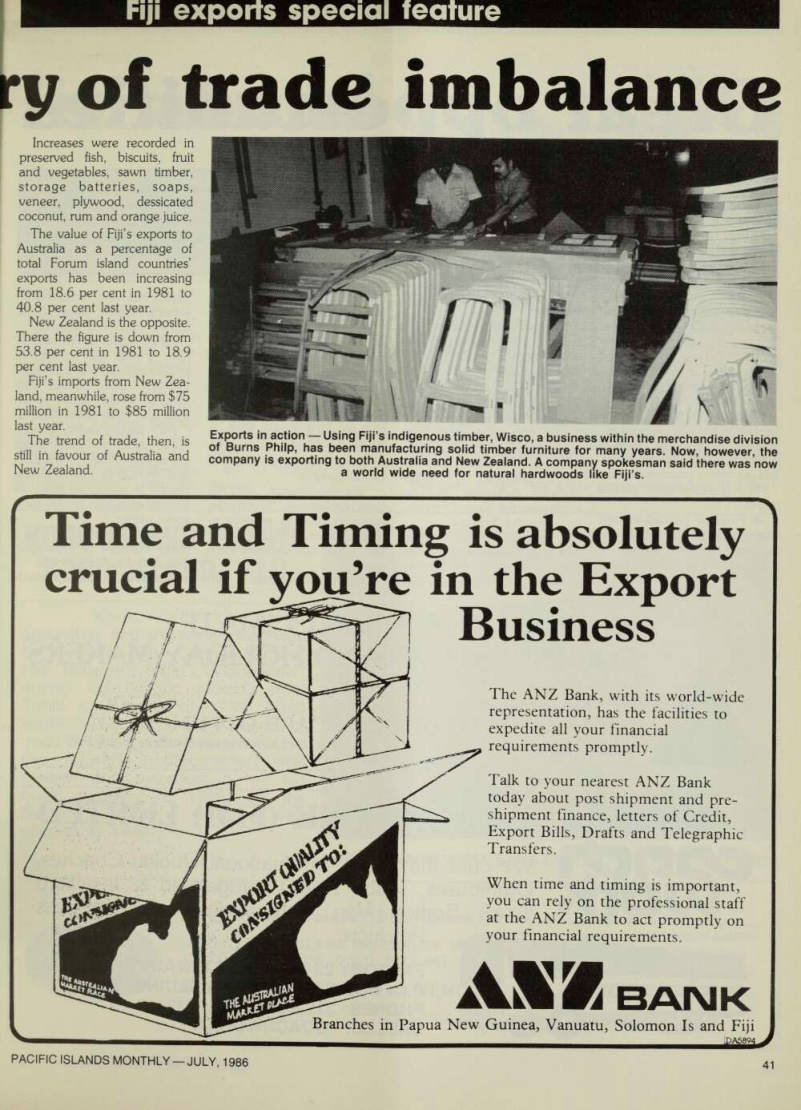
Exports in action Using Fiji’s indigenous timber, Wisco, a business within the merchandise division of Burns Philp, has been manufacturing solid timber furniture for many years. Now, however, the company is exporting to both Australia and New Zealand. A company spokesman said there was now a world wide need for natural hardwoods like Fiji’s.