The good old days
p. 28 · Read in the full issue
are coming back
JAPAN is quietly reforging eco nomic and political links with its former Pacific island posses sions lost over 40 years ago during World War 2.
Palau and its neighboring Micronesian states appear to be prime targets.
Japan ruled them from 1914 to 1944 before its imperial forces were driven out in bloody, island-hopping battles by American troops.
Many Japanese businessmen and tourists who flock to the islands spread across hundreds of miles of the Western pacific, still talk about “our paradise”.
Older islanders, many of whom speak fluent Japanese, fondly remember what they call “the good old days”.
Palau with a population of 15.000 largely leisure-seeking islanders has a special lure for the Japanese. It was once the capital of Nanyo, Japan’s South Seas empire.
The League of Nations gave Japan a mandate over the Micronesian territories after Tokyo seized them from their German colonisers during World War 1.
Palau became an administra tive centre and more than 70.000 Japanese and Koreans went to live there.
Koror, a bustling metroplis with factories, markets, theatres and geisha houses, had an elaborate, land, sea and air network linking the far-flung archipelago.
Palau, with some of the world’s richest marine re sources, supplied Japan with 70 per cent of its dried fish. Bauxite and phosphate mines gave the islands a thriving export in dustry.
Large agricultural plantations at Babeldaob the biggest island in Micronesia ex ported pineapples and sugar cane to the “mother country”.
Today, after 40 years under U.S. administration as a United Nations trust territory, Palau has no export or manufacturing industries and relies entirely on
an annual $2O million in U.S. aid.
Palauan leaders say Amer ican interest is based purely on their islands’ strategic location.
The U.S. has secured Palauan agreement in a recent plebiscite to establish naval, air and military bases here in ex change for semi-independance.
The Palauan group compris es 200 inlands, some volcanic, but only eight are permanently inhabited.
The capital of Koror, Palau’s main island, is a balmy, sleepy little town with dilapidated wooden buildings, poor roads and no proper sanitation.
Remains of the Japanese era loom like relics of a lost, ancient civilisation.
A rusted cannon stands lone ly guard at the entrance to the capital’s well-sheltered Malakal harbor, a testament to the militarism which brought down Japan’s Micronesian empire.
Not everything is lost, how ever. The Japanese have re turned with their mighty yen to try and redeem their lost para dise.
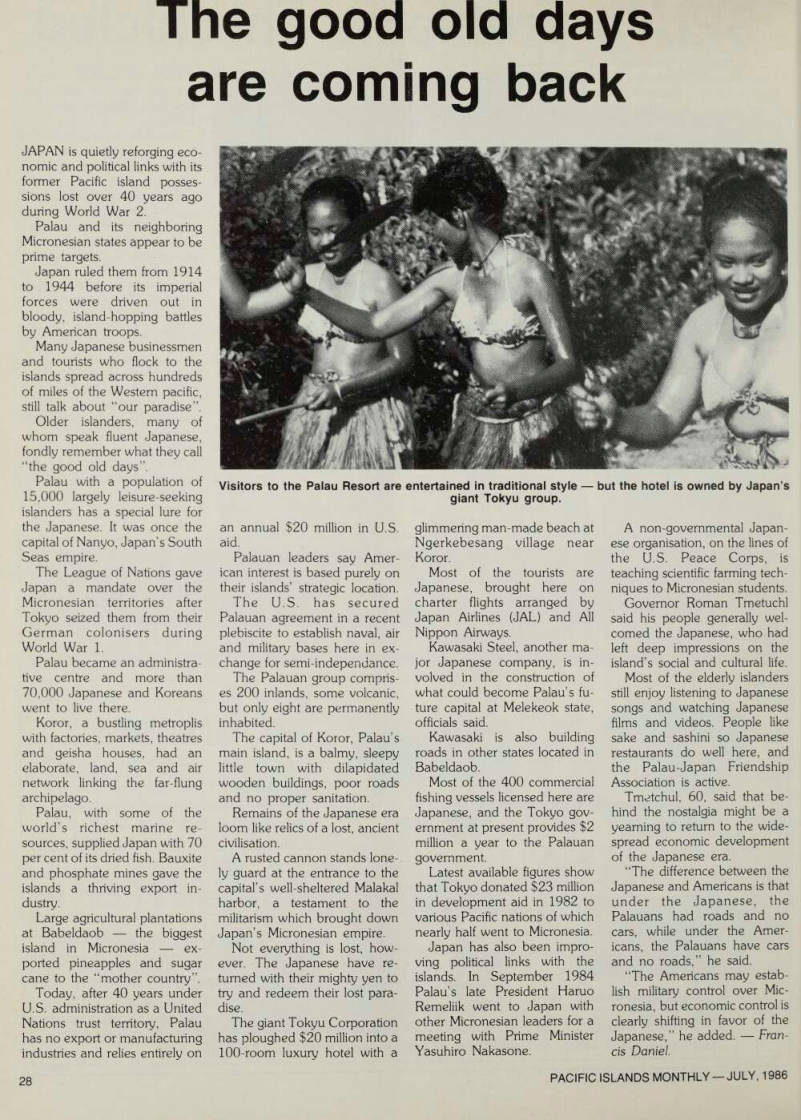
The giant Tokyu Corporation has ploughed $2O million into a 100-room luxury hotel with a
glimmering man-made beach at Ngerkebesang village near Koror.
Most of the tourists are Japanese, brought here on charter flights arranged by Japan Airlines (JAL) and All Nippon Airways.
Kawasaki Steel, another ma jor Japanese company, is in volved in the construction of what could become Palau’s fu ture capital at Melekeok state, officials said.
Kawasaki is also building roads in other states located in Babeldaob.
Most of the 400 commercial fishing vessels licensed here are Japanese, and the Tokyo gov ernment at present provides $2 million a year to the Palauan government.
Latest available figures show that Tokyo donated $23 million in development aid in 1982 to various Pacific nations of which nearly half went to Micronesia.
Japan has also been impro ving political links with the islands. In September 1984 Palau’s late President Haruo Remeliik went to Japan with other Micronesian leaders for a meeting with Prime Minister Yasuhiro Nakasone.
A non-governmental Japan ese organisation, on the lines of the U.S. Peace Corps, is teaching scientific farming tech niques to Micronesian students.
Governor Roman Tmetuchl said his people generally wel comed the Japanese, who had left deep impressions on the island’s social and cultural life.
Most of the elderly islanders still enjoy listening to Japanese songs and watching Japanese films and videos. People like sake and sashini so Japanese restaurants do well here, and the Palau-Japan Friendship Association is active.
Tmetchul, 60, said that be hind the nostalgia might be a yearning to return to the wide spread economic development of the Japanese era.
“The difference between the Japanese and Americans is that under the Japanese, the Palauans had roads and no cars, while under the Amer icans, the Palauans have cars and no roads,” he said.
“The Americans may estab lish military control over Mic ronesia, but economic control is clearly shifting in favor of the Japanese,” he added. Fran cis Daniel.
Visitors to the Palau Resort are entertained in traditional style but the hotel is owned by Japan’s giant Tokyu group.