people
pp. 59-60 · Read in the full issue
A welcome recent visitor to Savusavu, Fiji, was Mrs Frances Gow of Florida, USA, who was visiting friends in Australia and Fiji. Her hostess in Savusavu was Mrs Lema Low.
Mrs Gow, now 84, first went to Fiji in 1942 as an American army nurse. She travelled with the first U.S. Army division to leave the American West Coast for the South Pacific. They travelled in five Liberty ships each built to accommodate 300, but they each carried 3000! The ships followed a zigzag course to Auckland, where they received a tumul tuous welcome. Later, Mrs Gow was stationed in Fiji where she met and married her late husband, Harold Gow, ship ping manager with Burns, Philp. He was transferred to Apia, Western Samoa, where the couple lived for 25 years.
One vivid memory of the war years which Mrs Gow shared with Savusavu’s Coconut Tele graph was of flying over “the Hump” in a C 54 aircraft with a load of casualties from fighting along the Burma Road. After touching down at Khartoum, they took off and flew 12 hours non-stop to Accra, with no food someone had forgotten the lunchboxes. From Accra they went to Ascension Island, then to Natal (northern Brazil), Trini dad and then Florida. She was fascinated to compare that slow trip with the speed of aircraft today.
Mrs Gow now lives in retire ment at the Covenant Village, Jacaranda, Florida, one of many such establishments sponsored by the Evangelical Covenant Church of America over the past 90 years.
While in Sydney Mrs Gow stayed with old friend Kathleen Costello.
Mrs Costello, 90, is the widow of Dan Costello, mother of prominent Fiji tour ism figure Dan Costello, and grandmother of singer Danny Costello.
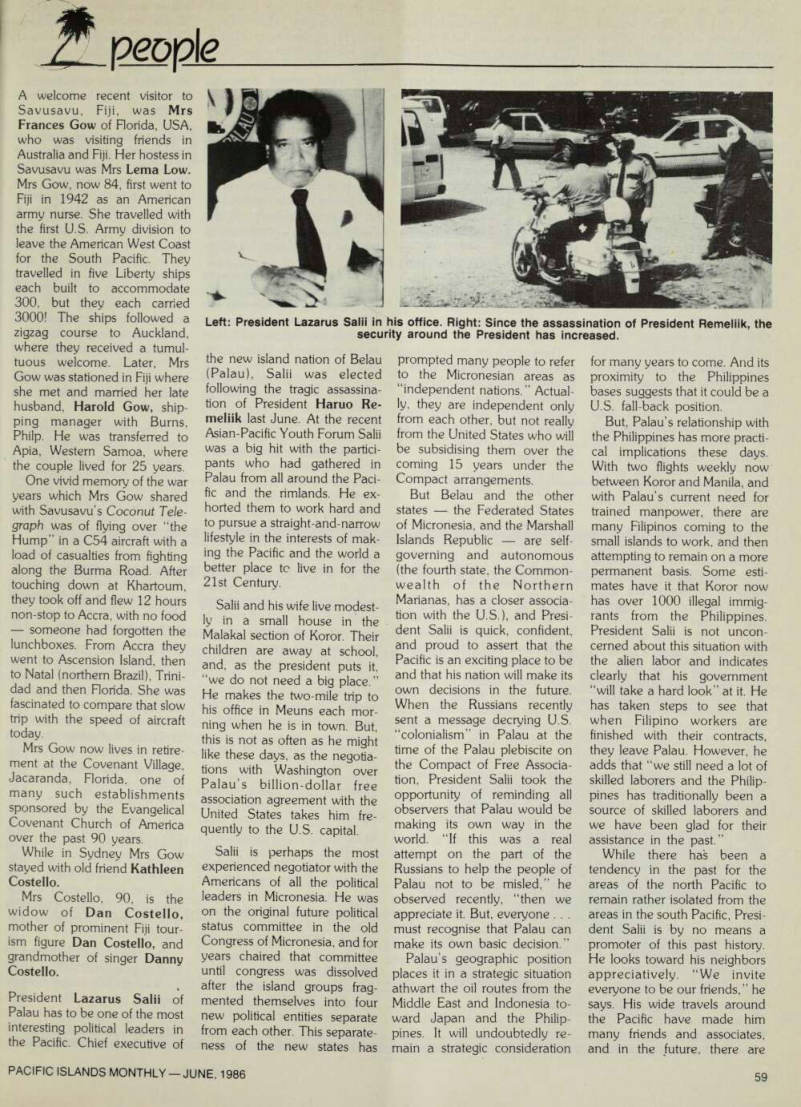
President Lazarus Salii of Palau has to be one of the most interesting political leaders in the Pacific. Chief executive of
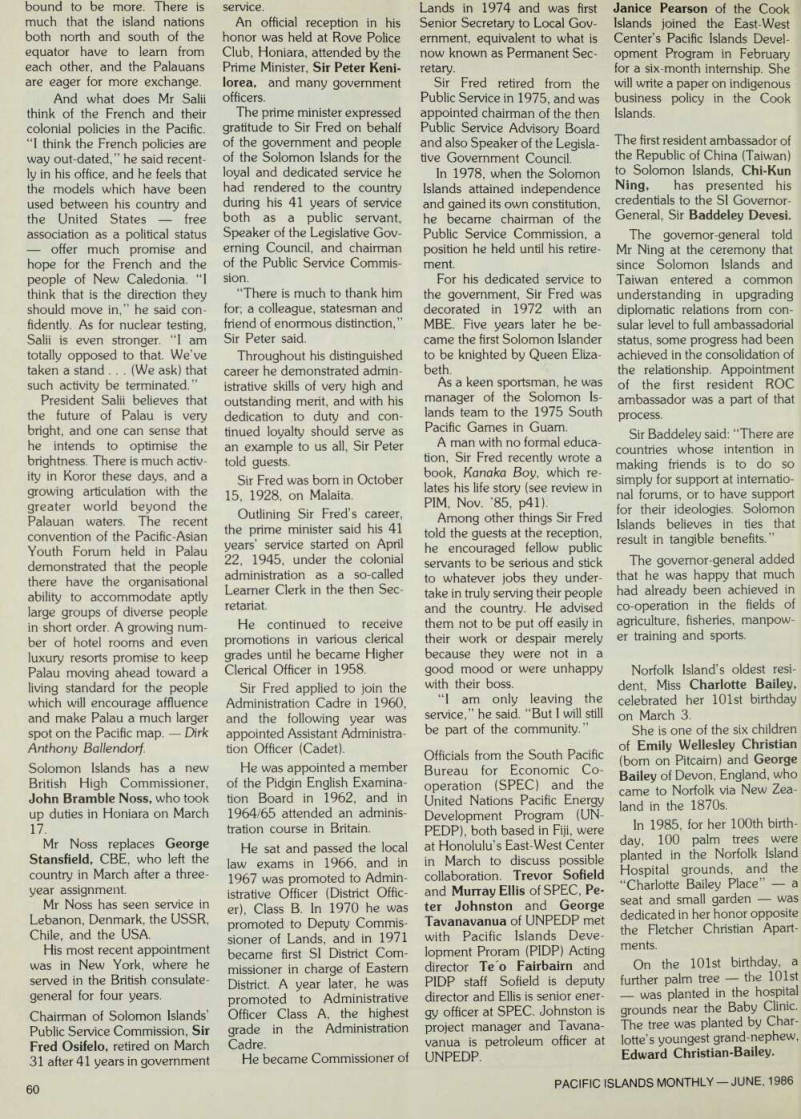
the new island nation of Belau (Palau), Salii was elected following the tragic assassina tion of President Haruo Re meliik last June. At the recent Asian-Pacific Youth Forum Salii was a big hit with the partici pants who had gathered in Palau from all around the Paci fic and the rimlands. He ex horted them to work hard and to pursue a straight-and-narrow lifestyle in the interests of mak ing the Pacific and the world a better place to live in for the 21st Century.
Salii and his wife live modest ly in a small house in the Malakal section of Koror. Their children are away at school, and, as the president puts it, “we do not need a big place.”
He makes the two-mile trip to his office in Meuns each mor ning when he is in town. But, this is not as often as he might like these days, as the negotia tions with Washington over Palau’s billion-dollar free association agreement with the United States takes him fre quently to the U.S. capital.
Salii is perhaps the most experienced negotiator with the Americans of all the political leaders in Micronesia. He was on the original future political status committee in the old Congress of Micronesia, and for years chaired that committee until congress was dissolved after the island groups frag mented themselves into four new political entities separate from each other. This separate ness of the new states has
prompted many people to refer to the Micronesian areas as “independent nations.” Actual ly, they are independent only from each other, but not really from the United States who will be subsidising them over the coming 15 years under the Compact arrangements.
But Belau and the other states the Federated States of Micronesia, and the Marshall Islands Republic are self governing and autonomous (the fourth state, the Common wealth of the Northern Marianas, has a closer associa tion with the U.S.), and Presi dent Salii is quick, confident, and proud to assert that the Pacific is an exciting place to be and that his nation will make its own decisions in the future.
When the Russians recently sent a message decrying U.S.
“colonialism” in Palau at the time of the Palau plebiscite on the Compact of Free Associa tion, President Salii took the opportunity of reminding all observers that Palau would be making its own way in the world. “If this was a real attempt on the part of the Russians to help the people of Palau not to be misled,” he observed recently, “then we appreciate it. But, everyone . . . must recognise that Palau can make its own basic decision.”
Palau’s geographic position places it in a strategic situation athwart the oil routes from the Middle East and Indonesia to ward Japan and the Philip pines. It will undoubtedly re main a strategic consideration
for many years to come. And its proximity to the Philippines bases suggests that it could be a U.S. fall-back position.
But, Palau’s relationship with the Philippines has more practi cal implications these days.
With two flights weekly now between Koror and Manila, and with Palau’s current need for trained manpower, there are many Filipinos coming to the small islands to work, and then attempting to remain on a more permanent basis. Some esti mates have it that Koror now has over 1000 illegal immig rants from the Philippines.
President Salii is not uncon cerned about this situation with the alien labor and indicates clearly that his government “will take a hard look” at it. He has taken steps to see that when Filipino workers are finished with their contracts, they leave Palau. However, he adds that “we still need a lot of skilled laborers and the Philip pines has traditionally been a source of skilled laborers and we have been glad for their assistance in the past.”
While there has been a tendency in the past for the areas of the north Pacific to remain rather isolated from the areas in the south Pacific, Presi dent Salii is by no means a promoter of this past history.
He looks toward his neighbors appreciatively. “We invite everyone to be our friends,” he says. His wide travels around the Pacific have made him many friends and associates, and in the future, there are
Left: President Lazarus Salii in his office. Right: Since the assassination of President Remeliik, the security around the President has increased.
bound to be more. There is much that the island nations both north and south of the equator have to learn from each other, and the Palauans are eager for more exchange.
And what does Mr Salii think of the French and their colonial policies in the Pacific.
“I think the French policies are way out-dated,” he said recent ly in his office, and he feels that the models which have been used between his country and the United States free association as a political status offer much promise and hope for the French and the people of New Caledonia. “I think that is the direction they should move in,” he said con fidently. As for nuclear testing, Salii is even stronger. “I am totally opposed to that. We’ve taken a stand . . . (We ask) that such activity be terminated.”
President Salii believes that the future of Palau is very bright, and one can sense that he intends to optimise the brightness. There is much activ ity in Koror these days, and a growing articulation with the greater world beyond the Palauan waters. The recent convention of the Pacific-Asian Youth Forum held in Palau demonstrated that the people there have the organisational ability to accommodate aptly large groups of diverse people in short order. A growing num ber of hotel rooms and even luxury resorts promise to keep Palau moving ahead toward a living standard for the people which will encourage affluence and make Palau a much larger spot on the Pacific map. Dirk Anthony Ballendorf.
Solomon Islands has a new British High Commissioner, John Bramble Noss, who took up duties in Honiara on March 17.
Mr Noss replaces George Stansfield, CBE, who left the country in March after a three year assignment.
Mr Noss has seen service in Lebanon, Denmark, the USSR, Chile, and the USA.
His most recent appointment was in New York, where he served in the British consulate general for four years.
Chairman of Solomon Islands’
Public Service Commission, Sir Fred Osifelo, retired on March 31 after 41 years in government
service.
An official reception in his honor was held at Rove Police Club, Honiara, attended by the Prime Minister, Sir Peter Keni lorea, and many government officers.
The prime minister expressed gratitude to Sir Fred on behalf of the government and people of the Solomon Islands for the loyal and dedicated service he had rendered to the country during his 41 years of service both as a public servant, Speaker of the Legislative Gov erning Council, and chairman of the Public Service Commis sion.
“There is much to thank him for; a colleague, statesman and friend of enormous distinction,”
Sir Peter said.
Throughout his distinguished career he demonstrated admin istrative skills of very high and outstanding merit, and with his dedication to duty and con tinued loyalty should serve as an example to us all, Sir Peter told guests.
Sir Fred was born in October 15, 1928, on Malaita.
Outlining Sir Fred’s career, the prime minister said his 41 years’ service started on April 22, 1945, under the colonial administration as a so-called Learner Clerk in the then Sec retariat.
He continued to receive promotions in various clerical grades until he became Higher Clerical Officer in 1958.
Sir Fred applied to join the Administration Cadre in 1960, and the following year was appointed Assistant Administra tion Officer (Cadet).
He was appointed a member of the Pidgin English Examina tion Board in 1962, and in 1964/65 attended an adminis tration course in Britain.
He sat and passed the local law exams in 1966, and in 1967 was promoted to Admin istrative Officer (District Offic er), Class B. In 1970 he was promoted to Deputy Commis sioner of Lands, and in 1971 became first SI District Com missioner in charge of Eastern District. A year later, he was promoted to Administrative Officer Class A, the highest grade in the Administration Cadre.
He became Commissioner of
Lands in 1974 and was first Senior Secretary to Local Gov ernment, equivalent to what is now known as Permanent Sec retary.
Sir Fred retired from the Public Service in 1975, and was appointed chairman of the then Public Service Advisory Board and also Speaker of the Legisla tive Government Council.
In 1978, when the Solomon Islands attained independence and gained its own constitution, he became chairman of the Public Service Commission, a position he held until his retire ment.
For his dedicated service to the government, Sir Fred was decorated in 1972 with an MBE. Five years later he be came the first Solomon Islander to be knighted by Queen Eliza beth.
As a keen sportsman, he was manager of the Solomon Is lands team to the 1975 South Pacific Games in Guam.
A man with no formal educa tion, Sir Fred recently wrote a book, Kanaka Boy, which re lates his life story (see review in PIM, Nov. ’B5, p4l).
Among other things Sir Fred told the guests at the reception, he encouraged fellow public servants to be serious and stick to whatever jobs they under take in truly serving their people and the country. He advised them not to be put off easily in their work or despair merely because they were not in a good mood or were unhappy with their boss.
“I am only leaving the service,” he said. “But I will still be part of the community.”
Officials from the South Pacific Bureau for Economic Co operation (SPEC) and the United Nations Pacific Energy Development Program (UN PEDP), both based in Fiji, were at Honolulu’s East-West Center in March to discuss possible collaboration. Trevor Sofield and Murray Ellis of SPEC, Pe ter Johnston and George Tavanavanua of UNPEDP met with Pacific Islands Deve lopment Proram (PIDP) Acting director Tc o Fairbairn and PIDP staff Sofield is deputy director and Ellis is senior ener gy officer at SPEC. Johnston is project manager and Tavana vanua is petroleum officer at
Unpedp.
Janice Pearson of the Cook Islands joined the East-West Center’s Pacific Islands Devel opment Program in February for a six-month internship. She will write a paper on indigenous business policy in the Cook Islands.
The first resident ambassador of the Republic of China (Taiwan) to Solomon Islands, Chi-Kun Ning, has presented his credentials to the SI Governor- General, Sir Baddeley Devesi.
The governor-general told Mr Ning at the ceremony that since Solomon Islands and Taiwan entered a common understanding in upgrading diplomatic relations from con sular level to full ambassadorial status, some progress had been achieved in the consolidation of the relationship. Appointment of the first resident ROC ambassador was a part of that process.
Sir Baddeley said; “There are countries whose intention in making friends is to do so simply for support at internatio nal forums, or to have support for their ideologies. Solomon Islands believes in ties that result in tangible benefits.”
The governor-general added that he was happy that much had already been achieved in co-operation in the fields of agriculture, fisheries, manpow er training and sports.
Norfolk Island’s oldest resi dent, Miss Charlotte Bailey, celebrated her 101st birthday on March 3.
She is one of the six children of Emily Wellesley Christian (born on Pitcairn) and George Bailey of Devon, England, who came to Norfolk via New Zea land in the 1870 s.
In 1985, for her 100th birth day, 100 palm trees were planted in the Norfolk Island Hospital grounds, and the “Charlotte Bailey Place” a seat and small garden was dedicated in her honor opposite the Fletcher Christian Apart ments.
On the 101st birthday, a further palm tree the 101st was planted in the hospital grounds near the Baby Clinic.
The tree was planted by Char lotte’s youngest grand-nephew, Edward Christian-Bailey.