Making sure U.S. shoes fit
pp. 54-56 · Read in the full issue
the Northern Marianas
Welcoming America’s Newest Commonwealth. The Second Interim Report of the Northern Mariana Islands Commission on Federal Laws to the Congress of the United States.
Washington, DC, August 1985.
Published by U.S. Government Printing Office. 595 p, supplement of 422 p.
“If the shoe doen’t fit, don’t wear it,” goes one old adage, The Commonwealth of the Northern Mariana Islands, America’s first significant acquisition of territory since the Virgin Islands were purchased just before the United States entered World War 1, is now in the process of trying on a
variety of new shoes. They are metaphoric of U.S. laws which are being applied to the new territory within the U.S. political family.
This is no light-hearted task, A commission has been work ing on it since 1980 and this present work is their second effort. They have indicated, moreover, that there might be yet another report before their work is really finished.
In 1976 a covenant for the Marianas was approved thus signalling a new relationship for the Marianas, excluding Guam which is a U.S. territory, with the United States. At the time it was expected that the Trustee ship Agreement which the U.S.
has with the United Nations for administering the area would end in 1981. But, it hasn’t worked out that way yet and still the end of the trusteeship cannot be clearly seen. The Reagan administration has been shepherding legislation through the Congress which will lead to the termination of the UN Strategic Trust but a variety of difficulties have held things up and it might require considerable more time before the new status is formalised.
In the meantime, the people of the Northern Marianas for many years desirous of a close relationship with the U.S. are eager to become more amalga mated and more accommo dated into the American politi cal scheme. The American gov ernment is also eager for this to happen and the persistent efforts of the Commission on Federal Laws is certainly testi mony to this.
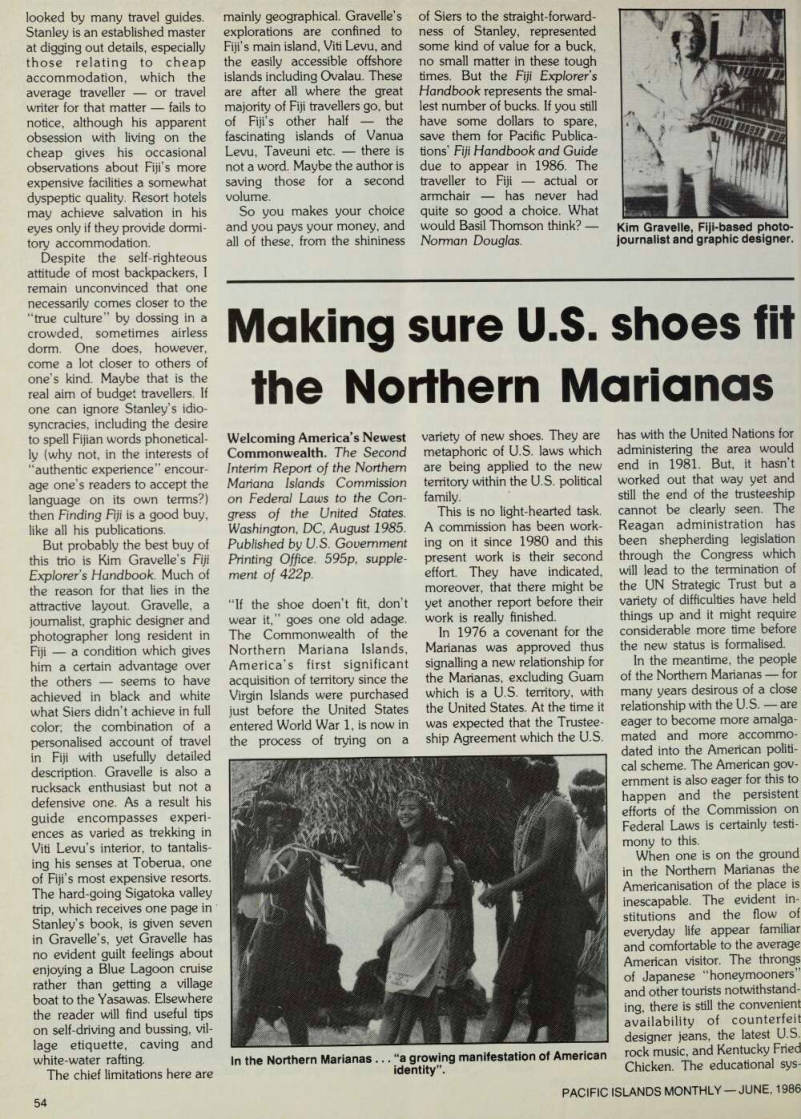
When one is on the ground in the Northern Marianas the Americanisation of the place is inescapable. The evident in stitutions and the flow of everyday life appear familiar and comfortable to the average American visitor. The throngs of Japanese “honeymooners” and other tourists notwithstand ing, there is still the convenient availability of counterfeit designer jeans, the latest U.S. rock music, and Kentucky Fried Chicken. The educational sys
In the Northern Marianas...“a growing manifestation of American identity”.
tern is familiar and one can observe many hoale youngsters firmly integrated with the local population. The teaching force is mixed and mainlanders also enrol themselves in the tertiary programs for credits which can in large measure be transferred to other American colleges and universities. The public health facilities, though not yet to be compared with those found in lowa for example, are nonethe less adequate and improving steadily. Where only a few years ago it was considered insensitive for foreign women to appear in short shorts or other wise scantily-clad, it is now commonplace to observe often quite agreeably a myriad of bikini out-decked lovelies from all ethnic groups.
Steadily, through all this pro cess of rapid change has come a growing manifestation of American identity for the people of the Northern Mariana Islands and in those areas where custom and law might overlap there has always been the inclination towards the American persuasion. The commission, recognising this, has made an excellent and intelligent effort to ensure, or encourage as appropriate, speedy and smooth accommodation in spite of the frustrating and seemingly com placent efforts of the law-mak ers and government officials far away in Washington.
Some federal laws will be come applicable to the North ern Mariana Islands only after the trusteeship under which the islands are now administered comes to an end. The commis sion has recommended that a number of these federal laws become applicable to the CNMI as soon as possible rather than only at the end of the trustee ship. Most prominent among these recommendations is a proposal that the United States issue special passports to citi zens of the Northern Marianas to eliminate the hassles they have often experienced on en tering the United States and to confirm their rights to reside and work in the U.S. before the end of the trusteeship without the visas or other documents required of aliens.
This far in the political experi ence and interchange between the mainland and the CNMI there have been few obvious
problems. The establishment of banking and economic institu tions has brought forth some anomalies and there has also been a certain adjustment ne cessary with regard to the reali ties of taxation and the attend ant social disciplines and change which are necessary.
Some other legal difficulties which have been evident and which will probably continue or increase have to do with the immigrants seen in the com monwealth from other parts of Asia and with the constant importation of labor.
All in all, the progress and change so far are more than satisfactory. Occasionally, there has been a touch of envy from nearby Guam residents who are determined to see an appropriate political change in their own status which will bring them more equally in line with the CNM1. Guam is an unin corporated U.S. territory with an Organic Act. Guam was taken by the U.S. in the Span ish-American war but the Orga nic Act was only finally approved in 1950. But the political progress and change in the north have prompted Guam also to seek a common wealth status. While for all practical purposes there is little difference in the opportunites and rights and benefits between the two political entities, the legal and technical differences — not to mention the flow of economic resources and money — make Guam’s goals impera tive.
The present documents will certainly be useful reading for people planning to come and live in the Northern Mariana Islands and for those who wish to do business there. We might expect a mild “run” on the GFO in Washington to supply them.
The commission has released its staff now but it wil remain in existence until one year after the termination of the trus teesip. More than the technical difficulties which might arise from adjustment to U.S laws is the difficulty being seen in the U.S. Congress in bringing the trusteeship to a just and happy conclusion. This undoubtedly is at present a greater challenge than finding or making the new
shoes fit properly.
Dirk
Anthony Ballendorf.
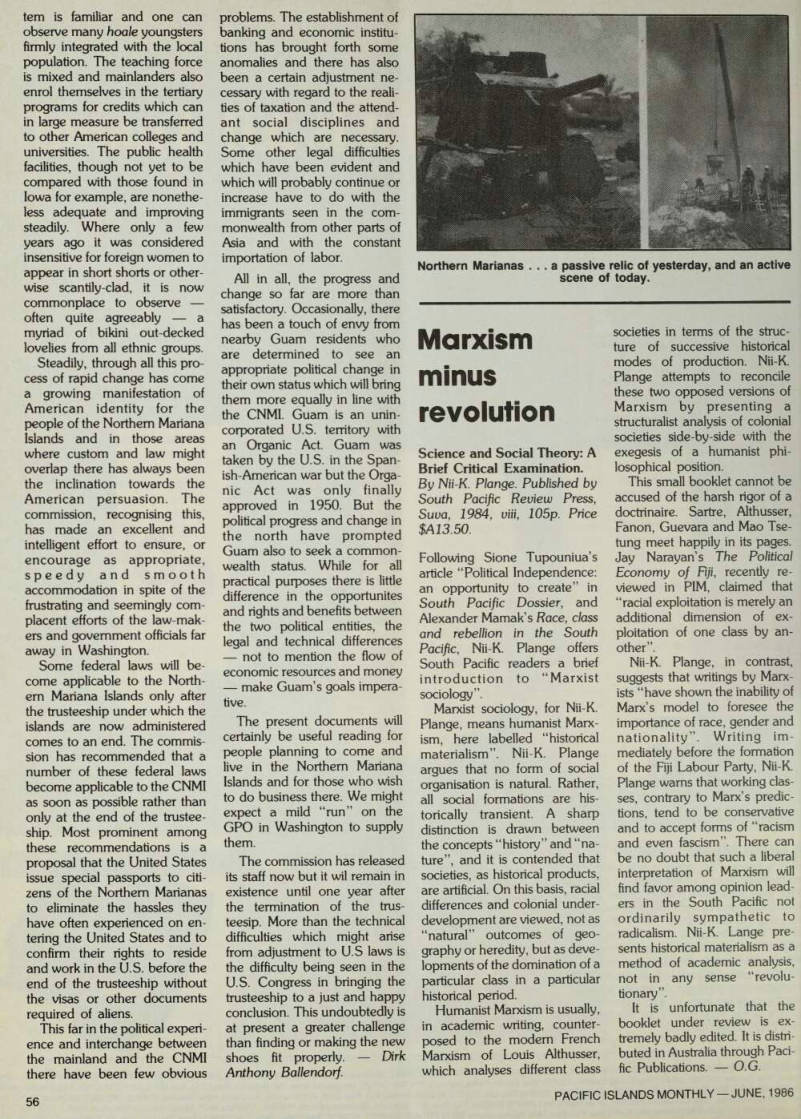
Northern Marianas...a passive relic of yesterday, and an active scene of today.