Two Lapero[?]e wreck or one? Confro[?]ation a Albi
pp. 50-52 · Read in the full issue
one? Confro[?]
A tri-institutional expedition to the Laperouse wreck sites in Vanikoro, Solomon Islands, was set to take place in April. It involved a team from the Queensland Museum, led by marine archeologist Ron Coleman, members of the Solomon Islands National Museum, and a team from the Association Salomon in Noumea, led by Alain Conan. The aim of the expedition was to evaluate the archeological worth of the sites, and to explore the reefs to the east of the known Laperouse wreck sites, for oral tradition has it or at least one version of it that one of the Laperouse vessels may have foundered there. Here Australian National University linguistics specialist DARRELL TRYON traces the background to the expedition, and describes the elaborate Laperouse bicentennial commemorations being or ganised in France and elsewhere. DrTryon last year attended a lively inaugural symposium for the bicentennial celebrations held in Albi, southern France, where he delivered a paper on linguistic evidence for the presence of Laperouse’s expedi tion at Vanikoro, and acted as interpreter for Vila-based marine salvage expert Reece Discombe.
The symposium was marked by a sharp division of opinion between participants on whether in fact both Laperouse wrecks have been found at Vanikoro, or only one.
As the bicentennial years (1985-1988) approached, interest in Laperouse was rekin dled, especially among the French, both in the Pacific and in metropolitan France.
In 1981 the Noumea-based Association Salomon, led by Alain Conan, mounted an ex pedition to Vanikoro aboard the Mae/ and the Parenthese , two ketches based in Noumea.
The expedition brought up a number of important items from the Laperouse wrecks, later displayed at an exhibition in Noumea in October 1982 in collaboration with the Societe d’Etudes Historiques de la Nouvelle-Caledonie. Part of this same exhibition was later displayed in Sydney and Can berra, in 1983.
In France, the French Gov ernment and the Association Laperouse Albi-France have or ganised commemorative celebrations worthy of their most illustrious explorer and navigator. These celebrations extend over a four-year period,
from 1985 to 1988.
To launch the celebrations, an international symposium on Laperouse was held in Albi, Laperouse’s home town in southern France near Toulouse, from March 28-31, 1985. The symposium was or ganised by the Association Laperouse Albi-France, whose president, Dr Pierre Amalric, is himself no stranger to Vani koro. The symposium brought together descendants of the famous explorer, scientists and historians from around the world, and all of the divers and salvage experts who have plumbed the depths of the Vanikoro lagoon where Laper ouse’s ships were wrecked two hundred years ago.
The first day’s program will give some idea of the tone and the importance accorded to the opening of the Laperouse bicentennial celebrations.
The symposium was opened by Jean Mistier, permanent sec retary of the Academie Fran caise, introduced by Haroun Tazieff, secretary of state to the
prime minister.
Then followed a galaxy of prestigious personalities, includ ing the pretender to the throne of France. The list of speakers and their topics on that opening morning is worth citing in full: • Alphonse de Bourbon, Duke of Anjou and Cadiz: “My uncle Louis XVI and Laper ouse”. • Duke of Castries, member of the Academic Francaise: “Marechal de Castries, Minister of the Navy and Laperouse”. • Baron de Shone: “My ancestor Claret de Fleuriu”. • Marquis Taffanel de la Jonquiere: “A famous Tarn family; Taffanel de la Jon quiere, Governor of Canada, and their nephew, the lieute nant-general”. • J. Pons and P. Amalric; “Admiral Henri Pascal de Rochegude, friend of the Jesuit College”. • P. Amalric; “J. F. Galaup de Laperouse: unpublished documents presented by the Dalmas and Barthez de Laper ouse families”.
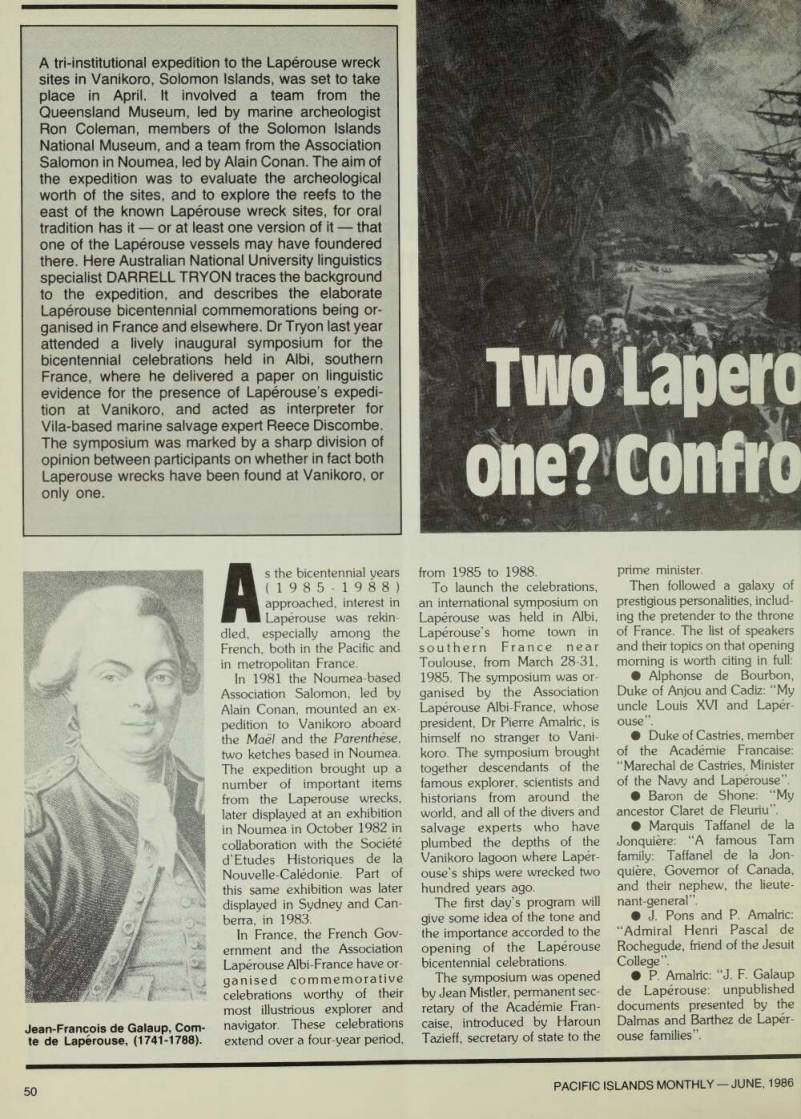
Jean-Francois de Galaup, Com te de Laperouse, (1741-1788).
• P. A. Fleuriot de Langle; “My ancestor Fleuriot de Langle”.
The family background and personal details of Laperouse having been established, the symposium moved in proces sion through the centre of a festooned Albi to the Palais de la Berbie for the opening of the Laperouse Exhibition by the mayor of this ancient city.
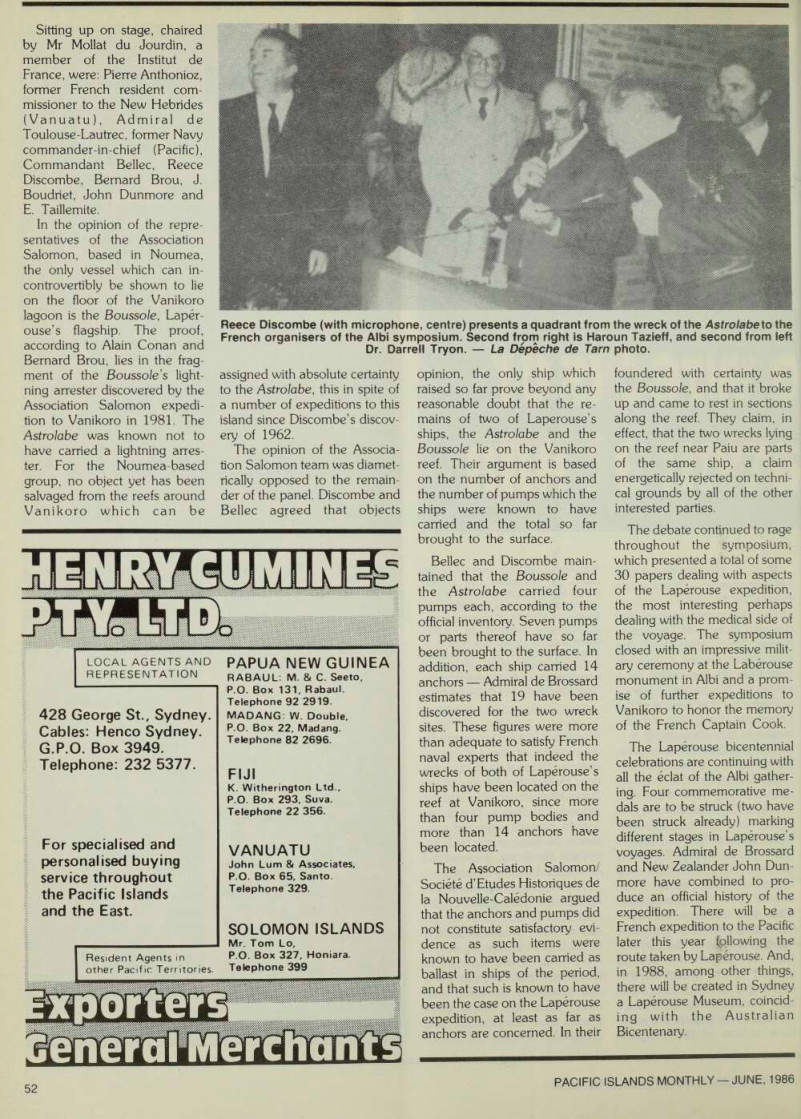
The highlight of the cere mony was the presentation by Reece Discombe of a quadrant recovered by him from the wreck of the Astrolabe.
The first afternoon began with a series of historical papers relating to the voyage, including one on Governor Phillip, by Professor Alan Frost (Mel bourne University). Then came what was perhaps the most interesting, certainly the most important, part of the sympo sium passionately argued and at times hectic sets of exchanges marked the round table discussion which followed the three key papers delivered in a section of the program
devoted to problems raised by the wrecks of the Laperouse vessels. The first, by Comman dant Bellec, the director of the Naval Museum in Paris, and the second, by Reece Discombe, argued strongly for the pre sence of two wrecks on the reefs at Vanikoro, those of the Astrolabe and the Boussole.
The third, a joint presentation by Bernard Brou, Alain Conan and Jean-Claude Roux of the Association Salomon/Societe d’Etudes Historiques de la Nouvelle-Cale donie in Noumea, maintained that there was absolutely no proof that more than one ship, albeit strewn over several sites, was involved.
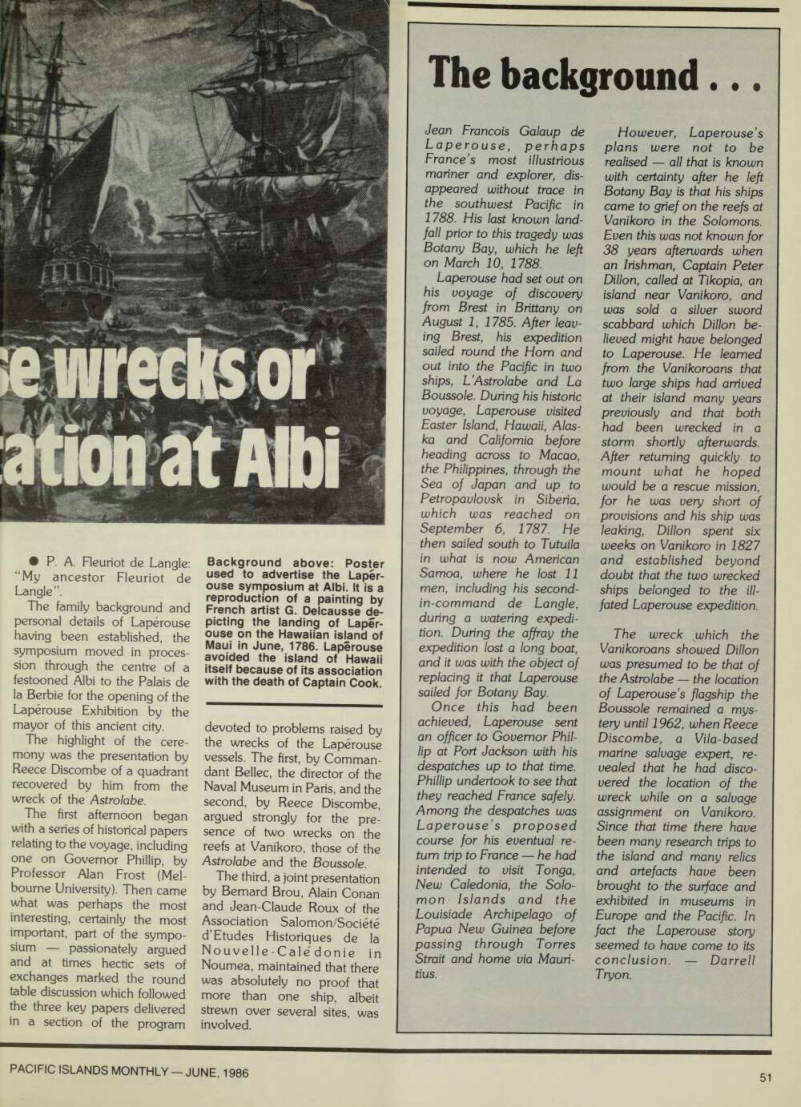
Background above: Poster used to advertise the Laper ouse symposium at Albi. It is a reproduction of a painting by French artist G. Delcausse de picting the landing of Laper ouse on the Hawaiian island of Maui in June, 1786. Laperouse avoided the island of Hawaii itself because of its association with the death of Captain Cook.
Sitting up on stage, chaired by Mr Mollat du Jourdin, a member of the Institut de France, were: Pierre Anthonioz, former French resident com missioner to the New Hebrides (Vanuatu), Admiral de Toulouse-Lautrec, former Navy commander-in-chief (Pacific), Commandant Bellec, Reece Discombe, Bernard Brou, J.
Boudriet, John Dunmore and E. Taillemite.
In the opinion of the repre sentatives of the Association Salomon, based in Noumea, the only vessel which can in controvertibly be shown to lie on the floor of the Vanikoro lagoon is the Boussole, Laper ouse’s flagship. The proof, according to Alain Conan and Bernard Brou, lies in the frag ment of the Boussole’s light ning arrester discovered by the Association Salomon expedi tion to Vanikoro in 1981. The Astrolabe was known not to have carried a lightning arres ter. For the Noumea-based group, no object yet has been salvaged from the reefs around Vanikoro which can be
assigned with absolute certainty to the Astrolabe, this in spite of a number of expeditions to this island since Discombe’s discov ery of 1962.
The opinion of the Associa tion Salomon team was diamet rically opposed to the remain der of the panel. Discombe and Bellec agreed that objects
opinion, the only ship which raised so far prove beyond any reasonable doubt that the re mains of two of Laperouse’s ships, the Astrolabe and the Boussole lie on the Vanikoro reef. Their argument is based on the number of anchors and the number of pumps which the ships were known to have carried and the total so far brought to the surface.
Bellec and Discombe main tained that the Boussole and the Astrolabe carried four pumps each, according to the official inventory. Seven pumps or parts thereof have so far been brought to the surface. In addition, each ship carried 14 anchors Admiral de Brossard estimates that 19 have been discovered for the two wreck sites. These figures were more than adequate to satisfy French naval experts that indeed the wrecks of both of Laperouse’s ships have been located on the reef at Vanikoro, since more than four pump bodies and more than 14 anchors have been located.
The Association Salomon/ Societe d’Etudes Historiques de la Nouvelle-Caledonie argued that the anchors and pumps did not constitute satisfactory evi dence as such items were known to have been carried as ballast in ships of the period, and that such is known to have been the case on the Laperouse expedition, at least as far as anchors are concerned. In their
foundered with certainty was the Boussole, and that it broke up and came to rest in sections along the reef. They claim, in effect, that the two wrecks lying on the reef near Paiu are parts of the same ship, a claim energetically rejected on techni cal grounds by all of the other interested parties.
The debate continued to rage throughout the symposium, which presented a total of some 30 papers dealing with aspects of the Laperouse expedition, the most interesting perhaps dealing with the medical side of the voyage. The symposium closed with an impressive milit ary ceremony at the Laberouse monument in Albi and a prom ise of further expeditions to Vanikoro to honor the memory of the French Captain Cook.
The Laperouse bicentennial celebrations are continuing with all the eclat of the Albi gather ing. Four commemorative me dals are to be struck (two have been struck already) marking different stages in Laperouse’s voyages. Admiral de Brossard and New Zealander John Dun more have combined to pro duce an official history of the expedition. There will be a French expedition to the Pacific later this year fpllowing the route taken by Laperouse. And, in 1988, among other things, there will be created in Sydney a Laperouse Museum, coincid ing with the Australian Bicentenary.
Reece Discombe (with microphone, centre) presents a quadrant from the wreck of the Astrolabe to the French organisers of the Albi symposium. Second from right is Haroun Tazieff, and second from left Dr. Darrell Tryon.- La Dépêche de Tarn photo.