Aussies spend
pp. 46-47 · Read in the full issue
their dollars at home
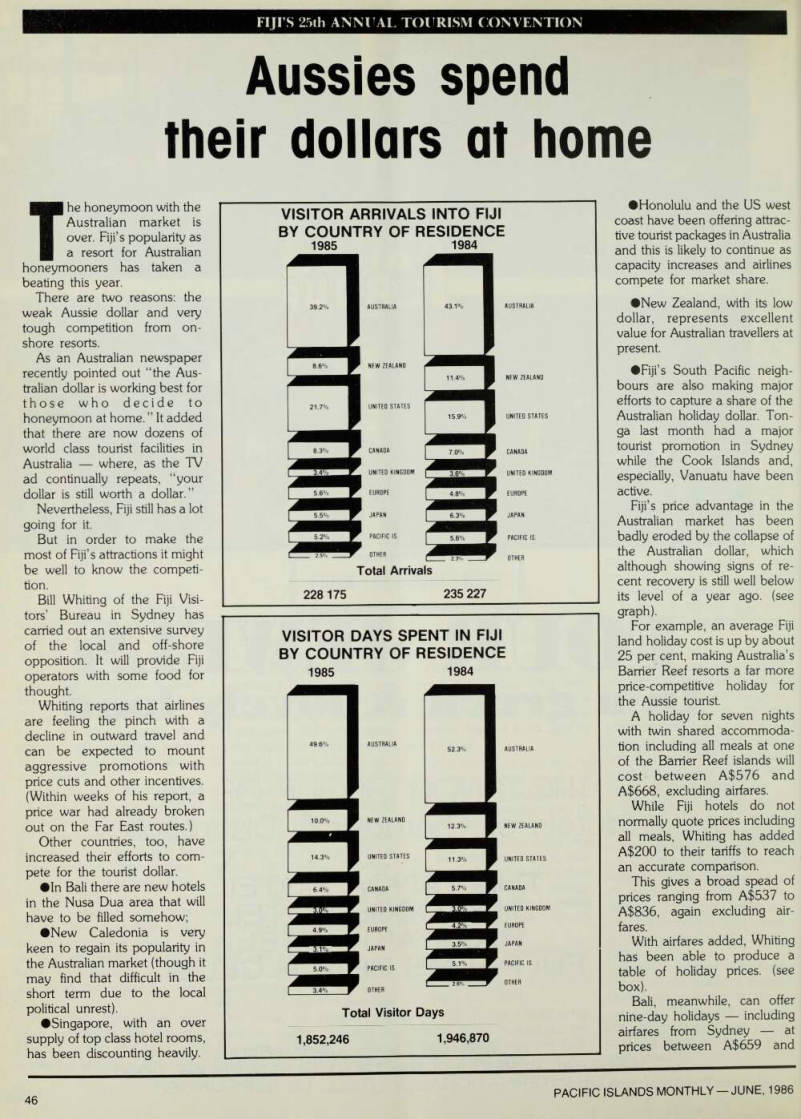
The honeymoon with the Australian market is over. Fiji’s popularity as a resort for Australian honeymooners has taken a beating this year.
There are two reasons: the weak Aussie dollar and very tough competition from on shore resorts.
As an Australian newspaper recently pointed out “the Aus tralian dollar is working best for those who decide to honeymoon at home. ” It added that there are now dozens of world class tourist facilities in Australia where, as the TV ad continually repeats, “your dollar is still worth a dollar.”
Nevertheless, Fiji still has a lot going for it.
But in order to make the most of Fiji’s attractions it might be well to know the competi tion.
Bill Whiting of the Fiji Visi tors’ Bureau in Sydney has carried out an extensive survey of the local and off-shore opposition. It will provide Fiji operators with some food for thought.
Whiting reports that airlines are feeling the pinch with a decline in outward travel and can be expected to mount aggressive promotions with price cuts and other incentives. (Within weeks of his report, a price war had already broken out on the Far East routes.) Other countries, too, have increased their efforts to com pete for the tourist dollar. •In Bali there are new hotels in the Nusa Dua area that will have to be filled somehow; •New Caledonia is very keen to regain its popularity in the Australian market (though it may find that difficult in the short term due to the local political unrest). •Singapore, with an over supply of top class hotel rooms, has been discounting heavily.
•Honolulu and the US west coast have been offering attrac tive tourist packages in Australia and this is likely to continue as capacity increases and airlines compete for market share. •New Zealand, with its low dollar, represents excellent value for Australian travellers at present. •Fiji’s South Pacific neigh bours are also making major efforts to capture a share of the Australian holiday dollar. Ton ga last month had a major tourist promotion in Sydney while the Cook Islands and, especially, Vanuatu have been active.
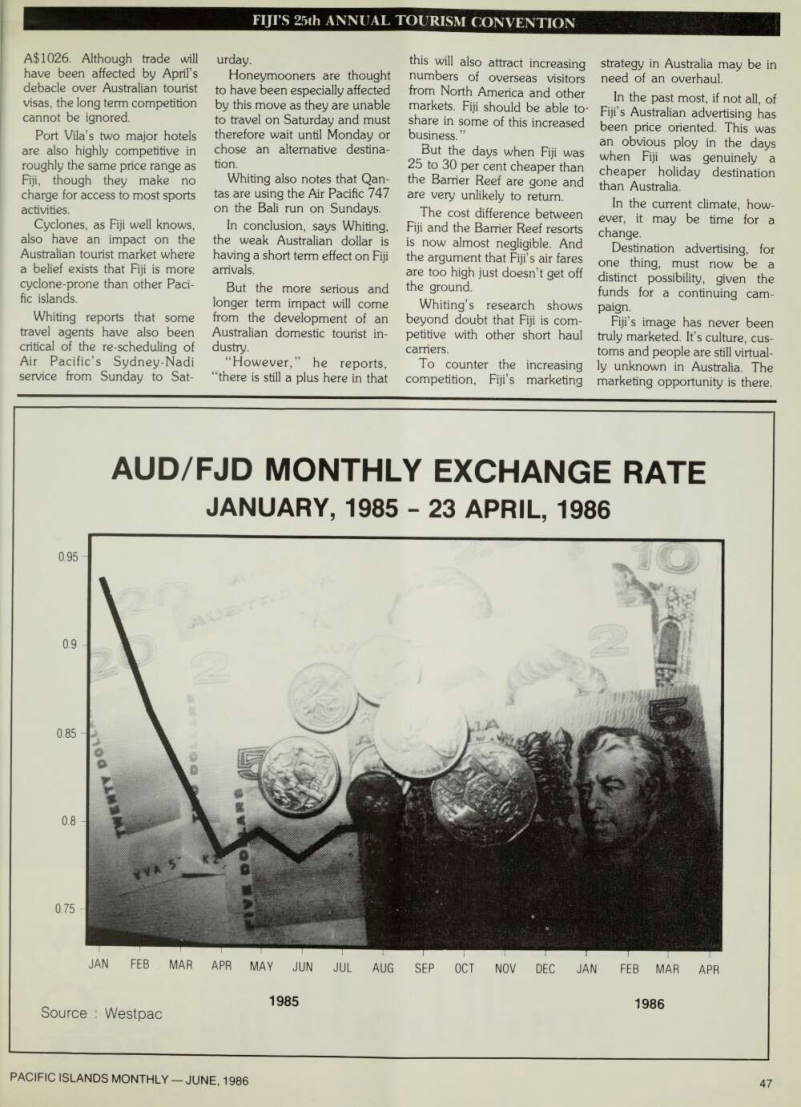
Fiji’s price advantage in the Australian market has been badly eroded by the collapse of the Australian dollar, which although showing signs of re cent recovery is still well below its level of a year ago. (see graph).
For example, an average Fiji land holiday cost is up by about 25 per cent, making Australia’s Barrier Reef resorts a far more price-competitive holiday for the Aussie tourist.
A holiday for seven nights with twin shared accommoda tion including all meals at one of the Barrier Reef islands will cost between A 5576 and As66B, excluding airfares.
While Fiji hotels do not normally quote prices including all meals, Whiting has added As2oo to their tariffs to reach an accurate comparison.
This gives a broad spead of prices ranging from A 5537 to AsB36, again excluding air fares.
With airfares added, Whiting has been able to produce a table of holiday prices, (see box).
Bali, meanwhile, can offer nine-day holidays including airfares from Sydney at prices between A 5659 and
A 51026. Although trade will have been affected by April’s debacle over Australian tourist visas, the long term competition cannot be ignored.
Port Vila’s two major hotels are also highly competitive in roughly the same price range as Fiji, though they make no charge for access to most sports activities.
Cyclones, as Fiji well knows, also have an impact on the Australian tourist market where a belief exists that Fiji is more cyclone-prone than other Paci fic islands.
Whiting reports that some travel agents have also been critical of the re-scheduling of Air Pacific’s Sydney-Nadi service from Sunday to Sat
urday.
Honeymooners are thought to have been especially affected by this move as they are unable to travel on Saturday and must therefore wait until Monday or chose an alternative destina tion.
Whiting also notes that Qan tas are using the Air Pacific 747 on the Bali run on Sundays.
In conclusion, says Whiting, the weak Australian dollar is having a short term effect on Fiji arrivals.
But the more serious and longer term impact will come from the development of an Australian domestic tourist in dustry.
“However,” he reports, “there is still a plus here in that
this will also attract increasing numbers of overseas visitors from North America and other markets. Fiji should be able to* share in some of this increased business. ”
But the days when Fiji was 25 to 30 per cent cheaper than the Barrier Reef are gone and are very unlikely to return.
The cost difference between Fiji and the Barrier Reef resorts is now almost negligible. And the argument that Fiji’s air fares are too high just doesn’t get off the ground.
Whiting’s research shows beyond doubt that Fiji is com petitive with other short haul carriers.
To counter the increasing competition, Fiji’s marketing
strategy in Australia may be in need of an overhaul.
In the past most, if not all, of Fiji’s Australian advertising has been price oriented. This was an obvious ploy in the days when Fiji was genuinely a cheaper holiday destination than Australia.
In the current climate, how ever, it may be time for a change.
Destination advertising, for one thing, must now be a distinct possibility, given the funds for a continuing cam paign.
Fiji’s image has never been truly marketed. It’s culture, cus toms and people are still virtual ly unknown in Australia. The marketing opportunity is there.