Planners keep watch
pp. 29-30 · Read in the full issue

on world movements
Fiji’s efforts over many years to develop its tourism industry have now made it the largest recreational destination in the South Pacific.
It has been helped by its geographic position which rep resents a natural hub for in ternational carriers to transit through Nadi airport. Some 99 per cent of Fiji’s visitors arrive by air.
The country’s major tourist markets are Australia, New Zea land and the USA for short haul visits while long haul markets exist in Canada, Japan, contin ental Europe and the UK.
The Fiji Visitor Bureau’s long term strategy is to continue to develop the primary markets and to seek to widen the marketing base in the long haul areas.
The bureau’s 1986 market ing and budget program emphasises that Fiji should con centrate on quality tourism.
With a 1986 budget of Fsl million from the government plus F 5250,000 for co-opera tive marketing and industry contributions, the FVB has set itself a target of 255,000 visitor arrivals.
The bureau hopes to achieve this by careful research and planning to identify potentially high-yield market segments which will then receive a marketing campaign to sell high quality beach and island resorts and cruises.
The FVB also plans to in terest airlines, hoteliers, tour wholesalers, tour operators, duty free dealers and other agencies in co-operative marketing.
The local industry will also be encouraged to make use of the FVB’s PR consultants network at no charge to enable them to place articles and in formation and to identify carefully selected groups of
media personnel to be invited on facility trips to Fiji.
The FVB plans special Fiji consumer and trade promo tions to stimulate awareness of Fiji as a desireable and presti gious destination.
The marketing strategy also includes seminars, point of sale materials, airline support and educational/promotional activi ties.
This year there is an updated Fiji Travel Guide (agent’s manual), a Fiji Book, a press kit, an increased number of give aways (Fiji handicrafts) for use in window displays, gifts to agents, decorations for func tions and promotions.
The FVB again hosts agents, journalists and media personnel either invited to or visiting Fiji.
Australia Fiji’s largest mar ket has been allocated a target of 104,300 arrivals, a 4.5 per cent increase on the 1985 estimate.
The major Australian growth targets are Victoria, South Aus tralia and Tasmania where the FVB hopes to increase market share.
New South Wales, for inst ance, with 36 per cent of Australia’s population, accounts for 55 per cent of Fiji’s Austra lian visitors.
Victoria, with some 27 per cent of the population provides 26 per cent of the visitors. This is despite the fact that surveys show that more Victorians take holidays out of state than do the people of NSW.
The FVB also sees the ob vious needs to maintain market share in NSW, increase traffic during the “off” and “shoulder” season months of February— June and November and to increase average earnings per visitor.
To achieve all this, says the bureau, more people have to be motivated to go into the various travel agents and book ing offices. And this can be done through vigorous con sumer advertising campaigns and by the FVB promoting its own services and expertise among travel agents and wholesalers.
New Zealand has recently been infertile ground for Fiji, but several factors may have combined to alter that picture.
The relative strengthening of the NZ dollar, the more com petitive airfares offered by Air Pacific and Air New Zealand and the introduction of a direct Christchurch-Fiji service have all had an impact.
Target for New Zealand arri vals in 1986 is 26,500 against the 1985 estimate of 20,000.
The South Island market, in particular, is seen as capable of development, though the major market areas of Auckland, Wel lington, Waitako and Taranaki cannot be neglected.
The Travel Agents Associa
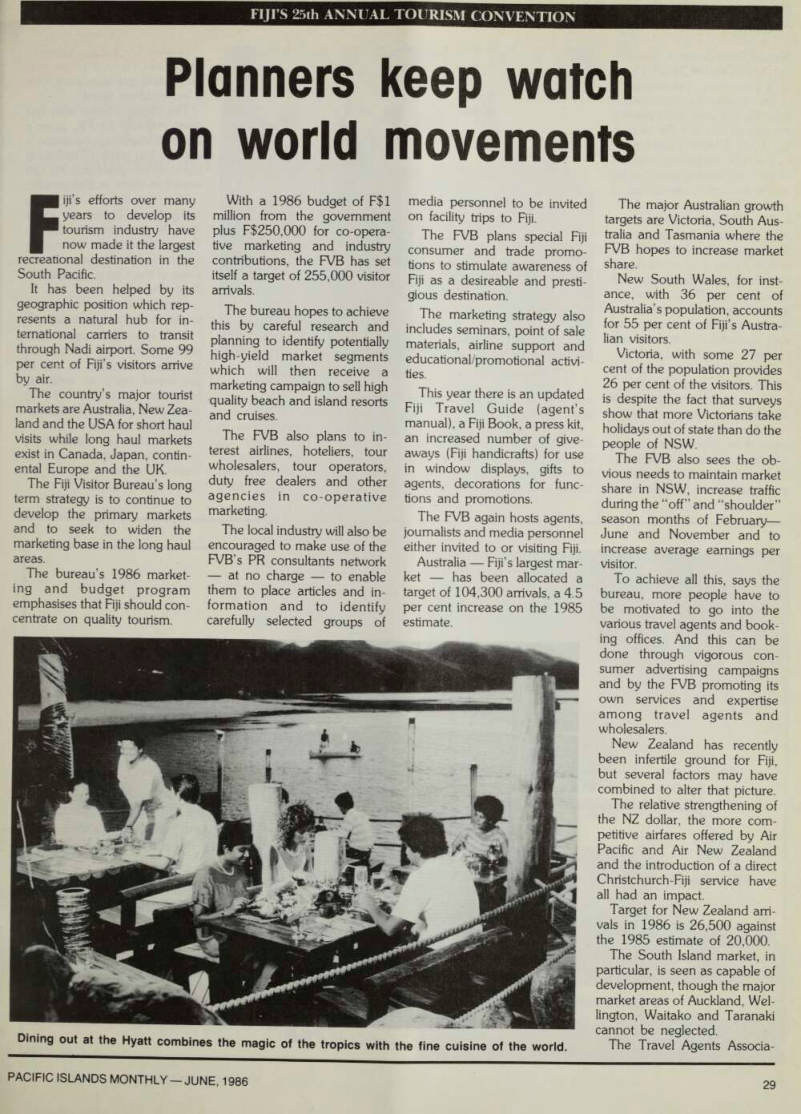
Dining out at the Hyatt combines the magic of the tropics with the fine cuisine of the world.
tion of New Zealand Conven tion from October 14-19 is seen as a marketing opportunity.
An impressive attendance from Fiji this year could present an opportunity for Fiji to host the 1991 TAANZ conference.
The US, frequently referred to as “the sleeping giant’’ as far as Fiji tourism is concerned, is also a FVB target.
The FVB, in co-operation with Qantas, will take part in their usual October series of South Pacific Adventure Semi nars for travel agents and will also visit the North American central reservations offices of Air New Zealand, Continental and Qantas to ensure staff are updated on all Fiji information.
The US market, however, poses specific problems.
The extreme length of the journey confronting most North American visitors to Fiji and the usual short stopover en route to a further destination combine to make it hard for the traveller to go home as a committed
ambassador for Fiji as a destina tion.
With little time to relax be tween flights, let alone get to know the pleasures and attrac tions of Fiji, the American tour ist is likely to get a mistaken
impression.
The FVB will campaign to:.
Increase the length of stay in order to overcome the di sorientation of jetlag.. Schedule Fiji as a homebound stopover after only short flights from
Australia or New Zealand.
Emphasise Fiji as a longer stay destination not associated with a more distant point.
The Japan market also has great potential for Fiji. Japan’s overseas travelling population is expected to reach 10 million in the next ten years and Fiji can expect to share in that growth.
But the market is highly competitive. There are more than 50 government offices in Tokyo devoted to promoting tourism in their home countries, some of them very aggressive in their marketing.
Strategy is very important under these circumstances.
FVB strategists suggest that sales promotions should be aimed at consumers as well as the travel trade in order to heighten awarness of Fiji among the other travel destina tions being offered.
With the yen continuing strong, the time has never been better to make a bid for the Japan tourist traffic
Fiji has attractions of its own to offer the gourmet.