From rubber to riches
p. 24 · Read in the full issue
How does a venerable island plantation operator come to be listed in the top 150 Australian companies? The answer for Koitaki Ltd was to get out of plantations and into financial services.
When the Darling family bought into Koitaki, a planta tion on PNG’s Sogeri plateau, one of the first changes they made was to move away from the traditional rubber and plant coffee. It was the first of a series of inspired decisions that set the company on the road to that spot in the hot 150.
The coffee move came just in time to catch the prices boom of the late ’7os which brought welcome returns for Koitaki, first listed as a public company in 1929 with the intention of developing a rubber plantation.
At the same time as the coffee boom, however, a re cently independent PNG was striving for national ownership in the plantation sector and the plantation was sold to national interests.
“We didn’t particularly want to sell,” recalls managing director Michael Darling. “But we saw the writing on the wall and, in the event, we negoti ated a sale in an amicable way. ”
In fact, Koitaki received three times earnings for the planta tion, a deal that would be hard to repeat in today’s commodity price climate.
The Darlings at the same time sold the Smugglers Inn in Madang to Steamships Ltd.
With cash in hand the family looked for investment opportu nities in PNG. “But there was nothing around at the time,” said Michael.
They did, however, maintain a PNG connection with the subsequent acquisition of a 25 per cent holding in Watkins, a company with substantial in terest and activity in the new nation.
An attempted take-over was beaten at the post by the Thiess group, although the Darlings were able to retire from the proceedings with a Aslo mil lion return for a $1.5 million initial investment.
Koitaki then turned to the
When the PNG government bought the Koitaki plantation from its then owners, it launched Koitaki Ltd. on a spectacular journey into the stock exchange stratosphere. RUSSELL HUN TER asks how it was done.
financial services industry with a 50 per cent share of Australian National Life Insurance, pioneering the Australian ver sion of a unit trust-linked life insurance plan that had caught on big in the UK but was as yet untried Down Under.
The other half of ANLI was taken up by Key West Invest ments Ltd which runs the Clayton Robard Unit Trust.
Koitaki later acquired 27 per cent of Key West.
The venture was, to say the least, a success.
In 1979 Koitaki was capital ised at $2 million. Current market capitalisation stands at around $179 million. The com pany earned $3.75 million in profits after tax in the last half year.
The 700 or so investors lucky enough to hold Koitaki scrip have had a good run for their money by any reckoning.
The original 800,000 shares climbed to about $2O before last year’s 9 for 1 issue brought
the price down again to $2.
Michael Darling says the company will split the shares again to reduce the price per share towards the $5 mark in the current 1:2 bonus issue.
“Then we’ll hope to repeat the process. ”
Koitaki itself consists of four executives and a secretary who operate out of a 20th floor eyrie in Sydney’s financial district.
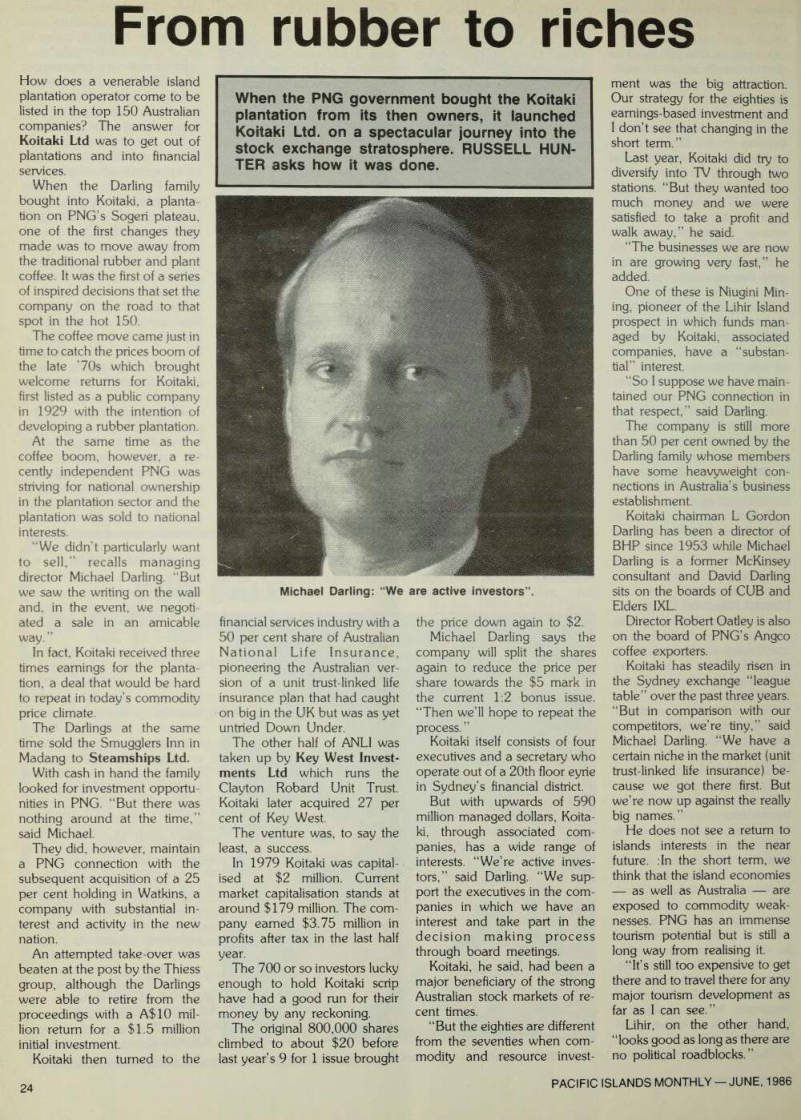
But with upwards of 590 million managed dollars, Koita ki, through associated com panies, has a wide range of interests. “We’re active inves tors,” said Darling. “We sup port the executives in the com panies in which we have an interest and take part in the decision making process through board meetings.
Koitaki, he said, had been a major beneficiary of the strong Australian stock markets of re cent times.
“But the eighties are different from the seventies when com modity and resource invest
ment was the big attraction.
Our strategy for the eighties is earnings-based investment and I don’t see that changing in the short term.”
Last year, Koitaki did try to diversify into TV through two stations. “But they wanted too much money and we were satisfied to take a profit and walk away,” he said.
“The businesses we are now in are growing very fast,” he added.
One of these is Niugini Min ing, pioneer of the Lihir Island prospect in which funds man aged by Koitaki, associated companies, have a “substan tial” interest.
“So I suppose we have main tained our PNG connection in that respect,” said Darling.
The company is still more than 50 per cent owned by the Darling family whose members have some heavyweight con nections in Australia’s business establishment.
Koitaki chairman L Gordon Darling has been a director of BHP since 1953 while Michael Darling is a former McKinsey consultant and David Darling sits on the boards of CUB and Elders IXL.
Director Robert Oatley is also on the board of PNG’s Angco coffee exporters.
Koitaki has steadily risen in the Sydney exchange “league table” over the past three years.
“But in comparison with our competitors, we’re tiny,” said Michael Darling. “We have a certain niche in the market (unit trust-linked life insurance) be cause we got there first. But we’re now up against the really big names.”
He does not see a return to islands interests in the near future. ;In the short term, we think that the island economies as well as Australia are exposed to commodity weak nesses. PNG has an immense tourism potential but is still a long way from realising it.
“It’s still too expensive to get there and to travel there for any major tourism development as far as I can see.”
Lihir, on the other hand, “looks good as long as there are no political roadblocks.”
Michael Darling: “We are active investors”.