American Samoans
pp. 14-16 · Read in the full issue

migrating to the US take on a wide variety of occupations but few match the endeavor of men like Mosi Tatupu, Terry Tautola, Wilson Faumuina, Manu Tuiasosopo and Jack Thomp son.
All of these are grid-iron footballers, practitioners of an art which, like cricket, is a sport notable mainly for its total lack of comprehension in large areas of the world.
Yet it is one of the most popular of spectator sports in the mainland US and, thus, offers, through athletic scholar ships, a chance of getting an extensive, and expensive, education which otherwise would be unavailable to many young men.
Because Samoans start early to play with the oval Rugby style football a version of which is used in American football, they take naturally to grid-iron and, today, between 70 and 80 young Samoans are to be found playing collegiate football in the US. University College, Los Angeles, Long Beach State, Washington State, Long Beach City College, and Uni versity of Southern California are among the many major university sides including Sa moans in their ranks.
From there many have be come professionals. Those named above are, today, the best-known and, of them all, the most famous is Mosi Tatupu who plays with the New Eng land Patriots.
He was born in Pago Pago in 1955 and moved to Hawaii as a boy during his father’s efforts to further a professional boxing career. Young Mosi had no pugilistic aspirations, but loved football and was soon one of the most successful players in Hawaiian schoolboy grade grid iron history. Leading mainland colleges, searching for football talent, quickly offered scholar ships and he chose University of Southern California, joining their team, the USC Trojans.
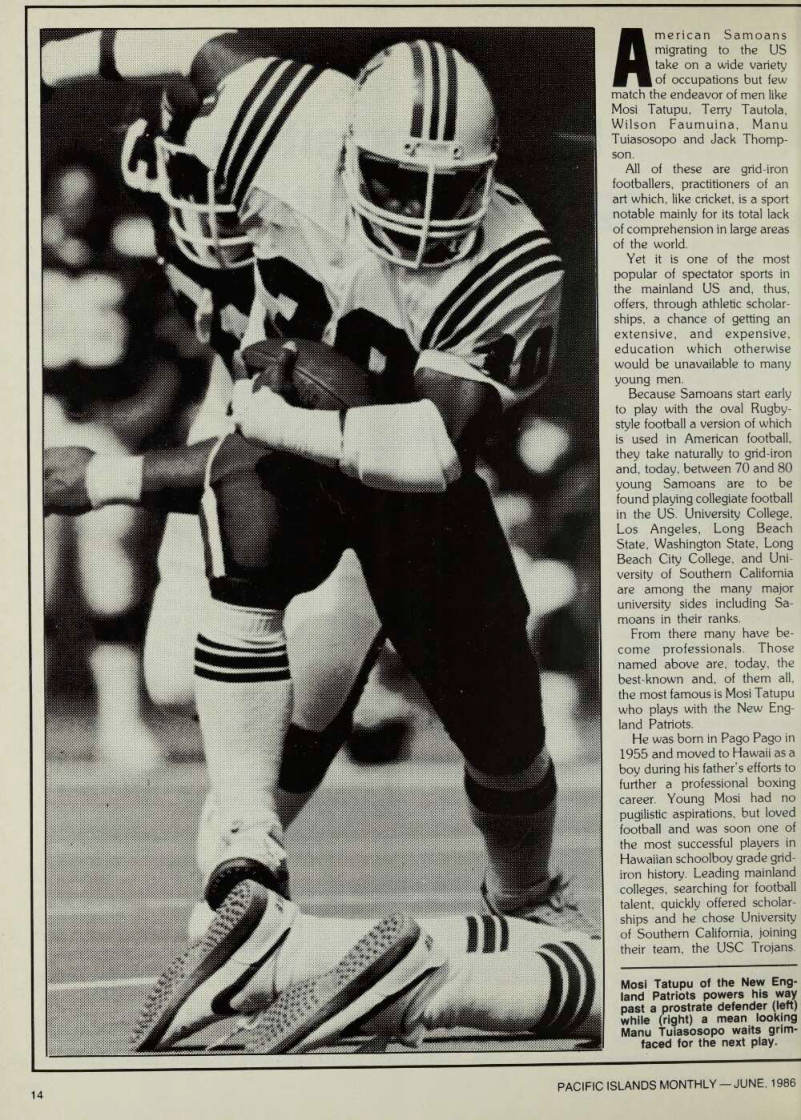
Mosi Tatupu of the New Eng land Patriots powers his way past a prostrate defender (left) while (right) a mean looking
Manu Tuiasosopo waits grim
faced for the next play.
A whole new ball game
He is still remembered in col legiate circles for the proficiency of his tackling.
In 1978 the New England Patriots, one of the US National Football League’s most popular clubs, drafted him into its paid ranks. Since then he has played in over 110 successive games, a record equalled by only three other Patriot players.
He is a “running back” whose forte is to carry the ball the last vital few yards to touchdown when the defence is at its most ferocious.
Tatupu stands exactly 6ft tall and weighs 16 stone, which makes him a comparative light weight in the National League where monstrous men rejoicing in names like “The Refrigera tor” and “Man Mountain” are commonly seen. But he has a low centre of gravity and ex tremely powerful legs, which gives him the ability to bulldoze his way through the smallest gap in the last desperate seconds of a score.
Off the field Tatupu is equally popular, spending many hours working for various charities,
notably animal welfare, the mentally handicapped and the Cancer Society. He is also to be found often visiting high schools in deprived areas, giv ing speeches on the importance of self-esteem and the value of a good eduction.
In between times Tatupu has started a business called, perhaps oddly, “The Snowin’
Samoan’s Hawaiian Style Shaved Ice Store.”
How he got the nickname, “The Snowin’ Samoan” is a bit of a mystery, but probably is related to the fact that some of his most brilliant performances were seen on snow-covered fields quite unlike the atmos phere of his homeland.
Mosi is married, with a daughter, Linnea Mosiula, and a son, Mosiula Mealofa. He will be 31 soon and therefore has a limited life left in professional football. Friends believe that on retirement he may turn to poli tics, perhaps back in Hawaii where his American career be gan and where he has many kinsmen very proud of his success. Paul Moon.
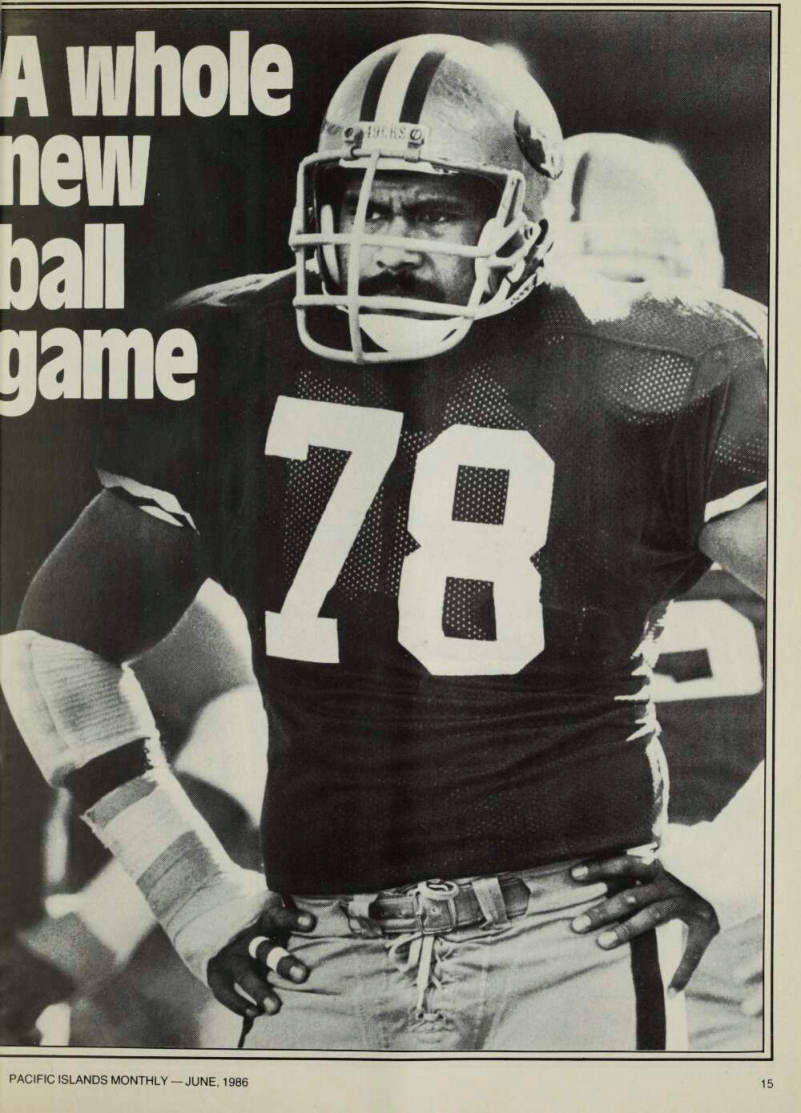
Manu Tuiasosopo of the San Francisco 49ers takes a tackle in his stride.