Palmyra saga
pp. 11-12 · Read in the full issue
End of 12-year Palmyra saga of piracy, murder
One of the most unusual cases in modern Amer ican jurisprudence a story involving piracy, circumstantial evidence, mur der and prison escape finally came to its end in San Francis co in March when Stephanie Stearns, a 39-year-old Los Angeles office manager, was acquitted.
The end to a drama that began in August of 1974 at Palmyra atoll, 1600 kilometres south of Hawaii, was suspense ful. Jurors told U.S. District Judge Samuel King, who came with the case from Honolulu where it originated, that they were tied 6-6 but did not indicate whether this position was fixed. The judge returned them for further deliberations.
They reported subsequently that they were now split 10-2.
Defence attorneys wanted a mistrial but the judge ordered more deliberations.
Stearns, a compact woman who wore business suits to her trial, fidgeted and was obvious ly nervous. Her mother, also in court, displayed tension. But Stearns was a free woman when the jurors made their final return to the courtroom which is high atop the 20-storey Fede ral Office Building near the San Francisco City Hall.
The skyscraper courtroom was much removed in time, distance and setting from the events which were laid out during the weeks of the trial.
Herewith a narrative; In the fall of 1974, the luxurious 38-foot ketch Sea Wind of San Diego, California,
PIM has often over the years reported on aspects of the grim events of August 1974 in Palmyra lagoon, most recently in our August ’B5 issue (p. 59) where we reported that a jury in San Francisco had found Buck Duane Walker guilty of the first-degree murder of Eleanor “Muff” Graham of San Diego, USA, at Palmyra in August 1974.
The marathon court hearings came to an end in March with the acquittal in San Francisco of Walker’s companion, Stephanie Stearns, who faced a charge of murdering Eleanor Graham’s husband, Malcolm.
Now RALPH CRAIB in San Francisco surveys the whole 12-year saga in an exclusive report for PIM.
was anchored in the Palmyra lagoon while its owners, Eleanor (Muff) Graham and her husband, Malcolm (Mac) Gra ham, fished and used the beaches. They were a wealthy couple and their vessel was abundantly supplied.
But Sea Wind soon had unwelcome company. The ketch lola limped into the la goon. It was crewed by Stearns and her boy friend, Buck Duane Walker, now 47. The newcomer was in ill repair and its hippie duo were poorly supplied. The vessel had to be bailed out daily by hand to keep it afloat.
Oceanographer, Norman Sanders, who was a witness at Walker’s trial in San Francisco last June, said that the situation at Palmyra wasn’t nice. The lagoon, he said, was awash with sharks, poisonous fish and hu man hostility. He said that he made plans to leave Palmyra
within a few days and that he also advised the Grahams to do so.
“If the 200
inches of rain
per year and the rapa cious sharks were bad ,
the culture
dash between
the hippies
and the
establishment
was worse ..
“I wrote in my log book,” the oceanographer said, “that it was a place where even the vinyl would rot.” If the 200 inches of rain per year and the rapacious sharks were bad, he
said, the “culture clash between the hippies and the establish ment” was worse.
Sanders told the court of hiding behind a palm tree in fear when Walker used a pistol to shoot one type of fish in the lagoon that was edible. This placed in the record of the trial Walker’s possession of a weapon. Sanders subsequently left Palmyra.
The Grahams’ equipment aboard the Sea Wind included a radio transmitter which en abled them to communicate with friends on the U.S. main land and in Hawaii. They main tained weekly radio schedules.
On August 28, 1974, Graham contacted Curt Shoemaker, a Honolulu amateur radio oper ator who had previously re layed messages to members of the Graham family. Graham told Shoemaker that the Sea Wind and the lola were still at Palmyra and that the lola was to leave in a few days. Graham said that the two people from the lola, whom he knew as Mr and Mrs Allen, were coming to his ketch that evening for a bon voyage party.
Graham was never heard from again. No trace of him has ever been found. Remains, subsequently identified as those of his wife, did however turn up seven years later.
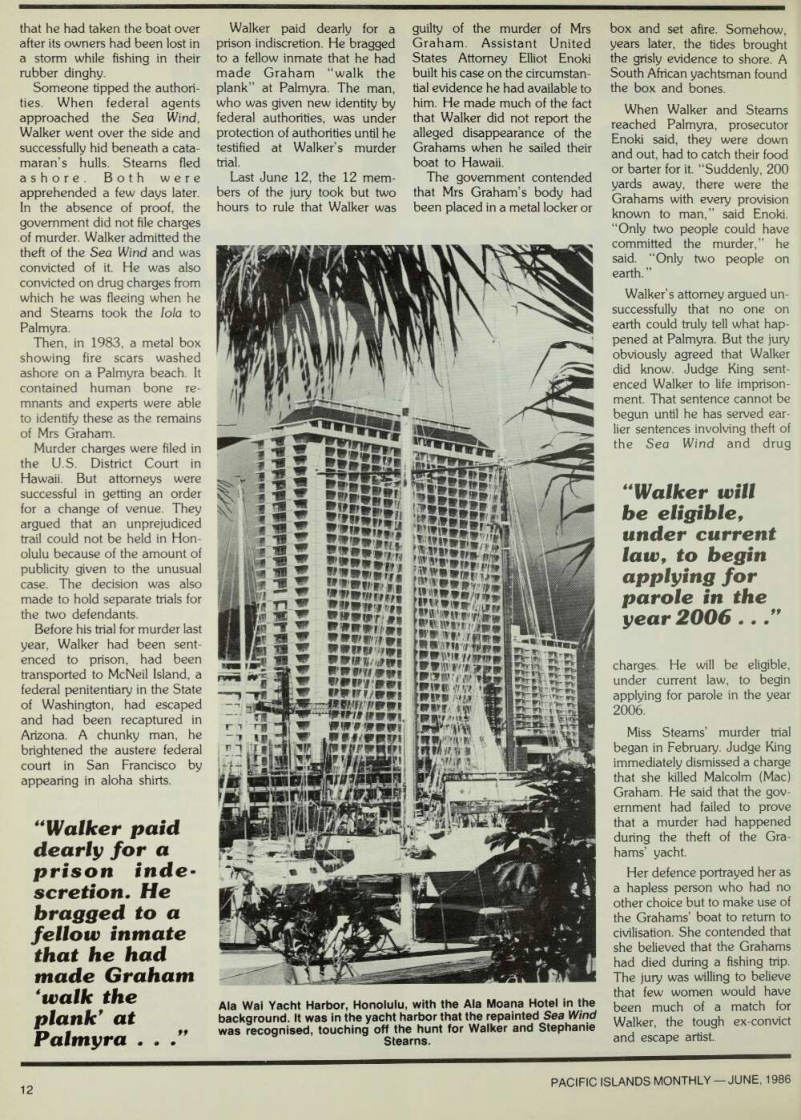
Two months after that Aug ust 1974 radio message, the repainted Sea Wind sailed into the Ala Wai Yacht Harbor, just a stroll from the luxury hotels of Oahu’s Waikiki. When other yachtsmen recognised the well known boat, Walker told them
that he had taken the boat over after its owners had been lost in a storm while fishing in their rubber dinghy.
Someone tipped the authori ties. When federal agents approached the Sea Wind, Walker went over the side and successfully hid beneath a cata maran’s hulls. Steams fled ashore. Both were apprehended a few days later.
In the absence of proof, the government did not file charges of murder. Walker admitted the theft of the Sea Wind and was convicted of it. He was also convicted on drug charges from which he was fleeing when he and Steams took the lola to Palmyra.
Then, in 1983, a metal box showing fire scars washed ashore on a Palmyra beach. It contained human bone re mnants and experts were able to identify these as the remains of Mrs Graham.
Murder charges were filed in the U.S. District Court in Hawaii. But attorneys were successful in getting an order for a change of venue. They argued that an unprejudiced trail could not be held in Hon olulu because of the amount of publicity given to the unusual case. The decision was also made to hold separate trials for the two defendants.
Before his trial for murder last year, Walker had been sent enced to prison, had been transported to McNeil Island, a federal penitentiary in the State of Washington, had escaped and had been recaptured in Arizona. A chunky man, he brightened the austere federal court in San Francisco by appearing in aloha shirts.
4 Walker paid
dearly for a
prison inde
scretion. He
bragged to a
fellow inmate
that he had
made Graham
‘walk the
plank’ at
Palmyra . . .”
Walker paid dearly for a prison indiscretion. He bragged to a fellow inmate that he had made Graham “walk the plank” at Palmyra. The man, who was given new identity by federal authorities, was under protection of authorities until he testified at Walker’s murder trial.
Last June 12, the 12 mem bers of the jury took but two hours to rule that Walker was
guilty of the murder of Mrs Graham. Assistant United States Attorney Elliot Enoki built his case on the circumstan tial evidence he had available to him. He made much of the fact that Walker did not report the alleged disappearance of the Grahams when he sailed their boat to Hawaii.
The government contended that Mrs Graham’s body had been placed in a metal locker or
box and set afire. Somehow, years later, the tides brought the grisly evidence to shore. A South African yachtsman found the box and bones.
When Walker and Steams reached Palmyra, prosecutor Enoki said, they were down and out, had to catch their food or barter for it. “Suddenly, 200 yards away, there were the Grahams with every provision known to man,” said Enoki.
“Only two people could have committed the murder,” he said. “Only two people on earth. ”
Walker’s attorney argued un successfully that no one on earth could truly tell what hap pened at Palmyra. But the jury obviously agreed that Walker did know. Judge King sent enced Walker to life imprison ment. That sentence cannot be begun until he has served ear lier sentences involving theft of the Sea Wind and drug
‘ Walker
be eligible,
under current
law, to begin
applying for
parole in the
year 2006 ..
charges. He will be eligible, under current law, to begin applying for parole in the year 2006.
Miss Steams’ murder trial began in February. Judge King immediately dismissed a charge that she killed Malcolm (Mac) Graham. He said that the gov ernment had failed to prove that a murder had happened during the theft of the Gra hams’ yacht.
Her defence portrayed her as a hapless person who had no other choice but to make use of the Grahams’ boat to return to civilisation. She contended that she believed that the Grahams had died during a fishing trip.
The jury was willing to believe that few women would have been much of a match for Walker, the tough ex-convict and escape artist.
Ala Wai Yacht Harbor, Honolulu, with the Ala Moana Hotel in the background. It was in the yacht harbor that the repainted Sea Wind was recognised, touching off the hunt for Walker and Stephanie Stearns.