people
pp. 48-49 · Read in the full issue
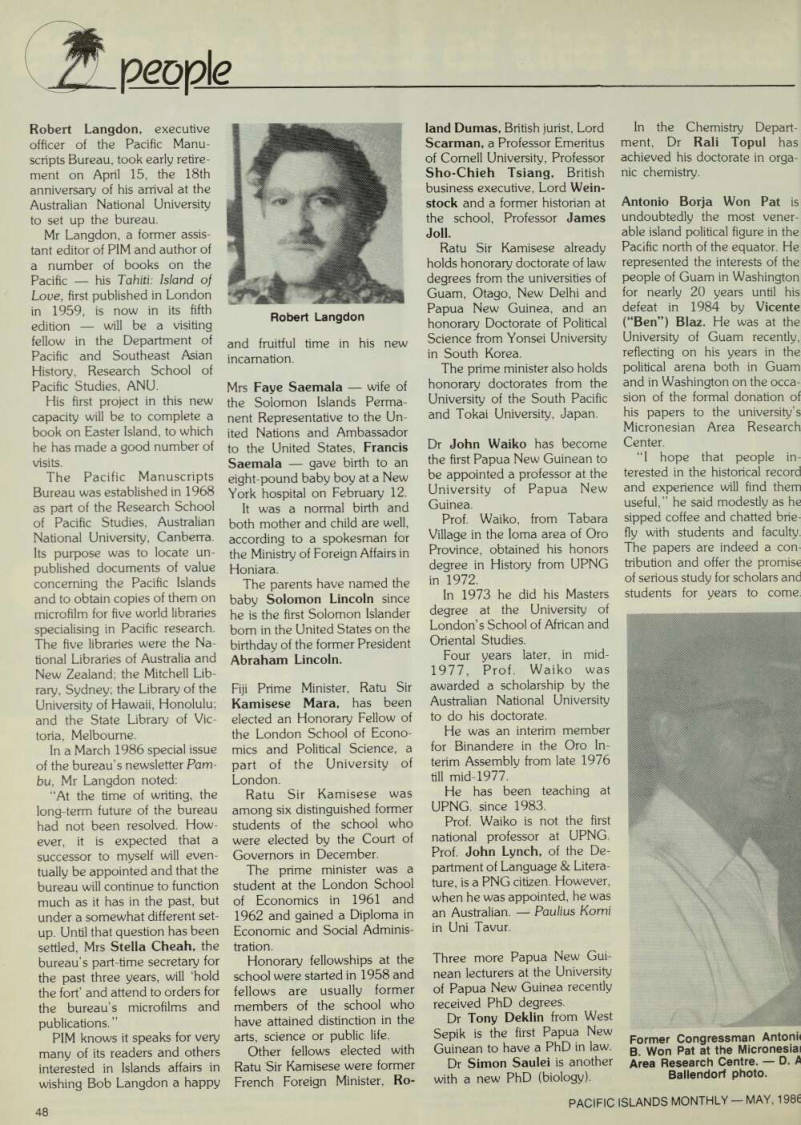
Robert Langdon, executive officer of the Pacific Manu scripts Bureau, took early retire ment on April 15, the 18th anniversary of his arrival at the Australian National University to set up the bureau.
Mr Langdon, a former assis tant editor of PIM and author of a number of books on the Pacific his Tahiti: Island of Love, first published in London in 1959, is now in its fifth edition will be a visiting fellow in the Department of Pacific and Southeast Asian History, Research School of Pacific Studies, ANU.
His first project in this new capacity will be to complete a book on Easter Island, to which he has made a good number of visits.
The Pacific Manuscripts Bureau was established in 1968 as part of the Research School of Pacific Studies, Australian National University, Canberra.
Its purpose was to locate un published documents of value concerning the Pacific Islands and to obtain copies of them on microfilm for five world libraries specialising in Pacific research.
The five libraries were the Na tional Libraries of Australia and New Zealand; the Mitchell Lib rary, Sydney; the Library of the University of Hawaii, Honolulu; and the State Library of Vic toria, Melbourne.
In a March 1986 special issue of the bureau’s newsletter Pam bu, Mr Langdon noted; “At the time of writing, the long-term future of the bureau had not been resolved. How ever, it is expected that a successor to myself will even tually be appointed and that the bureau will continue to function much as it has in the past, but under a somewhat different set up. Until that question has been settled, Mrs Stella Cheah, the bureau’s part-time secretary for the past three years, will ‘hold the fort’ and attend to orders for the bureau’s microfilms and publications. ”
PIM knows it speaks for very many of its readers and others interested in Islands affairs in wishing Bob Langdon a happy
and fruitful time in his new incarnation.
Mrs Faye Saemala wife of the Solomon Islands Perma nent Representative to the Un ited Nations and Ambassador to the United States, Francis Saemala gave birth to an eight-pound baby boy at a New York hospital on February 12.
It was a normal birth and both mother and child are well, according to a spokesman for the Ministry of Foreign Affairs in Honiara.
The parents have named the baby Solomon Lincoln since he is the first Solomon Islander bom in the United States on the birthday of the former President Abraham Lincoln.
Fiji Prime Minister, Ratu Sir Kamisese Mara, has been elected an Honorary Fellow of the London School of Econo mics and Political Science, a part of the University of London.
Ratu Sir Kamisese was among six distinguished former students of the school who were elected by the Court of Governors in December.
The prime minister was a student at the London School of Economics in 1961 and 1962 and gained a Diploma in Economic and Social Adminis tration.
Honorary fellowships at the school were started in 1958 and fellows are usually former members of the school who have attained distinction in the arts, science or public life.
Other fellows elected with Ratu Sir Kamisese were former French Foreign Minister, Ro
land Dumas, British jurist, Lord Scarman, a Professor Emeritus of Cornell University, Professor Sho-Chieh Tsiang, British business executive, Lord Wein stock and a former historian at the school, Professor James Joll.
Ratu Sir Kamisese already holds honorary doctorate of law degrees from the universities of Guam, Otago, New Delhi and Papua New Guinea, and an honorary Doctorate of Political Science from Yonsei University in South Korea.
The prime minister also holds honorary doctorates from the University of the South Pacific and Tokai University, Japan.
Dr John Waiko has become the first Papua New Guinean to be appointed a professor at the University of Papua New Guinea.
Prof. Waiko, from Tabara Village in the loma area of Oro Province, obtained his honors degree in History from UPNG in 1972.
In 1973 he did his Masters degree at the University of London’s School of African and Oriental Studies.
Four years later, in mid -1977, Prof. Waiko was awarded a scholarship by the Australian National University to do his doctorate.
He was an interim member for Binandere in the Oro In terim Assembly from late 1976 till mid-1977.
He has been teaching at UPNG. since 1983.
Prof. Waiko is not the first national professor at UPNG.
Prof. John Lynch, of the De partment of Language & Litera ture, is a PNG citizen. However, when he was appointed, he was an Australian. Paulius Komi in Uni Tavur.
Three more Papua New Gui nean lecturers at the University of Papua New Guinea recently received PhD degrees.
Dr Tony Deklin from West Sepik is the first Papua New Guinean to have a PhD in law.
Dr Simon Saulei is another with a new PhD (biology).
In the Chemistry Depart ment, Dr Rali Topui has achieved his doctorate in orga nic chemistry.
Antonio Borja Won Fat is undoubtedly the most vener able island political figure in the Pacific north of the equator. He represented the interests of the people of Guam in Washington for nearly 20 years until his defeat in 1984 by Vicente (“Ben”) Blaz. He was at the University of Guam recently, reflecting on his years in the political arena both in Guam and in Washington on the occa sion of the formal donation of his papers to the university’s Micronesian Area Research Center.
“I hope that people in terested in the historical record and experience will find them useful,” he said modestly as he sipped coffee and chatted brie fly with students and faculty.
The papers are indeed a con tribution and offer the promise of serious study for scholars and students for years to come.
Robert Langdon
Former Congressman Antonu[?] B. Won Pat at the Micronesia[?] Area Research Centre.-D. A Ballendorf photo.
Certainly, those interested in the history of Guam and the Trust Territory will have to consult them for a proper in terpretation of the post World War II period.
Altogether, there are about 230 archival boxes full of materials which go back to 1965 when Won Pat first went to Washington as a lobbyist for Guam. In 1972 he became a delegate (non-voting) and sub sequently served on two impor tant committees of the U.S.
House of Representatives the Interior Sub-committee on Insular Affairs, and the Armed Services Sub-committee on Military Facility s.
“Some of tnese papers are quite personal and sensitive,” said Won Pat, “and will have to be culled through to remove some of them out of respect for people and families involved.”
There are also quite a few photographs some of pre- WW II vintage and a number of video tapes of Washington activities. U.S. Government classified material has already been removed from the files, especially that which pertained to the congressman’s commit tee work on the Armed Services Committee.
University of Guam librarian William Wuerch will have the job of organising the papers and doing some cataloguing in order that they can be made available to the scholarly com munity and general public as soon as possible.
For all his political acumen and prowess, A.B. Won Pat seems an unlikely figure to be so successful in Guam politics.
Son of a Chinese cook and a Chamorro mother, he was born in 1910 and attended the elementary schools on pre-war Guam. “We had mostly military personnel and their dependents as teachers,” he recalls. After some teachers’ college training, Won Pat became a teacher in 1930, and later the principal of the Sumay school. He was elected to the Guam House of Assembly in 1936, and became its chairman in 1948. In 1951 he took his seat in the First Guam Legislature, and became Speaker.
In 1950 he met President Truman in the White House together with the first civilian governor of Guam, Carlton Skinner. “We talked about the
Guam Organic Act, and the president assured us that it would become a reality. ” It did, and Won Pat and Guam’s governance under that act have gone hand in hand for most of the time since.
The 76-year-old Won Pat prides himself on keeping an open mind, and remarks with a smile that although he is a Catholic he “only goes to church occasionally.’’ More than once that alone caused some of Guam’s citizenry and clergy to be critical; Guam is predominantly Roman Catho lic. To what does Antonio Borja Won Pat attribute his success?
“I was just lucky . . . perhaps.”
Dirk Anthony BaWendorf on Guam.
Karl Toukoune, of Erakor Vil lage, Efate, Vanuatu, has won a government-sponsored scholarship for a five-months course in hotel management and reception at the Ryde Col lege of Technical and Further Education in Sydney, Australia.
Karl is employed in the front office of the Inter Continental Island Inn, Port Vila.
This department recently won the coveted No. 1 Award presented each year by the world-wide Inter Continental chain.
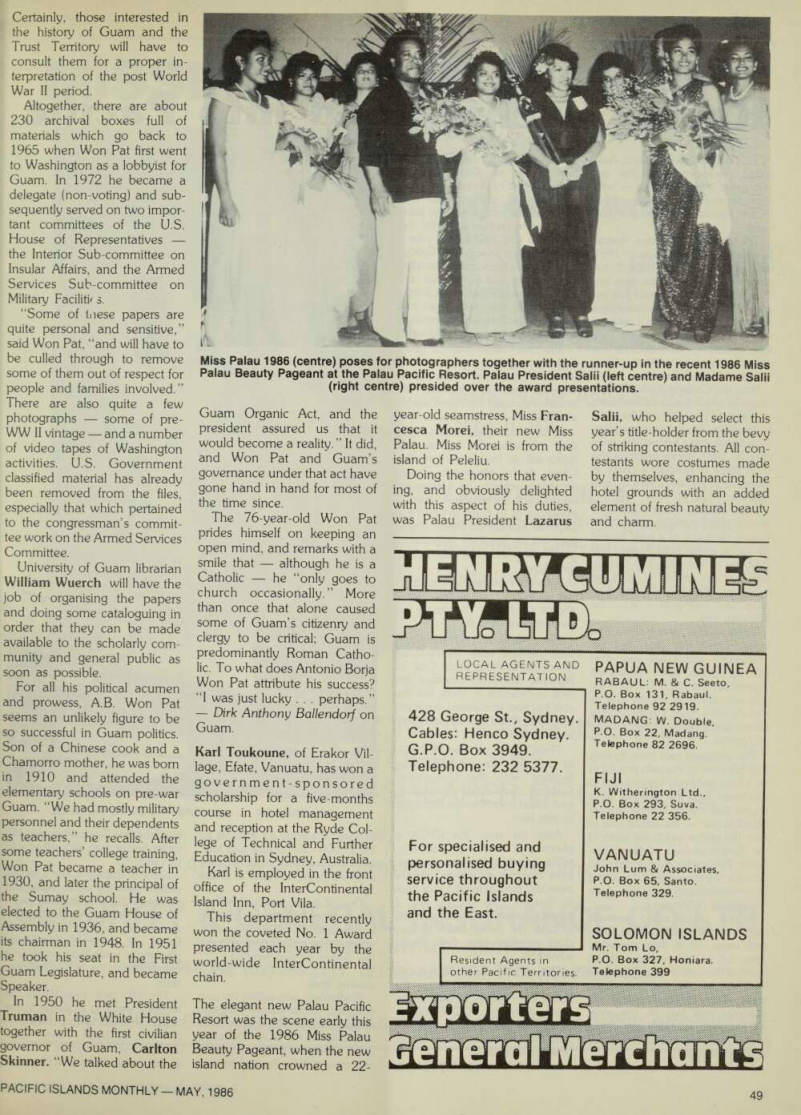
The elegant new Palau Pacific Resort was the scene early this year of the 1986 Miss Palau Beauty Pageant, when the new island nation crowned a 22-
year-old seamstress, Miss Francesca Morei, their new Miss Palau. Miss Morei is from the island of Peleliu.
Doing the honors that evening, and obviously delighted with this aspect of his duties, was Palau President Lazarus
Salii, who helped select this year’s title-holder from the bevy of striking contestants. All con testants wore costumes made by themselves, enhancing the hotel grounds with an added element of fresh natural beauty and charm.
Miss Palau 1986 (centre) poses for photographers together with the runner-up in the recent 1986 Miss Palau Beauty Pageant at the Palau Pacific Resort. Palau President Salii (left centre) and Madame Salii (right centre) presided over the award presentations.