Kiribati: The problems,
pp. 39-41 · Read in the full issue
and the promise
Kiribati, an island republic since 1979, has been pushed into the political limelight of late by its acceptance of Russian interests in its fishing zone. Previously, Kiribati was virtually unknown except for those fortunate enough to have read Grimble’s colorful depictions of life in the Gilbert Islands, as they were once known. Recently, journal ists have looked to these tiny atolls and depicted them as poor islands without a future.
However, what is needed is a thorough perusal of the islands, their history, the resourceful ness of the people and the present mode of living, before bold statements are made about Kiribati, or denunciations directed against the island re public.
On July 12, 1979, the former Gilbert Islands, under the politi cal jurisdiction of Great Britain, became the independent Kiri bati incorporating Ocean Is land, the Line and Phoenix Islands. Prior to white contact, various types of political control had developed in the original 16 Gilbert Islands. There were two kingdoms, those of Butar itari and Apemama, while to the south, the unimane, or old men, ruled the community through the maneaba system, the maneaba being the council meeting house where the va rious lineages met. Northwards the islanders engaged in inces sant warfare between lineages, sections of islands, and even between islands. It was not till Great Britain took over the Gilbert Islands as a protectorate in 1892 that this fierce warfare was quelled. By this time, French Catholic missionaries, as well as both American and English Congregationalists, had established missions on the va rious islands. While inter-island warfare diminished, occasional skirmishes erupted between ri val denominations.
At present, Kiribati is gov erned by a president, Jeremiah Tabai, and a bi-cameral house of assembly, called by the I Kiribati (the people of Kiribati) Maneaba ni Maungatabu, which
Often written off as a group of “poor islands without a future”, the Republic of Kiribati has more going for it than meets the casual eye. SANDRA RENNIE writes here of the problems and the promise before its 60,000 people.
is based on the Westminster model. The importance of Tabai’s presidency cannot be over-emphasised. Tabai is a Protestant and yet has con sistently gained the vote of both Protestants and Catholics. He is now in his third term of office.
His presidency signalled a unity which preceded independence.
The population is approx imately 60,000, which is a heavy concentration on these tiny coral atolls. The Phoenix and Line Islands were used by a former British Commissioner, H. E. Maude, to settle the excess population. In former times, the I Kiribati had prac tised abortion to curb popula tion growth. This problem of population growth remains one
of the most pressing problems of the new republic.
The other major problem is that of finance. Formerly, the finance to support the gov ernmental infrastructure of South Tarawa, the seat of gov ernment, came from Ocean Island, or Banaba, with its phosphate industry. Ocean Islanders often resented the contribution they made to the Gilbert Islands, and one of the reasons why the Gilbertese waited so long for their inde pendence was the fact that Ocean Islanders did not want to be incorporated into a new identity in unison with the Gil bert Islands. Eventually this problem was settled, but to no financial advantage to the new
republic of Kiribati; the phos phate had run out. The difficul ty has been to find a lucrative alternative to this former com modity.
It may be argued, however, that on these narrow and sparse coral atolls, where on the outer islands life is still on the subsist ence level, money is not really needed at all. Islanders live mainly on fish, babai, a root vegetable, pandanus fruit, coconuts and some breadfruit.
The diet is limited but ade quate. But increasingly, islan ders are turning to tinned meat and fish, tinned fruit and bis cuits. This, perhaps, is under standable in an environment subject to intermittent drought.
Especially is this true to the south. Only Butaritari, the most northerly island of the original Gilbert Islands, falls within the rain belt, and here undergrowth occurs and vegetation is lux-
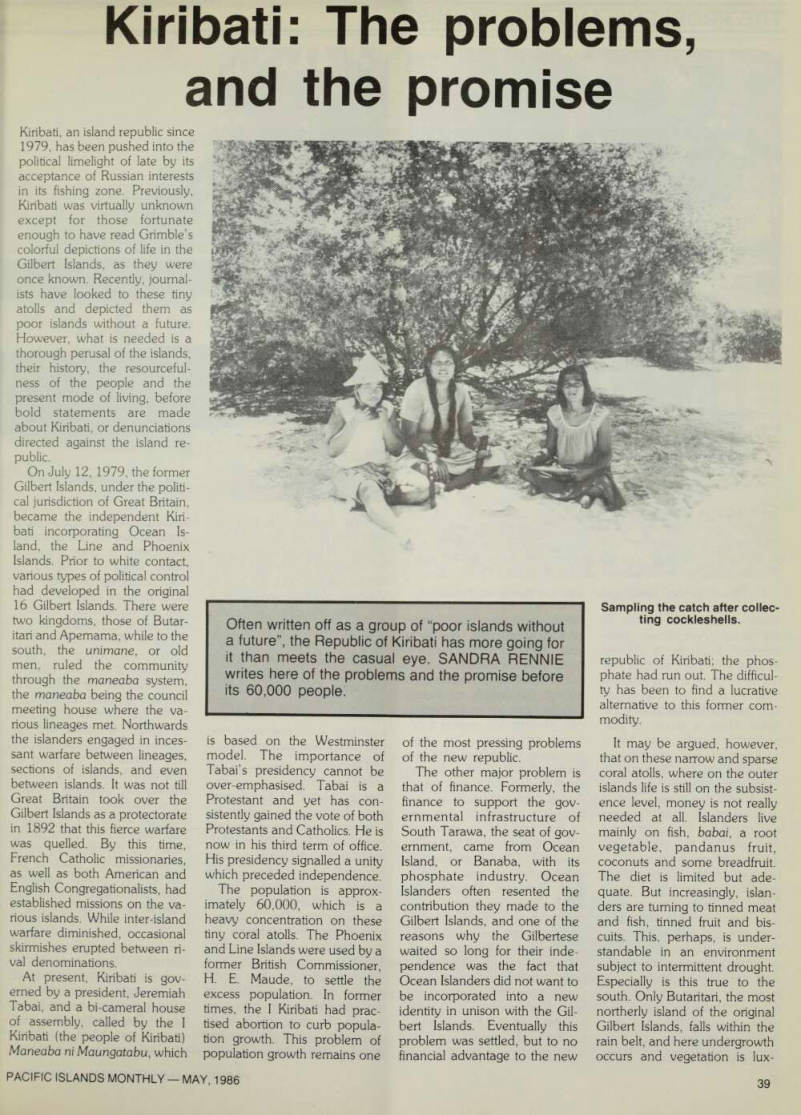
Sampling the catch after collec ting cockleshells.
uriant compared to the rest of the group. Agricultural development, therefore, is unlikely to have any quick success and will never provide an alternative food supply. The only vegetable the I Kiribati cultivate is the babai which is grown in pits, preferably marshy ones. Many an English V.S.O. has become frustrated in his attempt to foster agriculture to interest the I Kiribati in this pursuit. This is understandable given the poor soil, the threat of drought, and the fact that the people are orientated towards the sea. The harsh environment is simply not conducive to agricultural development. Early missionaries, both American and Hawaiian, tried without success to grow their own vegetables, even going to the trouble of bringing over soil. The islanders, therefore, must continue to eat their own food supply, which provides a healthy, balanced diet, or import Australian and New Zealand tinned food which be-
comes quite expensive due to transportation costs. The local retail trade is dominated by co-operative societies, The political infrastructure left by the British on South Tarawa, and continued by the new government, creates a de mand for finance. An ever increasing number of islanders flock to South Tarawa, forcing another decision to be made, that of decentralisation, or con tinuing to restrict development to the seat of government, Either decision will have its drawback. The delicate ecologi cal balance of coral atolls is easily disturbed, and it is diffi cult to know whether to ease the pressure off South Tarawa or to maintain the purity of the outer islands. On South Tara wa, jobs such as clerical posi tions, servicing and secretarial places have been created and the “cash-economy” is the accepted mode of transaction, On the outer islands, money is not needed to a large extent,
and the system of bubuti pre vails whereby an individual can request an item or service from his extended family and simply not be refused. Yet, the lure of Western goods is even reaching the outer islands. A wider de mand is made for such items as motor cycles, bicycles, radios, cassette players and even the occasional sewing machine and typewriter. Often due to island rivalry, islanders also desire planes, trucks, good roads and electricity. What one island has, the others also demand.
The present sources of in come are fishing, the copra industry, sales of handicrafts, and the income gained by Gilbertese sailors and workers on Nauru. In 1978 a 200nautical-mile fishing zone was declared around the Gilbert Islands. The fishing industry attracted Japanese and Amer ican interests. The Japanese consolidated their interests by providing aid and fishing boats.
The copra industry is subject to the fluctuation of the world market; sale of handicrafts is not bringing in large sums of income. Tourism, which is so often seen as the panacea for financial difficulties of Pacific
Island countries, hardly has a viable future in Kiribati. To begin with, a great input of capital would be needed to build hotels, eating places and other facilities essential to the type of tourism most Wester ners seem to demand in the Pacific Western luxury in a tropical environment. At pre sent, there is only one hotel at South Tarawa, the Otintai, one at Christmas Island, the Captain Cook, and another at Apema ma. Both the Otintai and the Captain Cook are operated by Atoll Hotels Ltd; the hotel at Apemama is owned by private non-islander interests. There are no alternative eating places, although drinks can be bought from stalls at the port of Betio.
Given that the necessary input of capital would need to be injected by foreign sources, what proportion of the di vidends would go to the I Kiribati?
Further difficulties need to be overcome. Water, a necessity, is often in short supply and not just in times of drought. Yet another problem needs to be faced. The Islanders are not ready to view bikini-clad Euro pean women on the beaches.
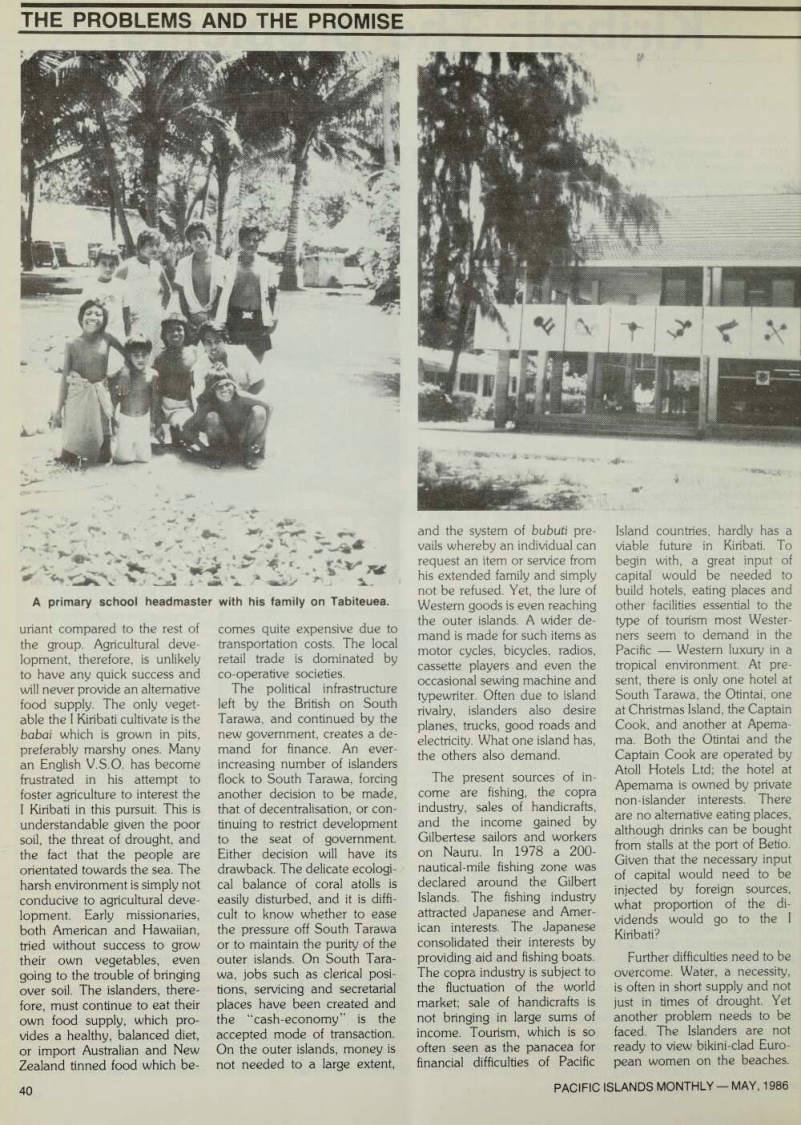
A primary school headmaster with his family on Tabiteuea.
Even shorts and strappy dresses for women are looked upon with distaste due to the mission ary teachings of former times on modesty. Gone are the days when men and women wore the scantiest of attire; the well dressed lady of South Tarawa must have full underwear, lace petticoat, top and skirt. In short, the people are simply not pre pared for the changed attitude of the European to dress. This is true of South Tarawa and even more so on the outer islands.
There, bathing must be done attired in one’s clothes. On the outer islands, the people are not psychologically prepared to greet invading tourists, who, even in moderate numbers, would soon threaten their peace, privacy and serenity. As the coral atolls are small, 1.3 km in width and 39 km in length on average, there is no place where tourists can be tucked away in a comer to themselves.
Is Kiribati then doomed to financial stagnation? Certainly, there is little hope of its ever being a booming economic en tity. However, this does not
mean it cannot survive in the modem world. A former gov ernor of the Gilbert Islands, John Smith, has given one solution. He argues that, although there may not be one sole alternative to phosphate, there may be a combination of separate alternatives. More islanders could spend part of their life on Nauru or serving on ships; milk fish could be sold to Nauru; doormats to Australia.
Pickling shellfish could find a market in Fiji; crab meat could be turned into bait or pet food.
The republic’s new government has taken steps to convert one of its islands, Christmas Island in the Line group, into a tourist stopover. The island is known as a bird sanctuary. One of the first acts of the government was to investigate the purchase of a jet plane which flies between Honolulu and Tahiti via Christ mas Island and Tarawa.
The I Kiribati have shown therefore that they are positive in trying to achieve a viable financial base. It is within this context that the I Kiribati accepted the Russian offer to gain a stake in the Kiribati fishing zone. Previous steps had been taken by the government to reduce economic depend ence. Efforts had been made to establish local breeding of pigs and poultry to curtail the $200,000 worth of imports of poultry, eggs and frozen meat.
Also, in collaboration with Aus tralia’s Melbourne-based Com monwealth Scientific and In
dustrial Research Organisation (CSIRO) local and imported trees are being produced for a trial run as, at present, $150,000 is spent annually on timber imports. Coconut re planting was a massive cam paign mounted by the Ministry of Natural Resource Deve lopment through its Agricultural Division. Nurseries of trees have been established on almost every island.
Past experience demons trates that it is the outlook of the people themselves which influ ences a country’s future. The example of Japan is well known; resources are not everything. The I Kiribati, how ever, do lack an avid individual, entrepreneurial spirit, as it is considered ill-mannered to push oneself forward and to strive to get ahead of others.
Yet the people counterbalance this with a concept of self sufficiency and a proud de termination and resourceful ness to override obstacles. In the past they have overcome drought by cooking delicious puddings and conserving the flesh of the coconut and the juice of the pandanus fruit which could be kept for months. They can cope again with new difficulties. They need not be solely dependent on foreign aid. But by clinging to what is beneficial in their own culture, they could restrict this dependence to times of great stress such as droughts. Britain undertook to provide deve
lopment aid of approximately $3l million over the four years from 1979 to 1982. This has since dwindled. Australia pro vides $l2 million worth of development assistance to Kiri bati over a five-year period, representing 62 per cent of the total bilateral aid allocation to Kiribati. The bulk of Australia’s aid has been directed to in frastructural projects. It is im portant that the people main tain their respect for their own cultural attainments and use western goods to augment these, such as using cloth for sails instead of the laboriously woven pandanus sails. Respect for katei ni Kiribati, the Gilber tese way, is being stressed now in school where islanders have most teaching positions. It is this ploy that Tabai has empha sised. His popularity is partly based on his insistence that I Kiribati retain the best aspects of their culture. He has also stressed continued subsistence a sensible approach.
It is the decision of I Kiribati, the people of this new republic, to choose between full capitula tion to the Western world or to balance the benefits of that with the achievements of their own society. The symbol of the new republic is that of the frigate bird, and like it, there is hope that the people will soar above their present problems as they have those of the past.
The post office using the canoe crests of the various lineages.
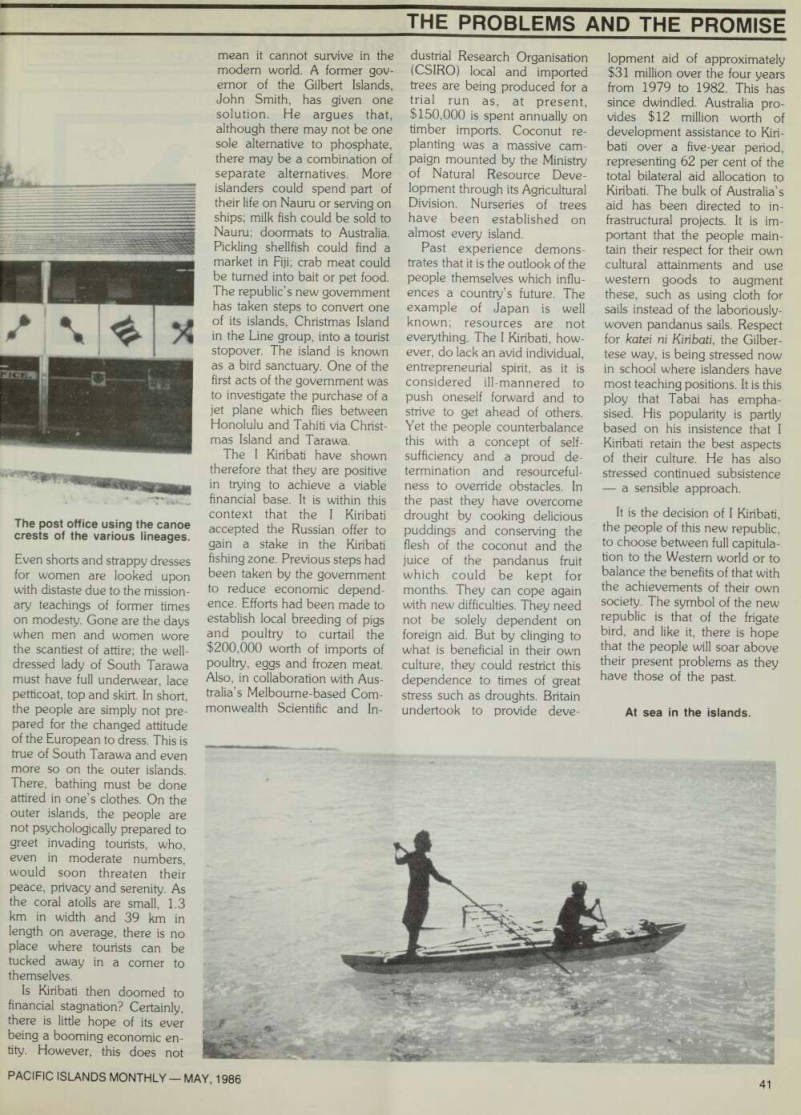
At sea in the islands.