Joint venturers prepare
p. 36 · Read in the full issue
to start screening
Fiji will have broadcast televi sion by the middle of next year.
Mr Kerry Packer’s Channel Nine network has been granted a 12-year licence to operate the service.
The Fiji government had agreed in principle last Septem ber to grant Australian com pany PBL (Publicity and Broadcasting Ltd) the licence.
However, the cabinet subse quently gave final approval.
PBL had conducted feasibil ity studies in several island countries including Fiji some 18 months ago.
Under the terms of the agree ment, PBL will initially hold 80 per cent of the Fiji company with the government taking up the remaining shares.
The Fiji government will in crease its holding to 40 per cent with some shares to be offered to the public at an unspecified later date.
The company will pay rent for all land it leases from the government.
A social impact study will be undertaken by the Australian firm Roy Morgan Research Pty Ltd which will use a local team to augment their own expertise.
The Fiji TV service plans to establish itself in stages, progre ssively covering all the country, regardless of the viability of the first stage of the project.
The TV joint venturers plan to reach about 70 per cent of the population in the first five years.
The directors of the local company will comprise five members of whom three will be Fijians. The government has nominated FINTEL (Fiji In ternational Telecommunica tions Company) and the Fiji Broadcasting Commission as its representatives in the joint ven ture.
According to the managing director of PBL Mr Lynton Taylor, the company will be guided by the results of the social impact study as far as program content is concerned.
Based on the study’s findings will be the hours of broadcas ting and the language distribu tion.
The program content will be controlled by regulations laid down by the Minister under the Television Broadcasting Act.
The Fiji Parliament is to de bate new legislation and all issues concerning the setting up of the service.
The new legislation would entail amendments to the Fiji Broadcasting Act, the Telecom munications Act and the Copyr ight Act (to allow the re broadcast of educational material).
The joint venture company will employ 47 staff of which between three and five will be expatriates.
Mr Taylor was expected in Fiji late last month to look for staff of which 15 seniors will receive training with Channel Nine in Sydney and Mel bourne.
The Fiji government has been accused of “going over board” with the Channel Nine proposal. It has also been criti cised for the secret nature of the talks with PBL.
The opposition National Federation Party and the Labor Party have both accused the Alliance government of con cluding a “secret pact” with the Channel Nine men without the benefit of public debate or discussion.
However, the government has rejected the secrecy claims.
An official statement said that a committee comprising senior government personnel had several metings with the PBL team since last October.
Immediately the proposal was approved in principle, the inter-departmental group was established to consider all aspects of PBL’s proposal and to advise the government.
On the basis of the commit tee’s recommendations, a sub mission went to cabinet, which had the final say.
The statement said that people knew through press re leases that the subject was being discussed. It added that releasing technical details of the discussions would have served no purpose.
The big question now being asked both privately and publicly is: what kind of prog rams will Channel Nine offer?
Mr Taylor has said that the programming will have a heavy bias towards news and current affairs and education.
But the level of local content remains to be seen. There have been publicly aired fears that Australian and American com mercial output will dominate the screens of Fiji.
The other question being asked is: why Channel Nine? Is it the best deaL for Fiji?
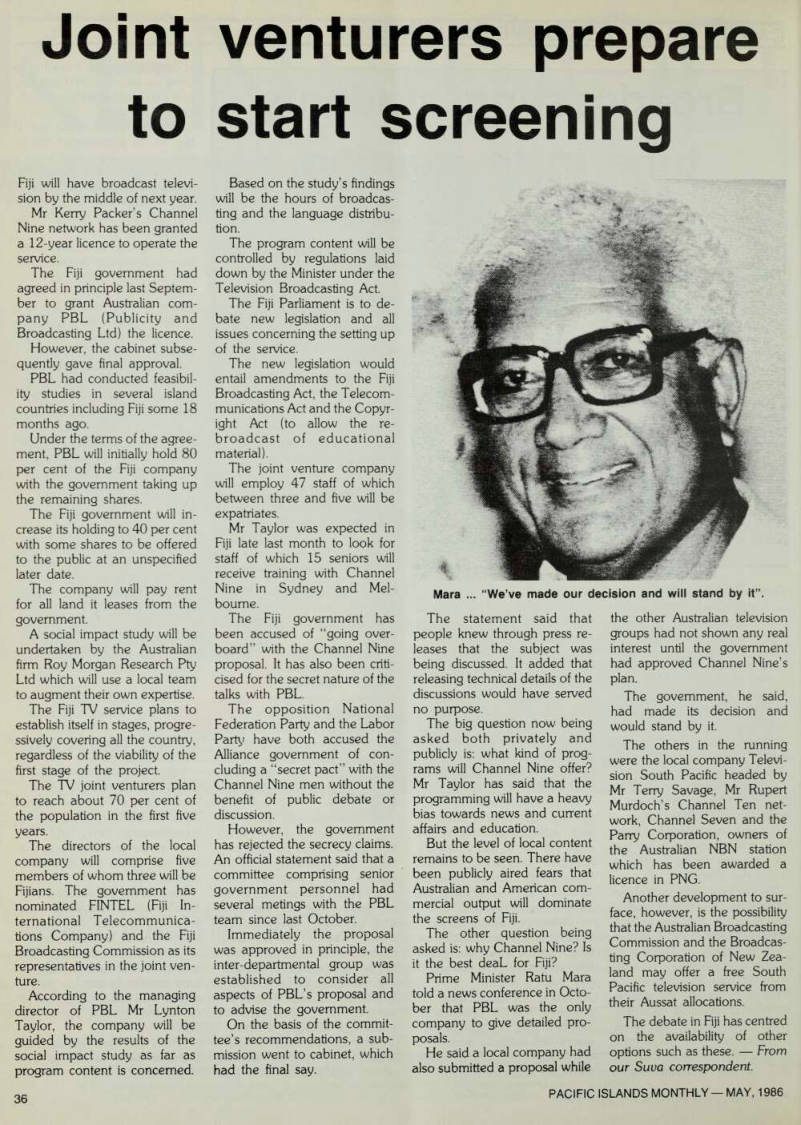
Prime Minister Ratu Mara told a news conference in Octo ber that PBL was the only company to give detailed pro posals.
He said a local company had also submitted a proposal while
the other Australian television groups had not shown any real interest until the government had approved Channel Nine’s plan.
The government, he said, had made its decision and would stand by it.
The others in the running were the local company Televi sion South Pacific headed by Mr Terry Savage, Mr Rupert Murdoch’s Channel Ten net work, Channel Seven and the Parry Corporation, owners of the Australian NBN station which has been awarded a licence in PNG.
Another development to sur face, however, is the possibility that the Australian Broadcasting Commission and the Broadcas ting Corporation of New Zea land may offer a free South Pacific television service from their Aussat allocations.
The debate in Fiji has centred on the availability of other options such as these. From our Suva correspondent.
Mara... “We’ve made our decision and will stand by it”.