Flosse landslide victory
pp. 25-26 · Read in the full issue
unites opposition leaders
The election score at closing time stood at 21 to 20 in Tahoeraa’s favor. But the following day, a recount in a Leeward Island constituency saw the Tahoeraa candidate returned with a four-vote margin.
Two independent assembly men, elected on their own separate platforms, promptly decided to jump on the winning bandwaggon, giving Flosse a final 24 to 17 majority.
But that is not the whole picture.
On a straight vote count, Tahoeraa actually polled less than the badly fragmented opposition parties 45,000 to 30,000.
The Flosse victory was a repeat performance of the pre vious territorial elections in 1982, when his party obtained as little as 30 per cent of the votes and only 13 out of the 30 scats then making up the Assembly, but nonetheless managed to put together a coalition government.
By 1985, however, most of his coalition partners had aban doned him and were moreover roundly denouncing his au thoritarian manner and accus ing him of corrupt practices.
The only solution for Flosse was to ask the French govern ment to dissolve the Territorial Assembly and call new elec tions two years early in the hope of being returned with a solid majority of his own.
The Paris government (which alone can dissolve the assembly and authorise new local elec tions) not only complied, but also increased the number of seats from 30 to 41.
By doing so it acceded to the repeated requests of all the local parties, motivated by the sharp population increase in the territory during the past 20 years, due both to the high post-war Polynesian birth rate and the massive French im "nigration since the nuclear tes ing bases were established in 1963.
After the most pessionete end vicious territories election cempeign in the history of French Polynesie, incumbent premier Geston Flosse end his ruling Tahoeraa perty won en outright mejority. But, sey MARIE-THERESE end BENGT DANIELSSON, there ere elements in the voting pettern thet indicete different priorities emong the electorete.
In accordance with the new, more liberal policies introduced during the 1982 elections, the Paris government also this time allowed all candidates 10 mi nutes time on radio and TV, which gave them an equal chance of reaching the voters in the outlying islands.
Flosse’s smart campaign managers and public relations men, mostly French expatri ates, immediately tried to make Tahoeraa’s economic policies and achievements the main issue. They could, for instance, rightly assert that inflation had diminished from 16 per cent when Flosse took over, to 8 per cent last year. Huge invest ments have also been made in the tourist industry, with huge hotels mushrooming all over the Society Islands (PIM April) creating hundreds of new em ployes.
Eighty Korean and Japanese fishing boats last year paid 100 million francs in licence fees with boat stores and provisions accounting for even bigger sums.
An enormous number of commercial and office buildings have also gone up in and around Papeete.
Social and welfare measures taken by Flosse’s government have been equally impressive though the household budgets of most Polynesian families are still far below the minimum level required for a decent existence.
It is nevertheless an undis puted fact that the minimum wage, which for most workers is also the maximum wage, has risen from 42,000 to 75,000
francs per month between 1982 and 1986, while the child allowance was increased during the same period from 2800 to 5500 francs.
Last but not least thousands of impoverished voters felt grateful to Flosse’s government for price controls on most essential food items, which, un fortunately from the nutritional point of view, are flour, rice, sugar, condensed milk and a few other tinned goods.
Although the thousands of leaflets, folders, posters and manifestos distributed by Tahoeraas did not exactly formulate the message in these words, there was no doubt that Flosse had managed to drag an impressive number of Polyne sians into a European-type eco nomy.
Flosse’s message to the 10,000 to 12,000 new French voters was different. He con centrated less on the material benefits of his years in power and took a strong line on protecting them against the per ceived threat of a pro-inde pendence avalanche.
The opposition leaders re torted that they could and would have done much better, if they had been in power, and then began hammering home what instead became the main campaign issue: Flosse’s incon siderate use of public funds.
To begin with they presented a table showing the lopsided manner in which the Tahoeraa dominated Assembly had allo cated money to the municipali ties controlled by their own party, as compared to those run by opposition mayors.
Worst treated was, not unex pectedly, Faaa, whose mayor is Flosse’s number one bogey man, Oscar Temaru, the most vociferous pro-independence and anti-bomb politician in the colony. Total allocation for his township in ’B3-’B5 was 3 mil lion francs, while Flosse’s Pirae got 477 million.
Flosse’s expenses for running the government, and the num ber of limousines and expatriate attaches employed by his 10 ministries, so came in for heavy criticism.
As well as the special funds of about 3000 million francs used in a sovereign manner by the premier and his ministers to subsidise friendly groups who formed “recreational” or “cultural” associations.
Is this not to buy voters, asked the angry opposition.
Flosse’s cutting answer was that while in power, the opposition parties used the same methods to win friends and influence voters.
Another contentious issue was Flosse’s distribution of gifts.
From before Christmas and right through the three-month campaign period, Flosse toured the islands, distributing building materials, outboard motors, food and even toys.
If the gifts were bought with taxpayers’ money, how was it that they were delivered by squads of men dressed in Tahoeraa T-shirts and election caps? asked the opposition.
And if they were bought with Tahoeraa funds, where did all this money come from? At any rate, insisted opposition leader and incumbent deputy Jean Juventin, since the dissolution of the old Territorial Assembly, Flosse headed only a caretaker government, which meant that all he was legally entitled to do was to sit in his Papeete office and handle minor, urgent affairs.
The la mana party asked for the setting up of a parliamenta rian committee to investigate.
As so often before, Gaston
Flosse’s own private business activities in the fields of insur ance, real estate, oil and tour ism also became the target of attacks especially after the French daily Liberation pub lished an expose, accusing him of shadowy deals under the headline: MR TEN PER CENT.
The Tahoeraa campaign staff quickly bought up all copies displayed on the newsstands, but the opposition got hold of a paper and kept photocopying and distributing the article until election day.
All these attacks definitely hurt Flosse, but they were not decisive in the final outcome, because of the trump card he held from the beginning.
This was the gift the French government, wittingly or unwit tingly, had handed him by cutting up one of the five constituencies to produce the seats the Tahoeraa needed.
This constituency is made up of the Mangareva and Tuamotu islands, where the two army bases at Hao and Moruroa,
with their thousands of French officers, technicians and offi cials, constitute a powerful pro- Flosse and pro -Tahoeraa corps.
What particularly enraged the opposition was that the number of Assembly seats allo cated to this small constituency was five, or one per 1100 voters, whereas in all other constituencies it took between two and three thousand votes to elect an assemblyman.
Flosse consequently concen trated his campaign efforts on capturing these scattered seats, making what were officially labelled “inspection tours”. He was greatly helped by the fact that he had already long before assumed the role of a fatherly benefactor, thanks to the effi cient manner in which he had succored the population after the terrible havoc wrought by the five successive cyclones which hit these islands during the first half of 1983. (PIM May, ’B3, p. 23.) A special relief agency, im mediately set up by Flosse’s
government, has ever since been distributing money, buil ding materials and sprouting coconuts to the distressed islan ders, who more often than not have the impression that they are personal gifts from Gaston Flosse.
His final tally in the Mangare va-Tuamotu constituency was four seats, the fifth being cap tured by the maverick Napo leon Spitz whose main slogan is: “Follow me to victory!”
The seven major opposition leaders, who finally joined forces after their defeat, had a long list of complaints, but very little hope of getting any redress from the new French govern ment headed by Gaston Flos se’s friend and party boss Jac ques Chirac.
The most radical course was proposed by Temaru, whose Liberation Front won two seats.
His advice: “We represent the vast majority of the Polyne sian people. Let us form a provisional government and ask the UN to help us to speed
up decolonisation and achieve independence.”
In the end, however, the more moderate opinion of the other opposition leaders pre vailed, and this was to wait for the Tahoeraa party to disinte grate, as it may soon do with the narrow power base remain ing to it.
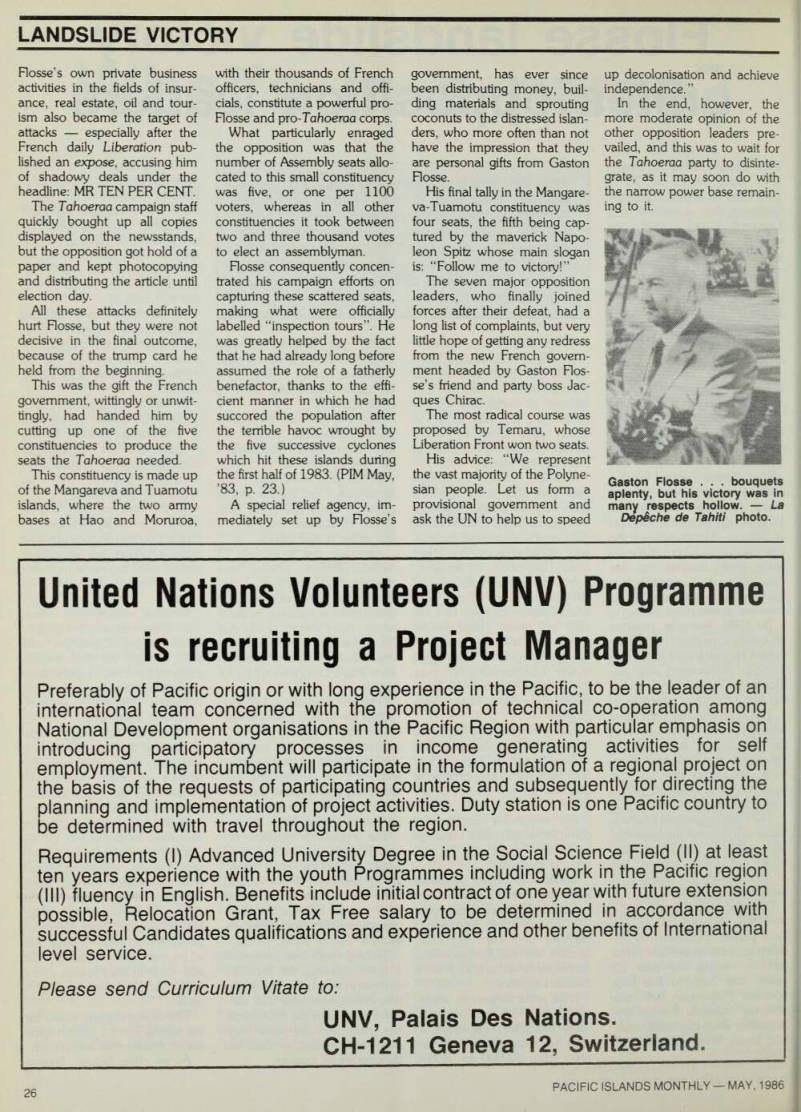
Gaston Flosse... bouquets aplenty, but his victory was in many respects hollow.- La Depeche de Tahiti photo.