Womens work may help
pp. 22-23 · Read in the full issue
to make jobe for the girls
Male violence in Pacific island nations is much discussed and written about. But young women are just as affected by the problems of their brothers.
Diane Goodwillie, co-ordinator of Fiji’s Ofis Bilong 01 Meri, suggests that there are ways of offering young women a better future.
WAVE on wave of unemployed restless young people are added each year to Pacific island statistics. For example, in Papua New Guinea, there is an estimated annual output of 40,000 school leavers but only 4000 new formal jobs created yearly.
Most newspaper reports have focussed on the visible increase of theft, rape and other forms of male violence. Yet on a quiet level but just as serious is the increase in female forms of dissent: prostitution, unwanted pregnancies and suicides.
Girls’ problems are often in visible or considered insignifi
cant. Yet the female contribu tion is strategic for the econo mic and social development of the nation. The education level attained by girls is less than for boys, especially in Melanesia.
PNG has only 31 per cent and the Solomons 33.2 per cent female enrolment in secondary schools and these figures do not begin to show the number of girls with little or no primary school education who never reach secondary schools.
Even in Kiribati, where girls are equal in secondary school enrolment, there is an unequal selection for tertiary education.
Not only are girls less edu-
cated but their chances of employment, especially in pro fessional or highly paid jobs, is miniscule. In the Solomons it is estimated that by 1986 the female population between the ages of 15-19 will swell to 14,510 but the female wage labor force participation rate will be 1310 (1983 Statistical Year Book).
There is a critical lack of secondary school placements for boys and girls. In Vanuatu, for example, the ratio of stu dents to the age-related popula tion drops from 87 per cent to 10 per cent after Class Six.
A 14 or 15-year-old girl finds herself pushed out of school, summoned back to her village to live in subsistence situations,
helping with family food gard ens, child rearing and waiting for marriage. Her academic training has introduced ideas of cash economy but not how to participate in it so she is ill prepared for adult life.
She lacks status, skills to improve herself and her fam ily’s situation and feels a total failure.
Scattered throughout the Pacific, isolated examples of concern for the plight of young women have resulted in the formation of girls’ school leav ers centres.
With the exception of gov ernment-run programs in Fiji and PNG these centres are sponsored by YWCAs and reli gious organisations (mostly Catholic communities) which operate residential programs with most staff paid next to nothing.
Boarding fees range from SUS7.OO to $20.00 a month; courses focus on the vague
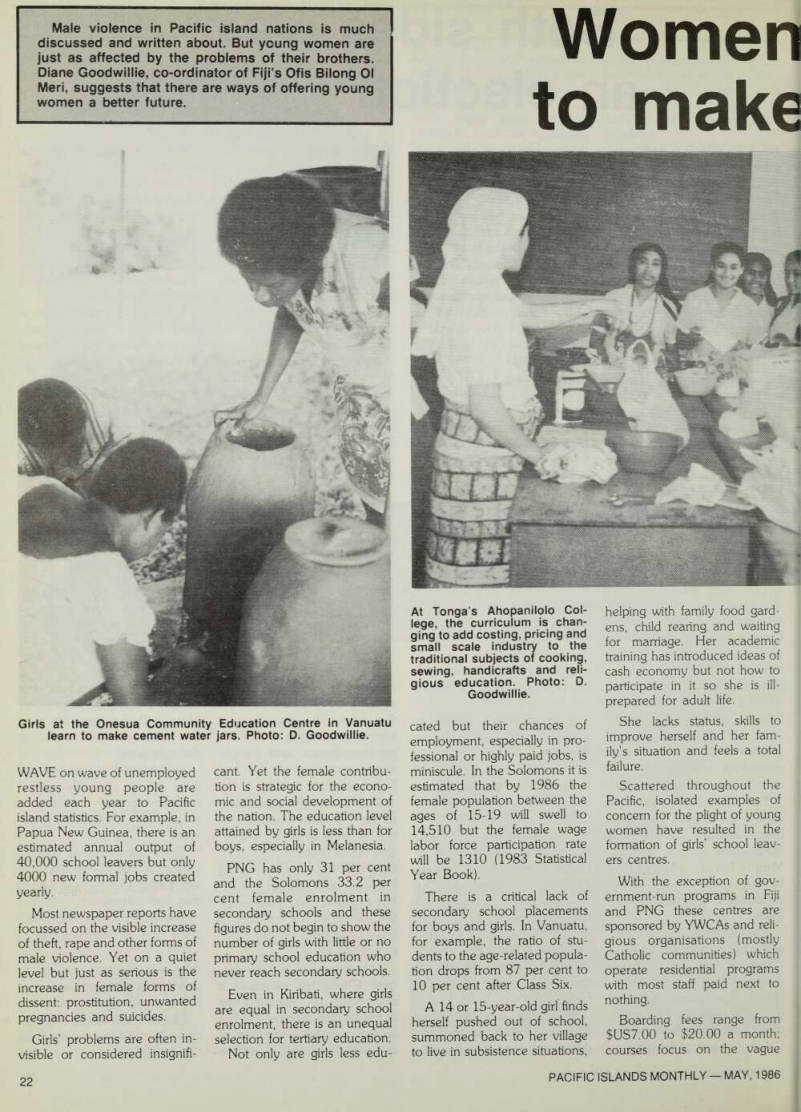
Girls at the Onesua Community Education Centre in Vanuatu learn to make cement water jars. Photo: D. Goodwillie.
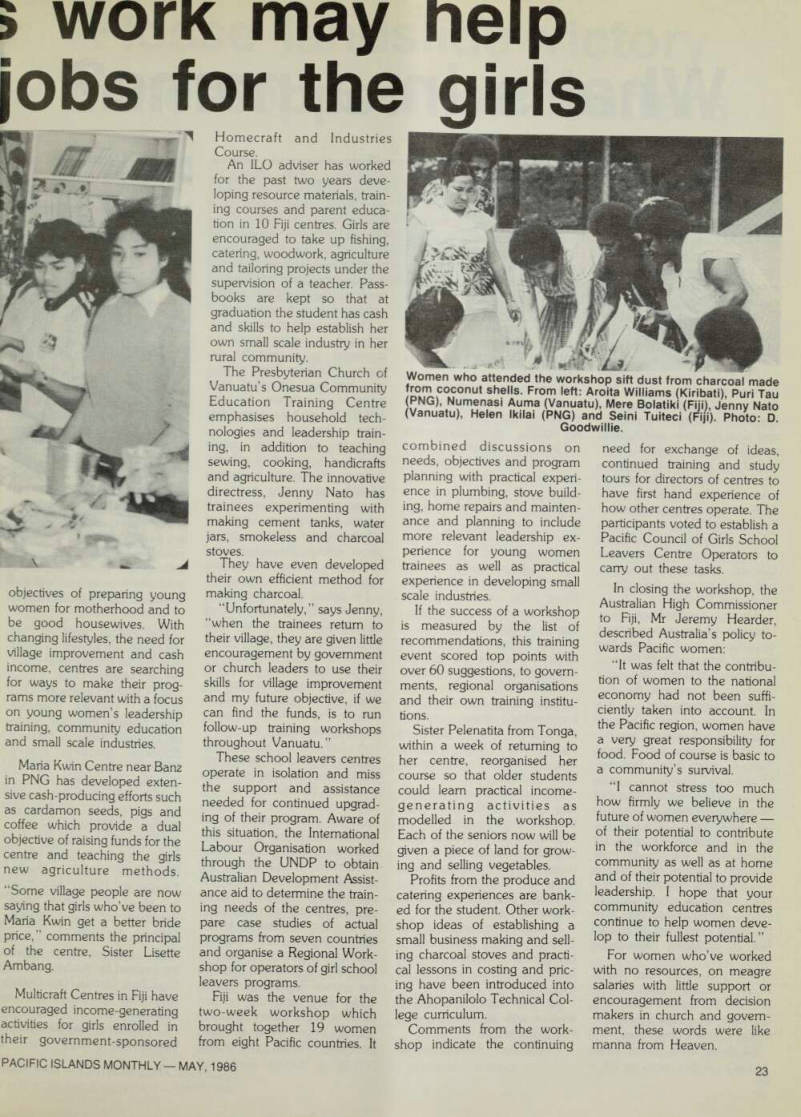
At Tonga’s Ahopanilolo Col lege, the curriculum is chan ging to add costing, pricing and small scale industry to the traditional subjects of cooking, sewing, handicrafts and reli gious education. Photo: D.
Goodwillie.
objectives of preparing young women for motherhood and to be good housewives. With changing lifestyles, the need for village improvement and cash income, centres are searching for ways to make their prog rams more relevant with a focus on young women’s leadership training, community education and small scale industries.
Maria Kwin Centre near Banz in PNG has developed exten sive cash-producing efforts such as cardamon seeds, pigs and coffee which provide a dual objective of raising funds for the centre and teaching the girls new agriculture methods.
“Some village people are now saying that girls who’ve been to Maria Kwin get a better bride price,” comments the principal of the centre, Sister Lisette Ambang.
Multicraft Centres in Fiji have encouraged income-generating activities for girls enrolled in their government-sponsored
Homecraft and Industries Course.
An ILO adviser has worked for the past two years deve loping resource materials, train ing courses and parent educa tion in 10 Fiji centres. Girls are encouraged to take up fishing, catering, woodwork, agriculture and tailoring projects under the supervision of a teacher. Pass books are kept so that at graduation the student has cash and skills to help establish her own small scale industry in her rural community.
The Presbyterian Church of Vanuatu’s Onesua Community Education Training Centre emphasises household tech nologies and leadership train ing, in addition to teaching sewing, cooking, handicrafts and agriculture. The innovative directress, Jenny Nato has trainees experimenting with making cement tanks, water jars, smokeless and charcoal stoves.
They have even developed their own efficient method for making charcoal.
“Unfortunately,” says Jenny, “when the trainees return to their village, they are given little encouragement by government or church leaders to use their skills for village improvement and my future objective, if we can find the funds, is to run follow-up training workshops throughout Vanuatu.”
These school leavers centres operate in isolation and miss the support and assistance needed for continued upgrad ing of their program. Aware of this situation, the International Labour Organisation worked through the UNDP to obtain Australian Development Assist ance aid to determine the train ing needs of the centres, pre pare case studies of actual programs from seven countries and organise a Regional Work shop for operators of girl school leavers programs.
Fiji was the venue for the two-week workshop which brought together 19 women from eight Pacific countries. It
combined discussions on needs, objectives and program planning with practical experi ence in plumbing, stove build ing, home repairs and mainten ance and planning to include more relevant leadership ex perience for young women trainees as well as practical experience in developing small scale industries.
If the success of a workshop is measured by the list of recommendations, this training event scored top points with over 60 suggestions, to govern ments, regional organisations and their own training institu tions.
Sister Pelenatita from Tonga, within a week of returning to her centre, reorganised her course so that older students could leam practical income generating activities as modelled in the workshop.
Each of the seniors now will be given a piece of land for grow ing and selling vegetables.
Profits from the produce and catering experiences are bank ed for the student. Other work shop ideas of establishing a small business making and sell ing charcoal stoves and practi cal lessons in costing and pric ing have been introduced into the Ahopanilolo Technical Col lege curriculum.
Comments from the work shop indicate the continuing
need for exchange of ideas, continued training and study tours for directors of centres to have first hand experience of how other centres operate. The participants voted to establish a Pacific Council of Girls School Leavers Centre Operators to carry out these tasks.
In closing the workshop, the Australian High Commissioner to Fiji, Mr Jeremy Hearder, described Australia’s policy to wards Pacific women: “It was felt that the contribu tion of women to the national economy had not been suffi ciently taken into account. In the Pacific region, women have a very great responsibility for food. Food of course is basic to a community’s survival.
“I cannot stress too much how firmly we believe in the future of women everywhere of their potential to contribute in the workforce and in the community as well as at home and of their potential to provide leadership. I hope that your community education centres continue to help women deve lop to their fullest potential.”
For women who’ve worked with no resources, on meagre salaries with little support or encouragement from decision makers in church and govern ment, these words were like manna from Heaven.
Women who attended the workshop sift dust from charcoal made from coco untshells. From left: Aroita Williams (Kiribati), Puri Tau PNG), Numenasi Auma (Vanuatu), Mere Bolatiki (Fiji), Jenny Nato (Vanuatu), Helen Ikilai (PNG) and Seini Tuiteci (Fiji). Photo: D.
Goodwillie.