the surface
pp. 19-20 · Read in the full issue
Corruption comes to the surface
THE year 1985 saw two men tirelessly campaign against corruption in Papua New Guinea’s corridors of power.
They were Catholic priest and politician Father John Momis and an aspiring young political leader called Paias Wingti.
Fr Momis repeatedly called for inquiries into mismanagement, misuse of public funds, accepting bribes and favoritism, saying the root cause of PNG’s violent crime was “white-collar crime by safari jacket criminals and the briefcase brigade”.
Mr Wingti fought the issue head-on, demanding inquiries into specific cases what he called the conspiracy over the issue of TV broadcasting and into ministers’ dealings with the controversial airline Pelair.
In March 1985 the two men switched allegiances through the wheeling and dealing of political parties during
a vote of no-confidence which failed in the then government of Michael Somare. Mr Wingti became Leader of the Opposition after earlier resigning as deputy prime minister. Fr Momis swapped from being Opposition leader to being Mr Somare’s deputy.
Fr Momis then had very little to say about corruption and Mr Wingti accused him of missing a “golden chance” to back up his corruption claims with facts.
“My reading of the Bible tells me that Jesus Christ said sinners can be saved but that hypocrites will never go to Heaven,” Mr Wingti said. “I’ve done my part to assist Fr Momis, but he has missed his chance. His credibility is now questionable.”
PNG’s prime minister Paias Wingti has pledged to stamp out corruption in high places before next year’s general elec tion. TIM SINCLAIR in Port Moresby reports that he is pulling no punches in his drive to clean up the corridors of power.
When Mr Wingti made it to power as Prime Minister last November, it was a different story. He has fearlessly tackled the sickness in all quarters and recently pledged that all corruption would be weeded out before the 1987 general elections.
The voluble Mr Paul Torato had been Lands Minister for only just over a month when he announced he was pushing for an inquiry into all land deals made since 1975.
People think there is widespread corruption in land deals and we have to clear that up,” he announced. “I don’t want corruption in land deals.”
A month later he revealed that development worth K2OO million was being hindered by Lands Board inefficiencies. “In the last six months, nothing has been done. No land titles, no work,
everything is in a mess. ”
And he dismissed the board chairman, Mr Konze Kara, because, he said, his appointment by the Somare government had not been made according to correct legal procedures. All deals made under his chairmanship would have to be reconsidered, he said.
Alarmed board officials quickly pointed out that such a move could lead to the government being sued for millions of kina by people who thought they had been given land approvals.
Then a month later, in March, Mr Torato himself was accused of being involved in dubious dealings. Former Lands Minister Mr John Nilkare claimed in Parliament that Mr Torato had demanded either the lands or minerals ministries in the first place because of
his interests in a farming and trading company and a minerals exploration company.
Mr Nilkare also accused Mr Torato of appointing as Lands Board chairman a business associate saying both had interests in some Port Moresby land. In connection with this were plans for a huge hotel on the capital’s beach front. Mr Torato had also ordered the Agricultural Bank to allocate large parcels of land to his family, MPs were told.
Mr Torato’s activities were being investigated by the Ombuds man, Mr Nilkare revealed.
And on top of all that, landowners in Mr Torato’s home province of Enga where the giant Placer company is planning to mine gold claimed he was blocking their development plans because of his own interests. The Lands Minister denied this.
No sooner had Mr Wingti come to power last November than an inquiry was announced into the Harbours Board. And it appears to have lifted the lid off a can of worms.
Initially, the probe was announced because Transport Minister Mr Neville Bourne was concerned that the board had spent nearly K 4 million in five years on property acquisitions.
A succession of sackings quickly followed first the board chairman, Mr Leo Debessa, for being “obstructive” in not providing Mr Bourne with information on the board’s activities, followed by the board’s general manager and his deputy for “irregularities and malpractices”. The fraud squad was called in to investigate.
Mr Debessa, it turned out, had been paid a K 9,600 three-year allowance in advance, two years of which the Harbours Board wanted back. The payment had been approved by the former Transport Minister, Mr Mathew Bendumb.
Mr Debessa did not take any of this lying down. First he went to court, but failed to win an injunction to prevent his immediate dismissal. Then, Mr Wingti told an amazed Parliament, he had tried
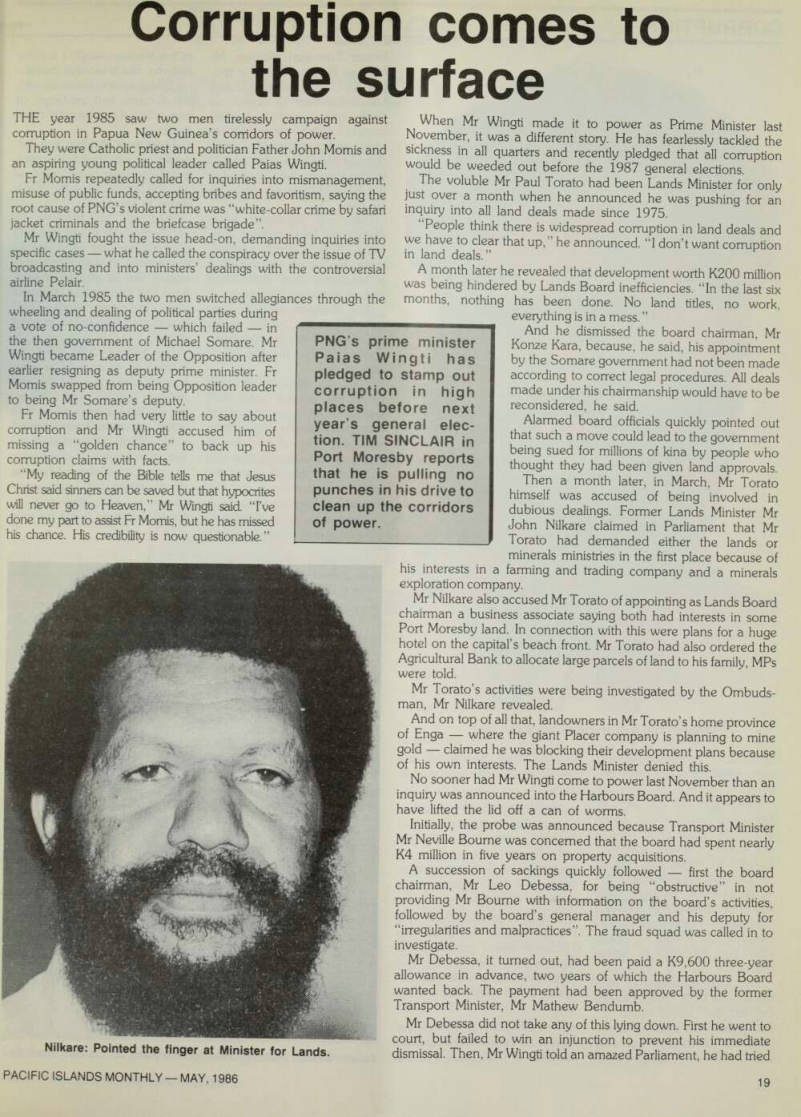
Nilkare: Pointed the finger at Minister for Lands.
to blackmail the Prime Minister into calling off police investiga tions.
MPs were told that Mr De bessa had forged a letter about bribes for house deals from a real estate company, which he thought Mr Wingti part owned.
Mr Debessa superimposed the letterhead of Niugini Real Estate on a letter that said the company and thus by im plication Mr Wingti would offer him K 70,000 in house bribes.
He then threatened, MPs heard, that if Mr Wingti did not call off the fraud squad in vestigations, the letter would be published. However, not only was the letter a forgery, but Mr
Wingti had resigned his directorship of the company in 1983.
Mr Wingti told MPs; “He was trying to blackmail me.”
Nothing was going to make him call off any investigation. All corruption would be cleaned up before the 1987 general elec tions, he pledged.
Police Commissioner Mr David Tasion described the Harbours Board matters under investigation as among the most serious he had encoun tered in his 19 years in the force.
The plot thickened when the Justice Minister Warren Dutton revealed in Parliament that the
former Transport Minister, Mr Mathew Bendumb, had a spenal KlO,OOO Harbours Board allowance that he spent on drink, giving cocktail parties, carpets for his home and trips at home and overseas. Mr Dutton claimed Mr Bendumb had lied to the House when he denied the KlO,OOO was set aside for his use.
Later Mr Bendumb again denied he had misused Harhours Boards funds and accused Mr Dutton of conducting a “kangaroo court” against him and of smearing his name.
The elections in 1987 may give Wingti the verdict on his promise to have all corruption cleared up. But there is a long way to go.
PNG traditionally is built round its wantok (one talk) system where you are obliged to help out people of your own family or tribe. If you are in power, it is expected that you share the perks with your wantoks. If you are down and out, they will look after you.
It certainly has its benefits being somewhat the equivalent
of the Western world’s welfare systems. But when this traditio nal village system meets up with the luxuries and privileges of high office, it can become open to abuse, There is a dividing line de tween helping your fellow men and lining your own pocket and the latter is what Mr Wingti wants to stamp out.
Putting the picture in perspective, Mr Wingti has said that malpractices were not as widespread as was being por frayed. But he warned precau tions had to be taken “to avoid PNG following other Third World countries into a corrupt state”.
He added: “We can’t do everything at once. The Har hours Board is the first one and as soon as it is out of the way, we will have a serious look into lands and many other bodies.”
Mr Wingti declined to name the other bodies. “I don’t want to mention them, otherwise people might start doing certain things hide files and do funny things so it will be diffi cult. ”
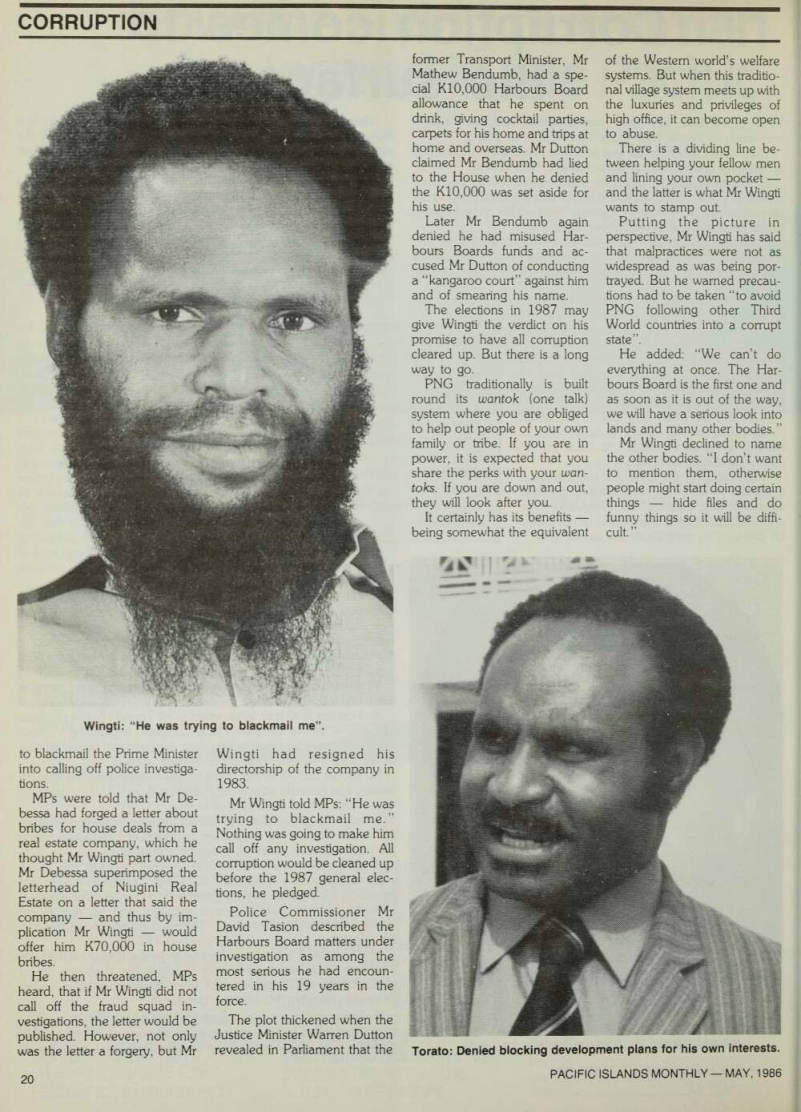
Wingti: “He was trying to blackmail me”.
Torato: Denied blocking development plans for his own interests.