Respecting the ‘Pacific Way’
pp. 15-17 · Read in the full issue
JACK SIONEHOLO, a Niuean graduate of Welling ton’s Victoria University who is now engaged in research on Pacific foreign policy issues, presents an Islander’s viewpoint on current international controversies in the region.
In the wake of political inde pendence, most Pacific Island nations have been engaged in a search for identity, for selfhood, among the ruins left behind by colonialism.
But these efforts are being frustrated by the insensitive, disrespectful, and arrogant be havior of two traditional Pacific powers who happen to be the region’s two major remaining colonial powers: the United States and France.
Their behavior is seen by Islanders to be a direct attack on their fundamental values.
The island environments threatened are the basic corner stones of “the Pacific Way”: universal kinship ties, the land, and the sea.
The island peoples have a great respect for the value of kinship ties, which are operative universally in their societies and generally function as extensions of immediate relations and as flexible rules for social, econo mic and political behavior.
Recent events are increasing ly encouraging islanders to be lieve that the real enemy is closer to home than they were originally led to believe, and a general feeling of resentment is arising. In some parts “anti” feelings have taken root, feel ings quite alien to the Pacific Way, particularly in relation to French nuclear testing at Moruroa. The fact is that unless the French can be persuaded in one way or another to take heed of this resentment, it is possible that these “anti” feel ings will be transformed into something more than just feel ings.
Foreign nations must be aware that Pacific politics is not Western politics, but a com bination, with values of the Pacific Way. Elections are not always decided on issues, but rather on personal and usually private appeals to several score voters in the constituencies.
This is possible because the constituencies are so minute. Of vital importance in these circumstances are family links, village or tribal connections.
popularity based on past achievements, and strong church orientation. Personality politics features strongly, which possibly accounts for the re latively large number of coali tion governments in the region.
Therefore, it is more than likely
that international issues are de cided not on the basis of na tional interest, or still less popu lar interest, but by interests from outside, particularly in favor of a country giving or thought likely to give the greatest amount of aid.
Land is an important compo nent of individual and group identities, and often a determi nant of status.
The great writer Professor Albert Wendt summed it up very well when he wrote; “The land is our greatest blessing from God, our most precious inheritance from our fore fathers. Without it we would have no roots, we would be a canoe without a secure anchor, birds with no permanent and safe resting ground. The land
defines us, gives meaning to our livelihood and history.”
The French Government must realise that the importance of land to any Pacific person applies in full to the Kanaks of New Caledonia. Unless the land issue is solved, the future of New Caledonia will be one of violence and bloodshed.
Likewise, the sea is a re source base of food, particularly for communities on low-lying islands where fish is the staple diet and the sole source of income.
Solomon Islands Prime Minister Sir Peter Kenilorea voiced the concern of Pacific peoples when he said: “. . . the sea is a major resource for us and all other Pacific Islanders, and we cannot allow it to be polluted” (PIM Mar. ’B5).
French nuclear testing, and US bullying on the tuna fishing issue, have inflicted damage mainly upon them selves.
But the resultant strains have caused divisions between the Island nations with some coun tries choosing to uphold their own particular interests, rather than the broad regional interest.
Forced to take sides, they have often sided with their main aid donor, or have focused atten tion primarily on a specific issue the one which is of direct importance to their own coun tries.
Islanders, particularly the younger generations who don’t have a deep attachment to the legacies of World War 11, feel that the security obligations of the Pacific should be the re sponsibility of Australia and
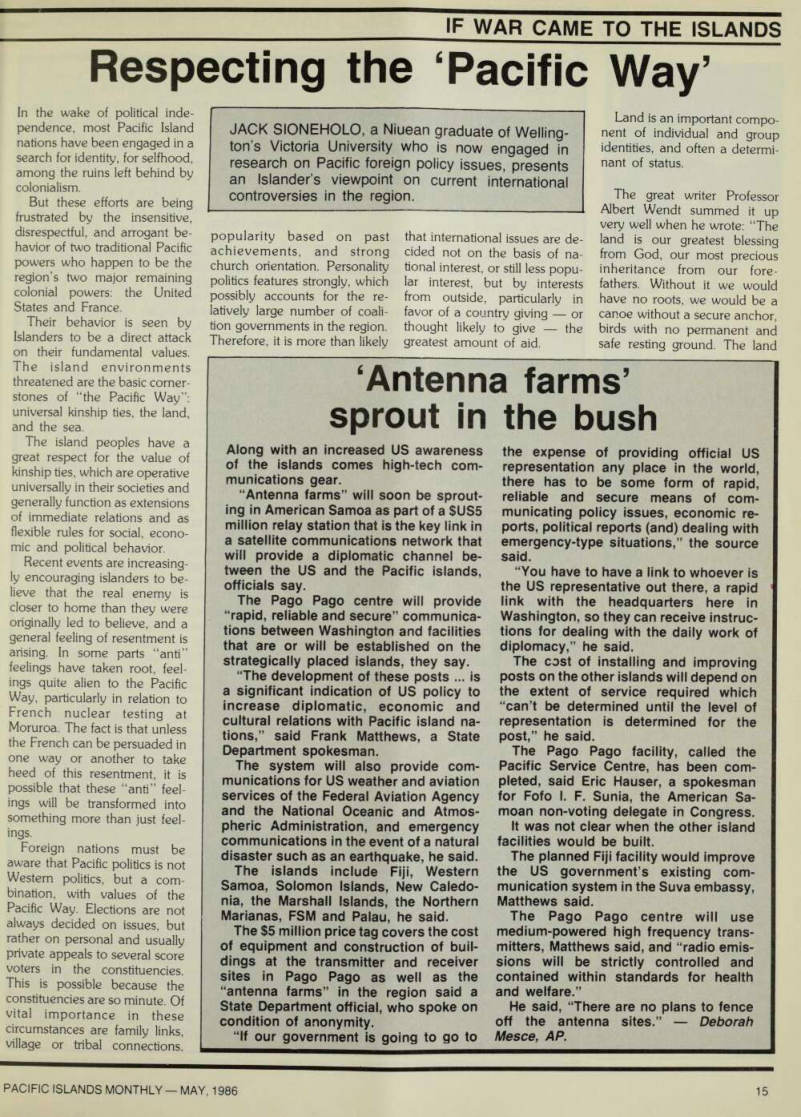
Jack Sioneholo... islander’s viewpoint.
New Zealand, with the support of Fiji and Papua New Guinea.
They view ANZUS as out of date, and really only serving U.S. interests. Their view is reinforced by the fact that the U.S. now is seen as supporting French arguments in favor of nuclear testing.
But in recent times islanders have become suspicious that Australia appears to be playing to the tune called by Washing ton, a suspicion supported by U.S. pressure on Australia to isolate New Zealand on secur ity-intelligence matters, follow ing the New Zealand stand on U.S. port visits.
The island nations are young and have national economic growth and self-sufficiency as their primary aims. They have faith that these should be the main goals of their efforts.
But recent French and U.S. behavior indicates that their own national and security in terests must be the island gov ernments’ prime concern.
These two big countries must reform their colonial habits, and take seriously the warning sig nals that are there. They can do this by conducting their policy towards the region in relation to its people, context, nature and environment as a whole, with
particular emphasis on econo mic needs and traditional values.
In the meantime it is hard for island leaders to choose be tween national and regional interests when the two offen ders are not only threatening their livelihoods, but are also encouraging divisions between the Micronesian-Melanesian countries (who are more vocal in their stances on specific issues), and Polynesian nations (who always have the tendency to side with New Zealand and Australia).
The U.S. and especially France must co-operate with local opinion, because the islan ders are very much aware of
their current motives both with in and outside the region, and both should pay utmost respect to the Pacific Way.
It is precisely their present line of policy which has caused disillusioned island countries to look elsewhere for the help they desperately need. Most recently it is countries of the Far East who have publicly announced their willingness to support Pacific nations’ development efforts. Communist countries are not too far behind, as was indicated by the fishing deal between Kiribati and the Soviet Union. Arab countries such as Libya also aspire to play a role.
Islanders’ patience can only last for so long.
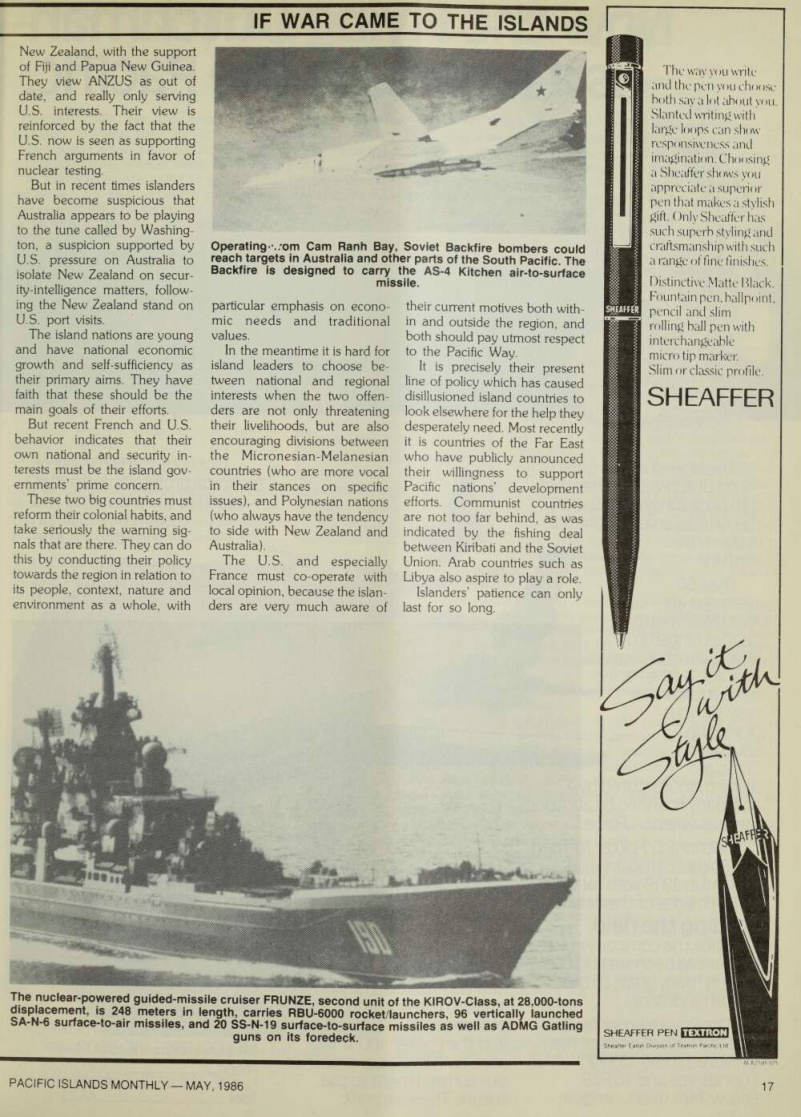
The nuclear-powered guided-missile cruiser FRUNZE, second unit of the KIROV-Class, at 28,000-tons displacement, is 248 meters in length, carries RBU-6000 rocket/launchers, 96 vertically launched SA-N-6 surface-to-air missiles, and 20 SS-N-19 surface-to-surface missiles as well as ADMG Gatling guns on its foredeck.
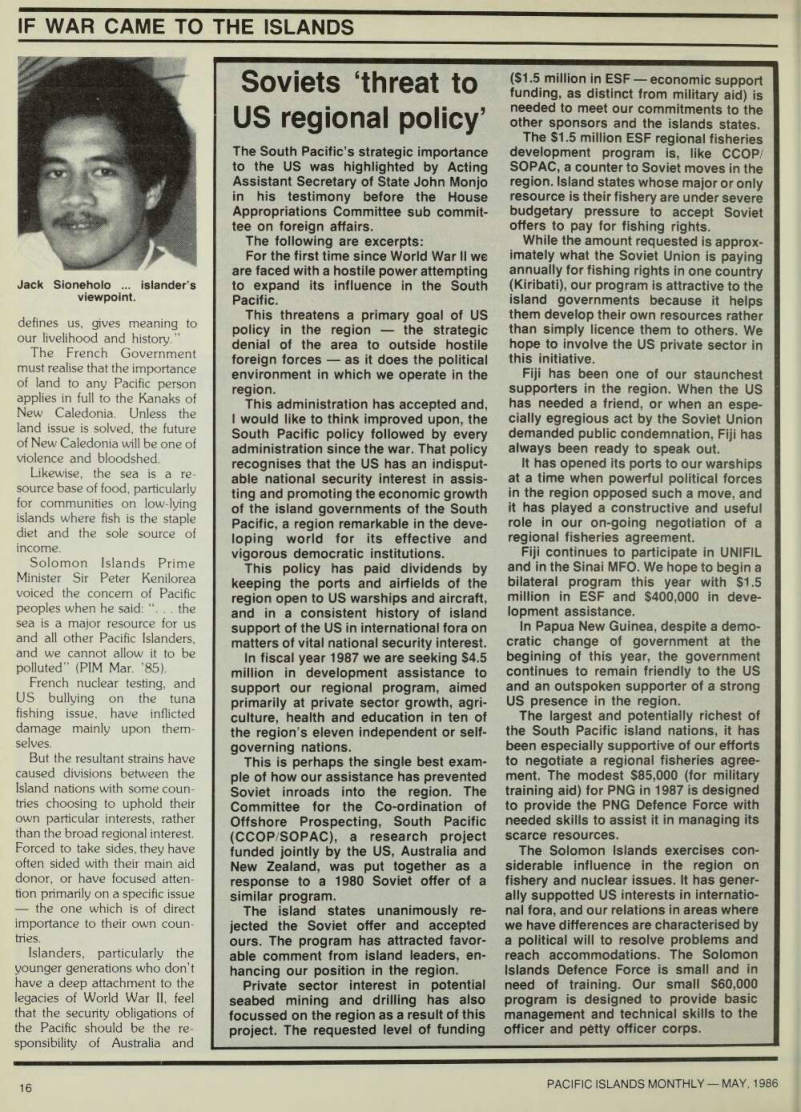
Operating [?]om Cam Ranh Bay, Soviet Backfire bombers could reach targets in Australia and other parts of the South Pacific. The Backfire is designed to carry the AS-4 Kitchen air-to-surface missile.