Tahiti: The other side
of the postcard
Tahiti: a picture postcard vision with lagoon, dramatically plun ging mountainsides, flowers, coconut palms, and smiling women. All the signs of prosperity are there; a gross domestic product which puts French Polynesia just behind Australia and New Zealand in terms of living standards, large and expensive motor cars on the roads, VCRs in many households.
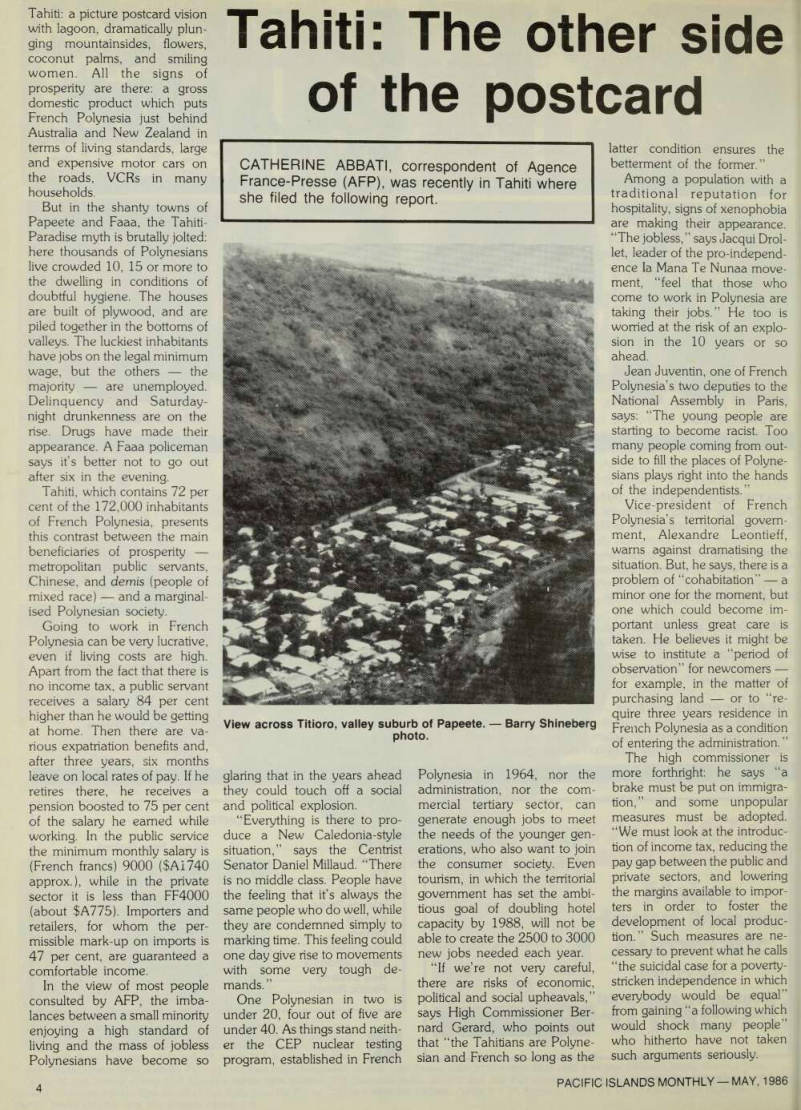
But in the shanty towns of Papeete and Faaa, the Tahiti- Paradise myth is brutally jolted: here thousands of Polynesians live crowded 10, 15 or more to the dwelling in conditions of doubtful hygiene. The houses are built of plywood, and are piled together in the bottoms of valleys. The luckiest inhabitants have jobs on the legal minimum wage, but the others the majority are unemployed.
Delinquency and Saturday night drunkenness are on the rise. Drugs have made their appearance. A Faaa policeman says it’s better not to go out after six in the evening.
Tahiti, which contains 72 per cent of the 172,000 inhabitants of French Polynesia, presents this contrast between the main beneficiaries of prosperity metropolitan public servants, Chinese, and demis (people of mixed race) and a marginal ised Polynesian society.
Going to work in French Polynesia can be very lucrative, even if living costs are high.
Apart from the fact that there is no income tax, a public servant receives a salary 84 per cent higher than he would be getting at home. Then there are va rious expatriation benefits and, after three years, six months leave on local rates of pay. If he retires there, he receives a pension boosted to 75 per cent of the salary he earned while working. In the public service the minimum monthly salary is (French francs) 9000 ($A1740 approx.), while in the private sector it is less than FF4OOO (about $A775). Importers and retailers, for whom the per missible mark-up on imports is 47 per cent, are guaranteed a comfortable income.
In the view of most people consulted by AFP, the imba lances between a small minority enjoying a high standard of living and the mass of jobless Polynesians have become so
CATHERINE ABBATI, correspondent of Agence France-Presse (AFP), was recently in Tahiti where she filed the following report.
glaring that in the years ahead they could touch off a social and political explosion.
“Everything is there to pro duce a New Caledonia-style situation,” says the Centrist Senator Daniel Millaud. “There is no middle class. People have the feeling that it’s always the same people who do well, while they are condemned simply to marking time. This feeling could one day give rise to movements with some very tough de mands. ”
One Polynesian in two is under 20, four out of five are under 40. As things stand neith er the CEP nuclear testing program, established in French
Polynesia in 1964, nor the administration, nor the com mercial tertiary sector, can generate enough jobs to meet the needs of the younger gen erations, who also want to join the consumer society. Even tourism, in which the territorial government has set the ambi tious goal of doubling hotel capacity by 1988, will not be able to create the 2500 to 3000 new jobs needed each year.
“If we’re not very careful, there are risks of economic, political and social upheavals,” says High Commissioner Ber nard Gerard, who points out that “the Tahitians are Polyne sian and French so long as the
latter condition ensures the betterment of the former.”
Among a population with a traditional reputation for hospitality, signs of xenophobia are making their appearance.
“The jobless, ” says Jacqui Drol let, leader of the pro-independ ence la Mana Te Nunaa move ment, “feel that those who come to work in Polynesia are taking their jobs.” He too is worried at the risk of an explo sion in the 10 years or so ahead.
Jean Juventin, one of French Polynesia’s two deputies to the National Assembly in Paris, says; “The young people are starting to become racist. Too many people coming from out side to fill the places of Polyne sians plays right into the hands of the independentists. ”
Vice-president of French Polynesia’s territorial govern ment, Alexandre Leontieff, warns against dramatising the situation. But, he says, there is a problem of “cohabitation” a minor one for the moment, but one which could become im portant unless great care is taken. He believes it might be wise to institute a “period of observation” for newcomers for example, in the matter of purchasing land or to “re quire three years residence in French Polynesia as a condition of entering the administration.”
The high commissioner is more forthright: he says “a brake must be put on immigra tion,” and some unpopular measures must be adopted.
“We must look at the introduc tion of income tax, reducing the pay gap between the public and private sectors, and lowering the margins available to impor ters in order to foster the development of local produc tion.” Such measures are ne cessary to prevent what he calls “the suicidal case for a poverty stricken independence in which everybody would be equal” from gaining “a following which would shock many people” who hitherto have not taken such arguments seriously.
View across Titioro, valley suburb of Papeete.-Barry Shineberg photo.