‘Wanderers’ bring trouble to town
pp. 44-45 · Read in the full issue
Spongeing relatives usually from their home villages are making life almost impossible for some Honiara families as the country sees the effects of urban drift. Aaron Hayes, a freelance writer who has spent some time in the Solomons, filed this report.
To the average visitor, Honiara, capital and focal point of Solo mon Islands appears to possess every characteristic of an easy going South Pacific town wen ding its slow course through the inevitable channels of mod ernisation.
On the surface.
As each day passes, a ruinous threat menaces the friendly faces of Honiara resi dents. Lurking behind an apparently successful social sys tem, and preying on a well intentioned but now distorted custom of hospitality, is the “liu”. The rumble of traffic down Honiara’s main thoroughfare, Mendana Ave nue, the scream of jets over head, and the bustle of crowed pavements is a far cry from the simple tranquility of the in numerable small villages dotted throughout the rest of the Solo mons.
No wonder then, that the capital with its shops, cinemas, cars and trucks, ocean liner and
concrete houses is of infinite attraction to the young men and boys of the villages.
Every week they arrive on ships from outlying provinces, set to experience the thrill of being surrounded by the move ment, noise, sights and different peoples of Honiara, which are all so alien to their village lives.
Having felt the accelerated pace of life in the city they are loath to return to a village which to them is dull by comparison.
According to Solomon Islands custom, a man is obliged to feed and house a relative or other person from his home village for as long as that person may wish to stay.
In the village situation, it would seem a man is well able to support such extras. He can feed his household off the land at no monetary cost to himself, and everyone can pitch in to help with garden chores.
But in Honiara, where it is a man’s limited working wage
which feeds his household, the system is becoming obsolete and unfair. Young thrillseekers from back home who arrive and set up permanent resi dence with relatives are placing immense strain on the re sources of Honiara families and the community at large.
Known locally as “liu” mean ing “wanderer” the main char acteristic of Honiara’s young layabouts is their unemployed status. There are usually ample light labor jobs available in the city, but it appears the average liu sees no reason to work when he is already receiving three meals a day and has a place to go home to every evening after a day mooching around town.
With every passing day in Honiara it is becoming in creasingly patent that suppor ting a large liu population is detrimental to the city. There are many currently evident problems, and other less ob vious complications. The city is becoming stifled by lius. They cause unnecessary crowding and congestion in commercial areas, on pavements, in stores.
Cramming of buses at peak hours is clearly aggravated by the joyriding liu who may have no particular destination.
The lius have joined alcohol as the two great threats to Honiara families.
For those wives whose hus bands drink heavily, managing a household on what is often a pitiful amount left over from payday drinking sprees is nearly impossible. Additional unpro ductive members of the house hold make it even harder.
However, it is surprising how many families are keeping their heads above water. Some do not though, and occasionally a family finds the only way to get rid of hangers-on is to give up and go back to the village.
Economists might hope that the liu population will boost demand for consumer goods, food and clothing. The eco nomy of any developing coun try or community requires that
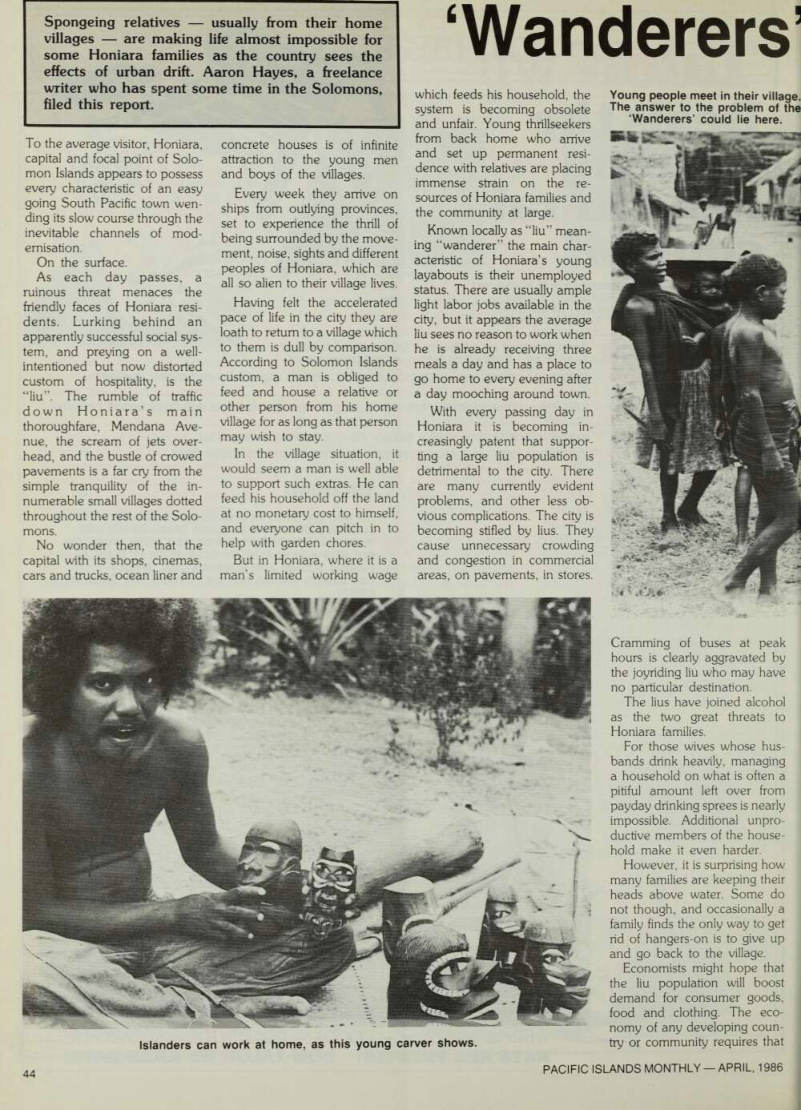
Islanders can work at home, as this young carver shows.
Young people meet in their village.
The answer to the problem of the ‘Wanderers’ could lie here.
people put something back into the system for what they take out. This is not happening. The lius demand much from the local economy but contribute little.
But the most frightening fac tor in Honiara is the steadily growing crime rate. The two national weekly newspapers “Solomon Star” and “Solo mons Toktok” often carry re ports of houses being broken into by individuals who fre quently turn out to be lius, and of drunken fights and other violence involving lius. Less reported but of common know ledge in Honiara is the amount of shoplifting and petty theft by lius with nimble fingers.
An obvious solution is to somehow get lius to take jobs.
They could then earn money for themselves and for their host households, and would support the demand for con sumer goods, which they ere
ate, by putting their labour and money back into commerce.
Good theory, but how does one make a contented liu, very satisfied with just sponging off relatives and hanging around town all day, take a job? An other possibility is a “real” unemployment crisis with such an increased demand for jobs.
Conceivably, family heads could take the initiative by throwing lius out of their houses, giving them nowhere to live and supposedly forcing them to return to their villages.
However, Islands custom for bids this and going against the grain of custom and tradition is an unacceptable practice in any part of the Solomons.
There is in any case no guarantee that lius would go home. The outcome could be a multitude of fringe-dwellers set ting up shanty towns on the city’s outskirts.
Probably the most viable solution would be to make village life more attractive to young Solomon Islanders.
Young people in the city as well as those still in the villages could be the targets of a “propagan da” program to kill two birds with one stone. Not only could lius in Honiara be enticed back to the villages, but perhaps migration from the villages to the city could be stemmed.
Villages are well able to sup port lius. Accommodation is no problem; leaf houses can be erected in a matter of days.
With careful planning, village gardens can be an almost infi nite source of food. There is little need for money in the subsistence-farming rural areas.
The rural village, however, without the sights of the city to
stare at all day, would probably become quite dull for a bored youth without anything interes ting to do. Keeping young village people busy and in volved, whether with village activites, private enterprise or interesting pastimes, may there fore be the key to keeping them at home. Perhaps the answer to the liu problem lies not in Honiara then, but rather in each provincial village.
No-one knows what the fu ture holds for the liu’s present strangle-hold on society in Honiara, but even the optimists must admit that things look grim. The community may be on the brink of a drastic nose dive, though at the moment the problem is most strikingly evi dent in the general retardation of the city’s development.
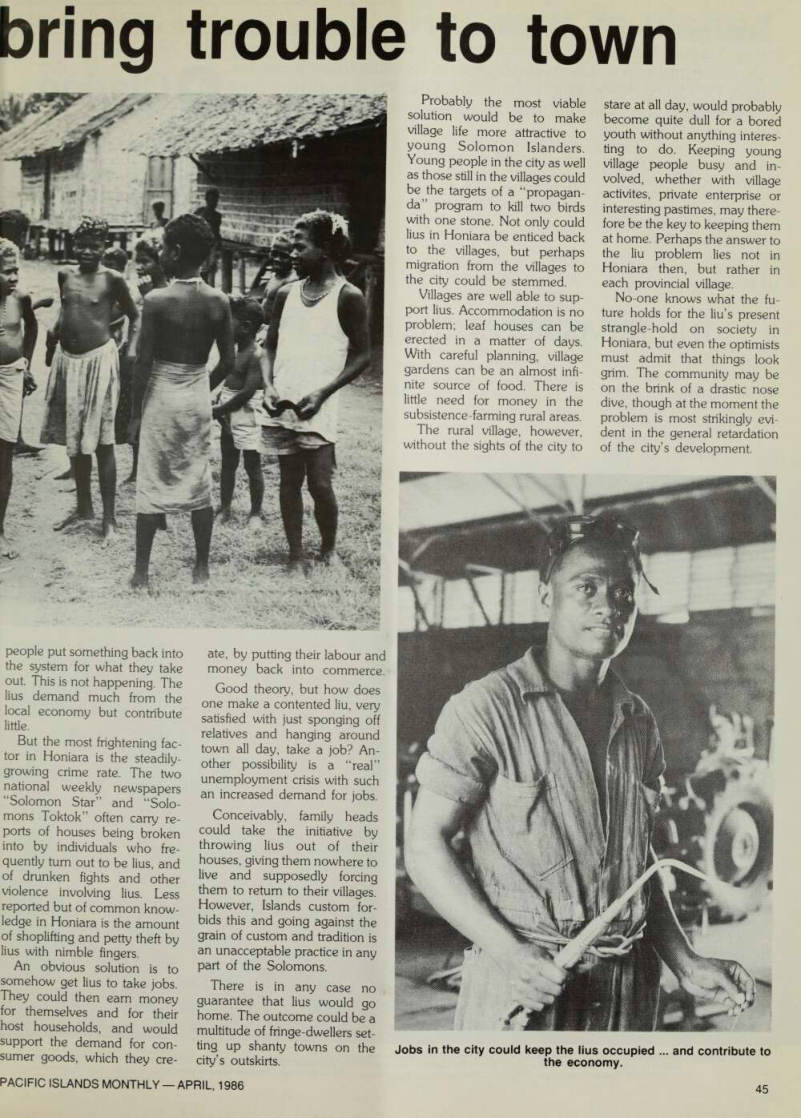
Jobs in the city could keep the lius occupied ... and contribute to the economy.